

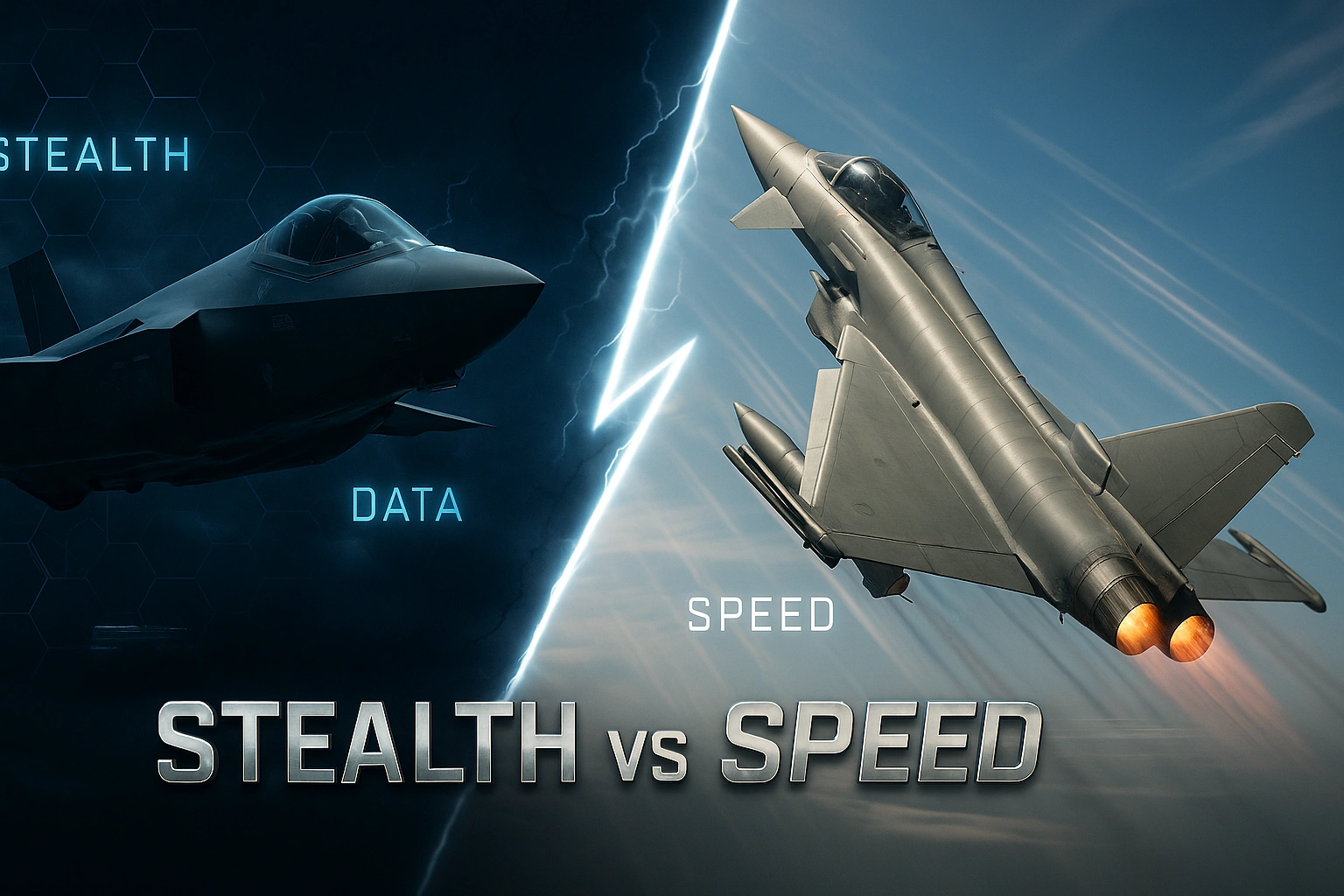
Imagine entering a contested airspace. Would you rather be in a jet that can fly at Mach 2 to outrun a missile, or in a jet that ensures the missile is never fired at all? This is the core dilemma in the F-35 vs. Eurofighter debate.
The F-35 Lightning II and the Eurofighter Typhoon represent two diverging doctrines in 21st-century air warfare. The F-35, a pure 5th Generation platform, prioritizes stealth (low observability) and unprecedented sensor fusion to achieve information dominance. It is designed as a penetrating strike asset capable of neutralizing threats before they are even detected.
In contrast, the Typhoon, a top-tier 4.5th Generation jet built by a multinational European consortium, prioritizes raw kinetic performance—speed, supercruise, and high-altitude agility. It remains one of the world’s most formidable traditional air superiority fighters.
So, who wins the battle of Stealth vs. Speed? Let’s dive into the technical breakdown.
Technical Specifications: F-35 vs Eurofighter Side-by-Side
To understand the operational differences, we must look at the data.
| Category | Metric | F-35 Lightning II (5th Gen) | Eurofighter Typhoon (4.5th Gen) |
| Philosophy | Core Doctrine | Stealth (VLO) & Information Dominance | Speed & Agility (Kinetic Energy) |
| Speed | Max Speed | Mach 1.6 | Mach 2.0+ (Supercruise capable) |
| Propulsion | Engine System | Single Pratt & Whitney F135 | Two Eurojet EJ200 Engines |
| Avionics | Sensors | Unparalleled Fusion (DAS, AN/APG-81 AESA) | PIRATE IRST & Praetorian DASS (High situational awareness) |
| Combat | Primary Role | BVR (Beyond Visual Range) Sniper | Dogfight & Interception Specialist |
| Stealth | RCS | Very Low Observable (VLO) | Reduced RCS (via composites), but visible |
| Cost | Flight Hour | ~$30,000 – $45,000 (decreasing) | ~$18,000 – $25,000 (more economical) |
The Deep Dive: Trading Kinematics for Data
1. The F-35: The Invisible Sniper
The F-35 isn’t built to turn tightly with an opponent; it is built to never arrive at the merge (close combat). Its Radar Cross Section (RCS) is roughly the size of a golf ball. Combined with its 360-degree Distributed Aperture System (DAS), the F-35 pilot sees everything.
Advantage: In a BVR engagement, the F-35 embodies the doctrine of “First Look, First Shot, First Kill.” It detects the Typhoon long before the Typhoon’s radar realizes something is out there.
2. The Eurofighter Typhoon: The Kinetic King
If the fight enters visual range, the tables turn. The Typhoon’s twin Eurojet engines provide a thrust-to-weight ratio that allows for incredible acceleration and sustained turns.
Advantage: In a traditional dogfight or rapid interception mission (Air Policing), the Typhoon’s superior kinematics and high-altitude performance make it the apex predator.
Economic Reality: Operational Costs
For air forces with tighter budgets, the Eurofighter Typhoon offers a distinct advantage with a lower cost per flight hour compared to the complex logistics of the stealth coating maintenance required for the F-35. However, as the global F-35 fleet grows, these costs are rapidly converging.

Conclusion: The Verdict
The conclusion to the F-35 vs. Eurofighter comparison depends entirely on the mission profile:
Choose the F-35 if you need networked survivability to penetrate deep into enemy territory protected by advanced S-400 or S-500 missile systems.
Choose the Eurofighter if you need rapid response to defend your own borders and dominate the skies in a permissive environment at a lower operational cost.
The Bottom Line: Stealth wins the war, but speed wins the dogfight.
1. Which is better: F-35 or Eurofighter Typhoon?
It depends on the mission. The F-35 excels in stealth, sensor fusion, and first-shot advantage, while the Eurofighter Typhoon dominates in speed, agility, and traditional air superiority roles.
2. Who has the advantage in BVR (Beyond Visual Range) combat?
The F-35 has a clear edge in BVR combat due to its low radar cross section, advanced sensor fusion, and ability to detect and engage targets before being seen.
3. Is the Eurofighter better than the F-35 in a dogfight?
Yes, in a pure visual-range dogfight, the Eurofighter’s thrust-to-weight ratio and maneuverability give it an advantage. The F-35 is designed to avoid dogfights altogether.
4. How do the radar and sensor systems compare?
The F-35 integrates radar, infrared, and electronic warfare sensors into a single fused picture. The Eurofighter has powerful sensors but lacks the same level of full-spectrum data fusion.
5. Does stealth really matter against the Eurofighter?
Yes. Stealth significantly impacts survivability and first-engagement outcomes. The Eurofighter is not a stealth aircraft, making it easier to detect in contested airspace.
6. Which aircraft is cheaper to operate?
The Eurofighter generally has a lower cost per flight hour. However, the F-35 can perform multiple mission roles in a single sortie, which can offset higher operating costs.
7. Why do NATO countries operate both jets?
Because they serve complementary roles. The F-35 acts as a stealth sensor and strike platform, while the Eurofighter provides air policing, interception, and air superiority support.
8. Which jet has more real combat experience?
The F-35 has been used in real combat operations, particularly in the Middle East. The Eurofighter’s operational history is focused more on air patrol and deterrence missions
9. Is the Meteor missile a serious threat to the F-35?
The Meteor is one of the most capable BVR missiles in service. However, the F-35’s stealth and situational awareness significantly reduce the likelihood of a successful engagement.
10. Which fighter has a stronger future outlook?
The F-35 benefits from continuous software upgrades and network-centric warfare integration. The Eurofighter will remain relevant through upgrades, but it is limited by its non-stealth design.