
• Login
UltiDefense: Military Tech Comparisons & Modern Warfare Analysis
  • Defense Systems
    • Air Platforms
      • Fighter Jets
      • Drones
      • Attack Helicopters
      • Strategic Bombers
    • Land Systems
      • Main Battle Tanks
      • Artillery & Firepower
      • Infantry Fighting Vehicles
      • Military Logistics and Support Vehicles
      • Soldier Systems & Robotics: UGV, Exoskeleton, and Modern Infantry Integration
    • Integrated Defense Systems
      • Ballistic Missile Defense
      • Air Defense Systems
    • Missiles & Munitions
      • Air-to-Air & Anti-Ship Missiles
      • Cruise Missiles
      • Strategic & Hypersonic Weapons
    • Naval
      • Aircraft Carriers
      • Submarines
      • Surface Combatants
      • Unmanned Maritime Systems
    • Future Tech & Innovations
      • Sensors and Avionics
  • Comparisons
  • Space Warfare
    • Counter-Space & ASAT
    • Spaceplanes & Launch Vehicles
    • Military Satellites & ISR
  • Defense News
  • Military Life
  • Policy, Budget and Geopolitics
  • Cyber Security & Electronic Warfare
No Result
View All Result
Defense News
No Result
View All Result

Home - Aircraft Carriers - USS Gerald R. Ford vs. Type 003 Fujian: The Supercarrier Showdown (2025 Analysis)

USS Gerald R. Ford vs. Type 003 Fujian: The Supercarrier Showdown (2025 Analysis)

George Schouten by George Schouten
December 11, 2025
in Aircraft Carriers, Comparisons
0
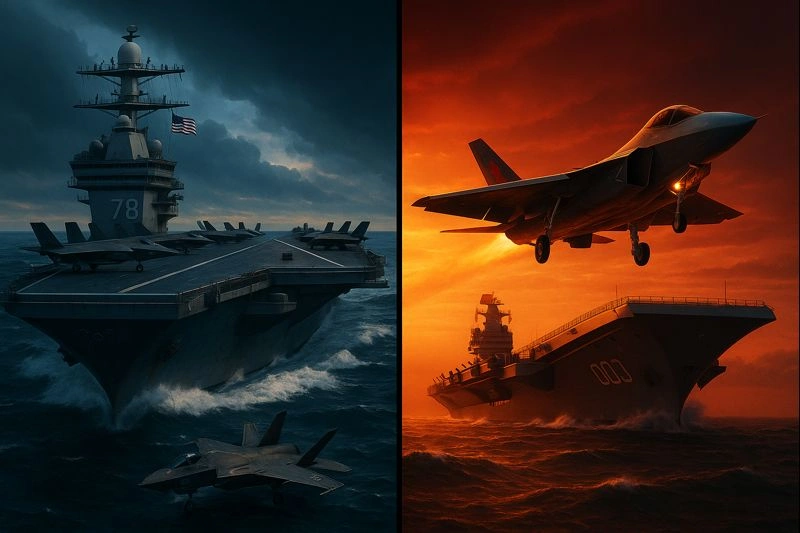
Split-screen illustration comparing the USS Gerald R. Ford (left) and China's Type 003 Fujian (right) aircraft carriers at sea.

East vs. West: A visual comparison of the world's two most advanced supercarriers, the nuclear-powered USS Gerald R. Ford and China's EMALS-equipped Type 003 Fujian.

158
SHARES
2k
VIEWS
Share on Twitter

Right now, in the Western Pacific, two naval giants represent the future of maritime power projection: America’s USS Gerald R. Ford (CVN-78) and China’s Type 003 Fujian.

One is the world’s most advanced nuclear-powered supercarrier. The other is the most ambitious carrier China has ever built—its first true attempt at matching U.S. catapult-launch capability (CATOBAR).

READ ALSO

LCA Tejas Mk-1A: India’s Indigenous 4.5-Gen Fighter & the JF-17 Rival

F/A-18F Super Hornet vs. F-35C Lightning II: The Workhorse vs. The Future

The launch of the Fujian didn’t just update China’s navy; it altered the strategic geometry of the Indo-Pacific. For the first time, a non-U.S. navy is fielding an EMALS-equipped supercarrier. But does that narrow the gap—or is the Ford still in a league of its own?

This enhanced UltiDefense Deep Dive delivers a complete technical, operational, and doctrinal comparison.


The Tale of the Tape (Comparison Table)

Use this table to understand the physical disparity between the titans.

FeatureUSS Gerald R. Ford (CVN-78) 🇺🇸Type 003 Fujian 🇨🇳
Displacement~100,000 tons (Full Load)~80,000+ tons (Estimated)
Propulsion2× A1B Nuclear ReactorsSteam Turbines (Conventional)
Launch SystemEMALS (Electromagnetic)EMALS (Electromagnetic)
Aircraft Capacity75–90 Aircraft60–70 Aircraft (Est.)
Primary FighterF-35C / F/A-18E Super HornetJ-35 (Stealth) / J-15B
RangeUnlimited (25+ years)Limited by fuel tankers
Crew~4,500~3,000+ (Est.)

1. Propulsion: Infinite Range vs. The Logistical Leash

Nuclear Power (Ford): Unlimited Reach

The Ford-class’s A1B nuclear reactors deliver unprecedented electrical output (nearly 3x the Nimitz class). Beyond propulsion, they power the energy-hungry EMALS, advanced dual-band radars, and future directed energy (laser) weapons.

  • Strategic Impact: 25 years without refueling means global dominance without logistical vulnerability.

Conventional Steam (Fujian): Powerful but Dependent

The Fujian relies on fossil-fuel steam turbines. While easier to build and maintain, this creates a “Logistical Leash.”

  • The Weakness: It must refuel frequently. In a war, the PLAN replenishment tankers become high-value targets. If the tankers sink, the Fujian stops.
  • Verdict: China is building a regional “Blue Water Navy.” The U.S. already operates a global one.

2. The Launch System: Battle of the EMALS

Both carriers have abandoned traditional steam catapults for Electromagnetic Aircraft Launch Systems (EMALS). This offers smoother acceleration (less stress on airframes) and the ability to launch heavy drones or light fighters.

  • Where Ford Leads: 5+ years of real carrier flight ops. Thousands of launches completed. Integration with the F-35C is mature.
  • Where Fujian Is Catching Up: This is China’s first CATOBAR (Catapult Assisted Take-Off But Arrested Recovery) ship. Engineering ambition does not equal operational readiness. The reliability of Chinese EMALS under wartime tempo is unknown.

3. The Air Wing: F-35C vs. J-35

This is the stealth battle that really matters.

F-35C Lightning II (Ford)

The world’s only fully operational 5th-gen carrier fighter.

  • Advantage: Sensor fusion. The F-35C is not just a fighter; it is a flying data center that shares targets via MADL (Multifunction Advanced Data Link).
  • Warfare Suite: Proven AN/ASQ-239 electronic warfare capabilities.

J-35 (Fujian)

China’s first naval stealth fighter (resembling a twin-engine F-35).

  • Advantage: Newer aerodynamic design.
  • Disadvantage: Likely inferior engine thermal management (WS-19/21 reliability) and stealth materials. It lacks the mature sensor fusion of the US fleet.

The Eyes: E-2D vs. KJ-600

Ford deploys the E-2D Advanced Hawkeye, the “Quarterback of the Sky.” Fujian relies on the copycat KJ-600. Without a fully operational AEW&C platform, a carrier is blind beyond ~250 km.


4. Sortie Generation Rate (SGR): The Hidden Metric

Wars are won by how many bombs you can drop in 24 hours.

  • Ford: Its “NASCAR Pit-Stop” deck layout and advanced weapons elevators allow for a 160 sorties/day surge.
  • Fujian: While unknown, estimates suggest 100 sorties/day. Training gaps and deck handling inexperience will reduce efficiency.

5. War Scenario Simulation: Taiwan Strait (2027)

How would these ships fare in a kinetic conflict?

Phase 1: Detection (Hour 0–24)

  • Ford: The E-2D detects PLAN activity at 400+ km.
  • Fujian: KJ-600 (if operational) detects US forces at 300 km.
  • Result: Ford gains the first-mover advantage.

Phase 2: Air Superiority (Hour 24–72)

  • Ford: F-35Cs launch from >700 nm, staying outside the range of China’s land-based missiles.
  • Fujian: The J-35s are forced to operate closer to the mainland Integrated Air Defense System (IADS) for protection.
  • Result: Ford uses its nuclear speed to reposition unpredictably. Fujian is tethered to tankers.

Phase 3: Attrition (Week 1+)

  • Ford: Sustains 140+ sorties/day indefinitely.
  • Fujian: Peaks early, then declines as fuel and ammo logistics become strained.

6. The Uncomfortable Question: Could Fujian Win?

Yes—but only under specific, high-risk conditions.

China could gain a localized advantage if:

  1. The battle happens within the “First Island Chain” (close to shore).
  2. DF-21D / DF-26 “Carrier Killer” missiles saturate the Ford’s defenses.
  3. PLAN submarines successfully ambush the US support fleet.

The Real Threat: It is not one Fujian. It is three Fujians, backed by land-based J-20s and Type 055 destroyers. That is a true A2/AD (Anti-Access/Area Denial) nightmare.


Final Verdict: Experience vs. Ambition

The Type 003 Fujian is the most technologically impressive non-U.S. warship ever built. It proves China has mastered the art of building a hull.

But the USS Gerald R. Ford remains unmatched due to:

  • Nuclear Propulsion: Unlimited strategic endurance.
  • The Air Wing: A mature 5th-generation force (F-35C).
  • The Human Factor: 100+ years of U.S. carrier aviation experience versus China’s first attempt at CATOBAR ops.

Fujian has narrowed the gap significantly. But the Ford still defines the standard.


❓ FAQ: Ford vs. Fujian

Q: Is the Type 003 Fujian nuclear-powered?
A: No. The Fujian uses conventional steam turbines powered by boilers, unlike the nuclear-powered USS Gerald R. Ford. This limits its range and requires frequent refueling.

Q: Which aircraft carrier is bigger?
A: The USS Gerald R. Ford is larger, displacing approximately 100,000 tons compared to the Fujian’s estimated 80,000+ tons.

Q: Does China have stealth fighters for the Fujian?
A: Yes. China is developing the J-35 (a naval variant of the FC-31) to operate from the Fujian, intended to rival the US F-35C.

Q: What is EMALS?
A: EMALS (Electromagnetic Aircraft Launch System) replaces traditional steam catapults with linear induction motors. It allows for smoother, faster launches and can handle a wider range of aircraft weights (from heavy drones to light fighters). Both the Ford and Fujian use this technology.
Tags: Aircraft Carrier ComparisonCATOBAREMALSF-35C vs J-35Indo-Pacific StrategyNaval WarfarePLANSupercarrierType 003 FujianUltiDefenseUS NavyUSS Gerald R. Ford

Related Posts

Indian Air Force LCA Tejas Mk-1A fighter jet soaring over the Himalayas, armed with indigenous Astra BVR missiles and equipped with an AESA radar nose cone.
Comparisons

LCA Tejas Mk-1A: India’s Indigenous 4.5-Gen Fighter & the JF-17 Rival

December 14, 2025
F/A-18F Super Hornet launching from carrier deck vs F-35C Lightning II waiting
Comparisons

F/A-18F Super Hornet vs. F-35C Lightning II: The Workhorse vs. The Future

December 9, 2025
Infographic comparing US Navy Virginia-class and Russian Yasen-M submarines. Highlights Virginia's pump-jet propulsor, acoustic stealth, and Tomahawk range (1,600 km) versus Yasen-M's larger size, Tsirkon hypersonic missiles, Kalibr, and Oniks loadout.
Comparisons

Virginia Class vs. Yasen-M

December 11, 2025
Zumwalt vs Type 055: Diverging Doctrines in 21st Century Naval Architecture
Comparisons

Zumwalt vs Type 055: Diverging Doctrines in 21st Century Naval Architecture

December 12, 2025
Patriot vs. S-400 vs. THAAD: A Technical Comparison of Ballistic Missile Defense Capabilities
Comparisons

Patriot vs. S-400 vs. THAAD: A Technical Comparison of Ballistic Missile Defense Capabilities

December 21, 2025
Side-by-side comparison of F-35 Lightning II stealth fighter and Eurofighter Typhoon jet representing stealth vs speed capabilities
Comparisons

F-35 vs. Eurofighter Typhoon: Stealth or Speed? The Ultimate Comparison

December 21, 2025
Next Post
Indian Air Force LCA Tejas Mk-1A fighter jet soaring over the Himalayas, armed with indigenous Astra BVR missiles and equipped with an AESA radar nose cone.

LCA Tejas Mk-1A: India’s Indigenous 4.5-Gen Fighter & the JF-17 Rival

Leave a Reply Cancel reply

Your email address will not be published. Required fields are marked *

About

Ultidefense is a digital platform focused on modern defense, military technology, and strategic innovation.
We explore how advancements in aerospace, AI, cybersecurity, and autonomous systems are transforming the global defense landscape.
Our mission is to connect technical insight with strategic awareness, helping readers understand the technologies shaping modern security and warfare.
At Ultidefense, we believe knowledge is strength — and our goal is to deliver clear, factual, and forward-looking analysis on the systems, science, and strategies defining the future of defense.

Categories

  • Comparisons
  • Cyber Security & Electronic Warfare
  • Defense News
  • Defense Systems
    • Air Platforms
      • Attack Helicopters
      • Fighter Jets
      • Global Military Drones: UAV Systems, Autonomy, and Unmanned Warfare
      • Strategic Bombers
    • Future Tech & Innovations
      • Sensors and Avionics
    • Land Systems
      • Artillery & Firepower: Self-Propelled Guns, Rocket Systems, and Barrage Analysis
      • Main Battle Tanks: Armor, Firepower, and Modern MBT Comparisons
    • Missiles & Munitions
      • Strategic & Hypersonic Weapons
    • Space Warfare
      • Military Satellites & ISR
      • Spaceplanes & Launch Vehicles
  • Integrated Defense Systems
    • Air Defense Systems
  • Military Life
  • Naval Systems: Warships, Carriers, and Maritime Defense Technology
    • Aircraft Carriers
    • Submarines
  • Policy, Budget and Geopolitics
  • Unmanned Maritime Systems

Recent Posts

  • Which Military Boot Camp is the Hardest? All 6 US Branches Ranked
  • The SFAS Fallout: What Happens After You Fail Special Forces Selection
  • The Algorithm of War:The Anatomy of Conflict in 2050
  • Russia’s Avangard HGV: Breaking the Shield of Global Missile Defense

Newsletter

Pages

  • About Us
  • Home
  • Contact Us
  • Privacy Policies
  • Terms of Service
  • Disclaimer

© 2025 Defense Systems

Welcome Back!

Login to your account below

Forgotten Password?

Retrieve your password

Please enter your username or email address to reset your password.

Log In
No Result
View All Result
  • Defense Systems
    • Air Platforms
      • Fighter Jets
      • Drones
      • Attack Helicopters
      • Strategic Bombers
    • Land Systems
      • Main Battle Tanks
      • Artillery & Firepower
      • Infantry Fighting Vehicles
      • Military Logistics and Support Vehicles
      • Soldier Systems & Robotics: UGV, Exoskeleton, and Modern Infantry Integration
    • Integrated Defense Systems
      • Ballistic Missile Defense
      • Air Defense Systems
    • Missiles & Munitions
      • Air-to-Air & Anti-Ship Missiles
      • Cruise Missiles
      • Strategic & Hypersonic Weapons
    • Naval
      • Aircraft Carriers
      • Submarines
      • Surface Combatants
      • Unmanned Maritime Systems
    • Future Tech & Innovations
      • Sensors and Avionics
  • Comparisons
  • Space Warfare
    • Counter-Space & ASAT
    • Spaceplanes & Launch Vehicles
    • Military Satellites & ISR
  • Defense News
  • Military Life
  • Policy, Budget and Geopolitics
  • Cyber Security & Electronic Warfare

© 2025 Defense Systems