

From Sun Tzu’s Timeless Art to Genghis Khan’s Network Warfare — What History’s Greatest Military Geniuses Would Do on Tomorrow’s Battlefield
War is humanity’s oldest art. Across a bloody line of continuity stretching from the plains of Mesopotamia to the steppes of Mongolia, from the shores of Carthage to the forests of the Ardennes, strategy has always walked ahead of technology. Looking at the next point on that line is both terrifying and intellectually unavoidable. The battlefield of 2050 is a map not yet drawn — but its coordinates are hidden in the footprints left by history’s greatest geniuses.
Sun Tzu wrote, “All warfare is based on deception.” Genghis Khan discovered the essence of modern network-centric warfare centuries before the term existed: fast, dispersed, coordinated units operating in concert. Hannibal Barca demonstrated the perfect execution of the encirclement doctrine at Cannae — a maneuver he invented 2,200 years ago that is still taught in military academies today. What would these men do if handed the tools of 2050? That is the real question.
| Era | Commander | Core Doctrine | 2050 Echo |
|---|---|---|---|
| ~500 BCE | Sun Tzu | Intelligence supremacy, winning without fighting, psychological pressure | Cyber warfare, cognitive operations, AI-driven deception |
| 247 BCE | Hannibal Barca | Double envelopment, defeating the many with the few | Drone swarm tactics, algorithmic flanking |
| 1162 CE | Genghis Khan | Distributed command, speed and shock, logistical dominance | Network-centric warfare, autonomous unit coordination |
| 1769 CE | Napoleon Bonaparte | Corps system, interior lines, battlefield flexibility | Modular multi-domain force design |
I. The New Geometry of the Battlefield
By 2050, the battlefield is no longer a geography — it’s a geometry. Picture a five-layered cube with physical, cyber, electromagnetic, cognitive, and space dimensions interlocked and overlapping: each layer is simultaneously an attack vector and a defensive surface. This multi-domain model of conflict, seeded in Ukraine, maturing in the Taiwan Strait, and crystallizing in the Arctic, will be standard operating procedure by mid-century.
Territorial control, the absolute objective of the old wars, has been displaced by connectivity control: sovereignty over energy grids, data backbones, AI decision loops, and satellite constellations. Collapsing a nation’s power grid can produce more strategic effect than crossing its border with tanks. Sun Tzu’s vision of “winning without fighting” has never been more concrete.
“The supreme art of war is to subdue the enemy without fighting.”
Sun Tzu, The Art of War — still the operating manual for algorithmic warfare in 2050
II. The Heir of Genghis Khan: Swarm Intelligence Weapons
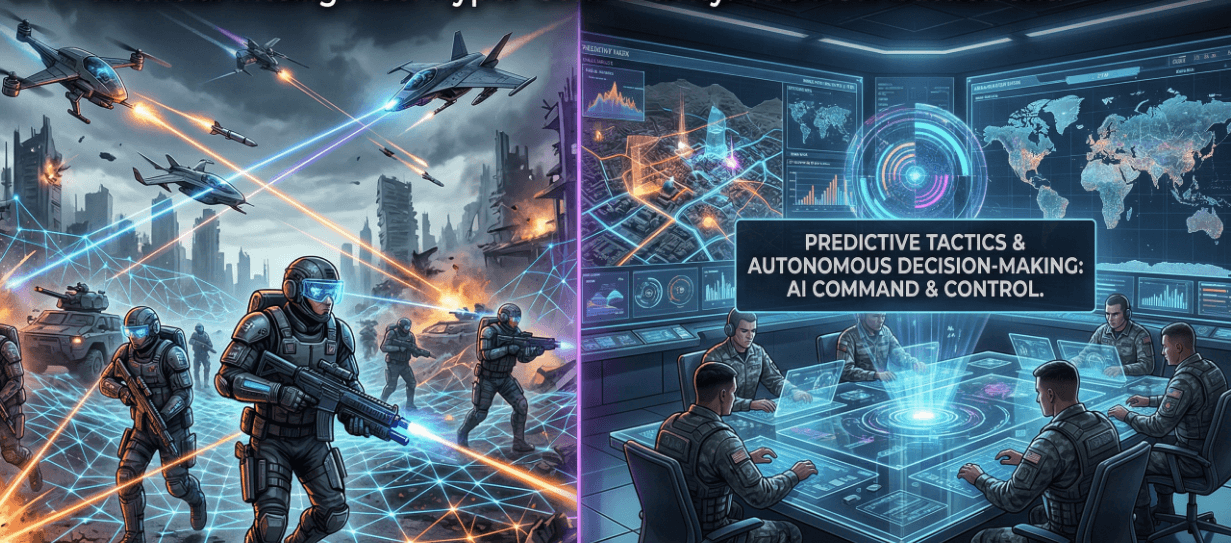
The Mongol army was the first force in history to operate true distributed command at scale. Each tumen moved autonomously toward a general objective without waiting on a central directive. That structure finds a perfect technical mirror in 2050’s unmanned vehicle swarms. Thousands of small, cheap, coordinated autonomous units — operating at sea, in the air, and on the ground simultaneously — each individually insignificant, collectively devastating.
Hannibal’s Cannae maneuver — a deliberate retreat at the center while the flanks envelop and close — has left a digital fingerprint on swarm tactics. An AI command system can analyze enemy formations in real time and reorient an entire swarm in milliseconds. Once the physical and cognitive limits of the human mind are removed from the equation, the geometry of Cannae becomes infinitely repeatable.
Yet history sounds a sharp warning against unchecked technological optimism: Genghis Khan’s greatest lesson was not speed — it was logistics. The Mongols could remain in the field far longer than their enemies because their supply chains were masterworks of operational planning. In 2050, the Achilles’ heel of autonomous systems will be precisely that: energy resupply points, software infrastructure vulnerable to cyberattack, communication fragility in electromagnetically contested environments. Grand strategy doesn’t change. It just changes clothes.
III. Cognitive Warfare: The Mind as Battlespace
The most important combat arena of 2050 is not a brain — it is a collective belief system. Cognitive warfare, targeting a society’s perception of reality, its decision-making machinery, and its motivational architecture, will no longer be an auxiliary tool. It will be the primary strategy. Our historical inheritance in this domain is, surprisingly, very rich.
Before the Mongols reached a city, they deliberately spread the message: “Submit and receive mercy; resist and be annihilated.” Large portions of the campaign were won before any physical contact occurred. In 2050, deepfake video, AI-generated disinformation campaigns, and social media manipulation are the digital versions of that psychological shock. The difference is scale and speed: the Mongols needed weeks to send a message to a city; reaching an entire nation’s public today is a matter of milliseconds.
Napoleon systematically weaponized battlefield psychology — disorienting the enemy, stripping him of initiative, making his own forces appear stronger than they were. A 2050 cyber-psychological operation could feed fabricated intelligence to an adversary nation’s elected leadership, driving flawed decisions; inject disinformation into defense-industrial command software; or crash stock markets and energy exchanges before a single shot is fired. Winning the war before it is declared — Sun Tzu’s dream made operational.
IV. Space as High Ground
Throughout military history, control of the high ground has always been decisive. From Thermopylae to the ridges of Gettysburg, from the hills of Palestine to the heights of the Himalayas — whoever holds the elevation holds the tactical advantage. In 2050, humanity’s highest ground is no longer a hilltop. It’s low Earth orbit.
Satellite constellations — GPS, communications, reconnaissance, early warning — are the central nervous system of a modern military. Severing, blinding, or spoofing that nervous system delivers far greater strategic effect than conventional firepower. Counter-space weapons — anti-satellite missiles, directed-energy lasers, signal jammers, cyberattacks — will be standard military capabilities by 2050. The historical parallel is exact: before Trafalgar, the British worked to cut French communication networks. Blinding your adversary in space carries the same strategic logic as blinding them at sea.
V. The Human Factor: The Unchanging Constant
Amid all this technological acceleration, war’s unchanging constant remains human psychology. A soldier’s fear, courage, exhaustion, and moral reckoning will never be fully translated into an algorithm. In every battlefield where autonomous systems expand their footprint, there will be — and must be — human beings who determine the legitimacy of those systems, who select their targets, and who make the final call.
Clausewitz’s “fog of war” does not disappear in 2050. It changes form. Real-time sensor fusion, AI-assisted intelligence analysis, and autonomous systems reduce uncertainty; they do not eliminate it. The adversary holds the same tools; deception, manipulation, and adaptation remain bilateral capabilities. Hannibal’s trap at Cannae worked because the Romans could not imagine he would do what he did. The military geniuses of 2050 will do exactly that: they will see possibilities their adversaries cannot conceive.
“The general who thoroughly understands the advantages that accompany variation of tactics knows how to handle his troops.”
Sun Tzu — “terrain” now encompasses the physical, cyber, cognitive, and space domains simultaneously
Conclusion: History’s Endless Loop
When we look at the battlefield of 2050, what we see is both familiar and alien. Technology changes; the essence of strategy stays fixed: intelligence supremacy, speed, deception, coalition management, and interior-line advantage. Sun Tzu’s thirteen chapters remain valid; only the tools behind the words have changed. Genghis Khan’s swarm doctrine lives in the unmanned vehicle fleet. Hannibal’s geometry of envelopment is rewritten in the mathematical language of an algorithm. Napoleon’s modular corps system breathes again in the multi-domain operations concept.
But history teaches us one thing more: the greatest military catastrophes are born of excessive confidence in technological superiority. The Roman legions trusted their numbers at Cannae and were annihilated. The Spanish Armada trusted its sea power and was scattered. In 2050, the side that over-relies on artificial intelligence and autonomous systems may find itself blindsided by an adversary’s analog, asymmetric, and unpredictable response. That is war’s oldest lesson: victory is never guaranteed.
The battlefield of 2050 belongs to those who can read the past without being imprisoned by it — who can honor the genius of Sun Tzu, Hannibal, and Genghis Khan while daring to imagine what none of them ever could. That has always been the definition of strategic greatness. It always will be.
This article synthesizes historical military doctrine with current defense technology trends to offer a speculative projection. The 2050 scenarios presented are an intellectual thought experiment grounded in contemporary academic and strategic analysis, not a predictive forecast.