

Patriot vs. S-400 vs. THAAD
A Comprehensive Technical and Operational Analysis of Modern Ballistic Missile Defense Systems
Introduction: Three Systems, Three Doctrines
While frequently compared as direct competitors, the Patriot, S-400, and THAAD systems represent fundamentally different approaches to missile defense, each shaped by distinct operational doctrines, threat environments, and strategic priorities. Understanding these systems requires moving beyond simple performance metrics to examine their roles within integrated air and missile defense (IAMD) architectures.
Key Distinction: SAM vs. BMD
- SAM (Surface-to-Air Missile): Optimized for aircraft and cruise missile interception within the atmosphere, emphasizing aerial dominance and area denial.
- BMD (Ballistic Missile Defense): Engineered to engage high-velocity ballistic missiles during their terminal or midcourse phases, focusing on trajectory negation and warhead neutralization.
Each system occupies a unique position within this spectrum:
- Patriot (PAC-3 MSE): Tactical, mobile, point defense system optimized for lower-tier endo-atmospheric interception with proven combat experience.
- S-400 Triumf: Multi-role, area defense platform designed for long-range air superiority with supplementary ballistic missile defense capability.
- THAAD (Terminal High Altitude Area Defense): Strategic, exo-atmospheric interceptor using pure kinetic hit-to-kill technology for upper-tier defense.
Technical Performance Comparison
| Parameter | Patriot PAC-3 MSE | S-400 Triumf | THAAD |
|---|---|---|---|
| Primary Mission | Tactical air & short-range BMD | Regional air dominance & limited BMD | Strategic exo-atmospheric BMD |
| Interception Altitude | 20–35 km | Up to 30–60 km (40N6E) | 40–150 km (upper atmosphere) |
| Interception Range | 160 km (aerial), 60 km (ballistic) | 400 km (aerial), 60 km (ballistic) | ~200 km (ballistic only) |
| Guidance System | Active radar homing + Ka-band seeker | Active/semi-active radar guidance | Infrared homing (IIR) + KKV |
| Radar System | AN/MPQ-65 (C-band phased array) | 92N6E “Grave Stone” (S/X-band) | AN/TPY-2 (X-band AESA) |
| Radar Range | ~170 km | ~600 km (detection), 250 km (tracking) | ~1,000 km (tracking mode) |
| Interceptor Speed | Mach 5+ | Mach 14 (40N6E), Mach 6 (48N6) | Mach 8.2+ |
| Warhead Type | Kinetic hit-to-kill + blast-frag | High-explosive fragmentation | Pure kinetic energy (KKV) |
| Kill Probability (Pk) | 0.80–0.90 (combat-proven) | 0.70–0.85 (estimated) | 0.85–0.95 (test data) |
| Mobility | High (15 min deploy/stow) | Medium (30+ min deploy/stow) | Medium (theater deployment) |
| Unit Cost (per interceptor) | ~$4–6 million | ~$2–3 million | ~$11–13 million |
| System Cost (battery) | ~$1 billion | ~$400–500 million | ~$3 billion |
Note: Performance data compiled from official specifications, combat reports (Patriot: Operation Desert Storm, Saudi Arabia 2015-2022; THAAD: controlled tests), and open-source intelligence assessments. S-400 combat effectiveness remains partially unverified in contested BMD scenarios.
Combat-Proven Performance and Operational History
Understanding the Differences: Patriot vs S-400
Extensive
100+ successful intercepts
Gulf War (1991): PAC-2 achieved mixed results against Scud missiles (30-40% success rate), prompting development of PAC-3 hit-to-kill technology.
Yemen Conflict (2015-2022): Saudi Patriot batteries successfully intercepted dozens of Houthi ballistic missiles and drones, with documented success rates exceeding 80% for PAC-3 MSE variants.
Ukraine (2022-present): Successfully intercepted Russian Kinzhal hypersonic missiles, validating PAC-3 MSE capabilities against advanced threats.
Limited
Primarily anti-aircraft
Syria (2015-present): Deployed primarily for air superiority and area denial. Limited engagement against Israeli aircraft; no confirmed ballistic missile intercepts.
Ukraine Conflict (2022-present): Used extensively for air defense but has suffered multiple losses to HIMARS, anti-radiation missiles, and Ukrainian strikes. Ballistic missile defense effectiveness remains unverified.
Assessment: While theoretically capable against ballistic threats with 40N6E missiles, lacks combat-proven BMD track record. Primarily validated in anti-aircraft role.
Operational readiness
18/20 (90%)
Test Program: THAAD has achieved 18 successful intercepts in 20 tests against medium and intermediate-range ballistic missile targets, including separating warheads.
Operational Deployments: Forward-deployed in South Korea (2017), UAE, Guam, and continental US. No combat engagements to date, but maintained at high readiness against North Korean and Iranian threats.
Technological Edge: AN/TPY-2 radar provides unmatched tracking range (1,000+ km), enabling early threat detection and engagement planning.
Electronic Warfare and Countermeasures
Critical Factor: ECM/ECCM Capabilities
Modern missile defense is increasingly an electronic warfare contest. The ability to operate in hostile electromagnetic environments often determines success or failure.
Patriot PAC-3 MSE
- Strengths: Active radar seeker with frequency-agile Ka-band allows terminal guidance independent of ground radar. Resistant to ground-based jamming during endgame.
- Vulnerabilities: AN/MPQ-65 radar operates in congested C-band spectrum, potentially susceptible to sophisticated electronic attack. Limited low-altitude performance against terrain-masking threats.
- ECCM Features: Adaptive waveform management, sidelobe cancellation, and multi-target tracking algorithms.
S-400 Triumf
- Strengths: 92N6E radar features claimed ECCM capabilities including frequency hopping and low probability of intercept (LPI) modes. Multi-band operation (S/X-band) provides redundancy.
- Vulnerabilities: Semi-active guidance missiles (48N6 series) remain dependent on continuous illumination, vulnerable to stand-off jamming. Centralized command architecture creates single point of failure.
- Operational Limitations: Ukraine conflict revealed vulnerability to anti-radiation missiles (AGM-88 HARM) targeting radar emissions. Several S-400 batteries destroyed via electromagnetic signature exploitation.
THAAD
- Strengths: Infrared homing provides complete immunity to radar jamming. Passive terminal guidance cannot be detected or jammed by electronic warfare systems.
- AN/TPY-2 Radar: X-band AESA architecture with advanced ECCM, including ultra-low sidelobe design and adaptive beamforming. Extremely difficult to jam or spoof.
- Operational Advantage: Can operate in total electromagnetic silence until missile launch, reducing vulnerability to anti-radiation weapons.
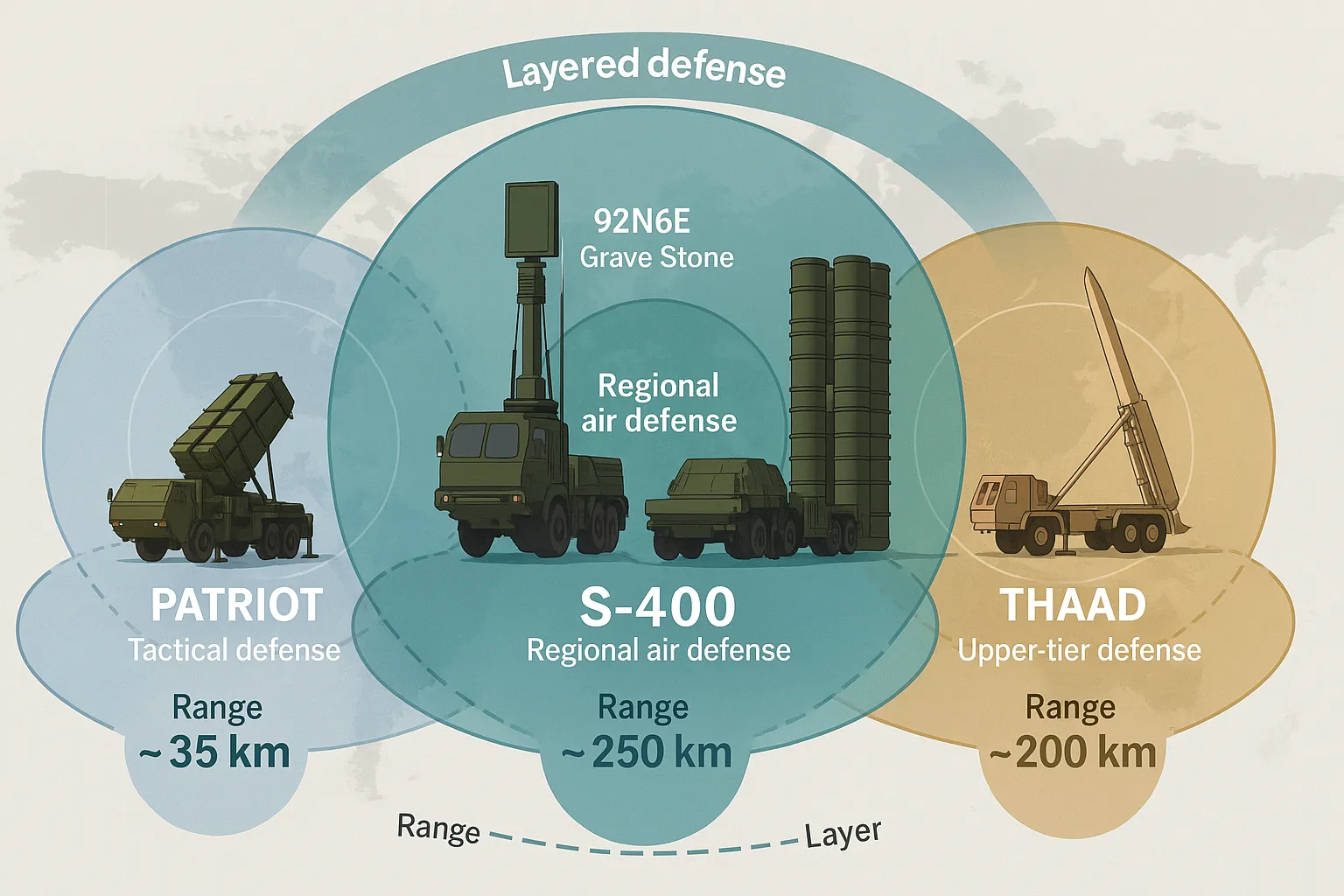
Layered Defense Architecture
Modern integrated air and missile defense (IAMD) doctrine recognizes that no single system can address all threats across all altitudes and ranges. Effective defense requires synchronized layering:
U.S./NATO Layered Defense Concept
- Upper Tier: THAAD intercepts MRBM/IRBM threats at 40-150 km altitude, engaging warheads in exo-atmospheric phase before atmospheric reentry.
- Lower Tier: Patriot PAC-3 MSE provides terminal defense against “leakers” and shorter-range threats (SRBM, cruise missiles, aircraft) at 20-35 km altitude.
- Point Defense: Short-range systems (NASAMS, Iron Dome) defend critical nodes against saturation attacks and residual threats.
- C4I Integration: Linked through IBCS (Integrated Battle Command System), enabling “any sensor, any shooter” capability and optimized engagement sequencing.
Russian Layered Defense Doctrine
Russian air defense philosophy emphasizes overlapping engagement zones rather than discrete altitude tiers:
- S-400: Forms the backbone, providing long-range air defense (400 km) with limited BMD capability via 40N6E missiles.
- S-300V4: Dedicated anti-ballistic missile system for theater defense, complementing S-400.
- Pantsir-S1: Short-range point defense against cruise missiles, drones, and precision-guided munitions.
- Integration Challenge: Unlike NATO’s IBCS, Russian systems historically operate with limited cross-platform data fusion, reducing engagement optimization.
Hypersonic Threat Challenge
The Hypersonic Dilemma
Hypersonic glide vehicles (HGVs) and maneuvering warheads represent an existential challenge to current-generation missile defense systems, fundamentally testing the limits of interception physics.
System Capabilities Against Hypersonic Threats
Patriot PAC-3 MSE:
- Limited Capability: Can engage hypersonic threats only in terminal phase with severely reduced engagement envelope. Mach 5 interceptor speed insufficient for head-on engagement of Mach 10+ targets.
- Ukraine Experience: While credited with Kinzhal intercepts, these likely occurred during terminal ballistic phase when velocity decreased below hypersonic threshold (Mach 5).
- Engagement Window: Estimated 3-6 seconds against true hypersonic threats, requiring near-perfect fire control and minimal reaction time.
S-400 Triumf:
- Theoretical Capability: Claims anti-hypersonic capability, but remains unproven. 40N6E missile speed (Mach 14) theoretically sufficient, but guidance system accuracy against maneuvering targets questionable.
- Radar Limitations: 92N6E tracking update rate may be insufficient for unpredictable HGV trajectories. Semi-active guidance requires continuous target illumination during high-G maneuvers.
- No Combat Validation: Zero confirmed intercepts of hypersonic weapons in operational environment.
THAAD:
- Best Positioned: Infrared seeker can track hot hypersonic airframes. KKV designed for high-speed intercepts with superior maneuverability.
- Limitations: Effective only against predictable trajectories in exo-atmospheric phase. HGVs maneuvering within atmosphere likely exceed engagement envelope.
- Future Upgrades: AN/TPY-2 radar upgrades and faster KKV variants under development specifically for hypersonic defense.
Cost-Effectiveness and Strategic Economics
Missile defense is fundamentally an economic equation: the cost of interception must justify the value of assets protected. This calculus becomes especially critical when adversaries can produce offensive missiles more cheaply than defensive interceptors.
| System | Interceptor Cost | Typical Threat | Threat Cost | Cost Ratio (Defense/Offense) |
|---|---|---|---|---|
| Patriot PAC-3 | $5 million | Scud-B SRBM | $1-2 million | 3:1 to 5:1 |
| S-400 | $3 million (40N6E) | 9M723 Iskander | $3-5 million | 1:1 to 1.5:1 |
| THAAD | $12 million | Shahab-3 MRBM | $1-3 million | 4:1 to 12:1 |
Strategic Justification
- Patriot: Cost-effective for tactical defense of high-value military assets (airbases, command centers, logistics hubs). Favorable economics when protecting targets worth $100+ million.
- S-400: Most economical per-interceptor cost, but effectiveness questions undermine value proposition. Suitable for area denial where mere presence creates deterrent effect.
- THAAD: High cost justified only for strategic defense of critical national assets (population centers, nuclear facilities, national command authority). Two-shot doctrine increases cost to $24 million per engagement.
Mobility and Survivability
In modern warfare, static defenses are priority targets for suppression and destruction. Mobility determines whether a system survives the opening hours of conflict.
Deployment Time: 15-30 minutes (quick reaction)
Mobility: Fully mobile on wheeled M983 HEMTT tractors. Can displace under fire and reposition between engagements.
Survivability: Small radar cross-section and rapid displacement capability enhance survivability. Vulnerable during setup/teardown phases.
Deployment Time: 30-60 minutes (deliberate setup)
Mobility: Semi-mobile on 8×8 MAZ-543 TELs. Can reposition but requires significant setup time. Centralized command post limits dispersion.
Survivability: Ukraine demonstrated vulnerability to counter-battery fire, loitering munitions, and HIMARS. High-power radar emissions enable targeting.
Deployment Time: Several hours (theater positioning)
Mobility: Strategically mobile via C-17 airlift but tactically static once deployed. AN/TPY-2 radar requires substantial setup.
Survivability: Typically deployed in rear areas beyond conventional strike range. Relies on strategic depth rather than tactical mobility.
Technology Evolution and Future Trajectory
Patriot Modernization Path
- PAC-3 MSE Segment Enhancement: Extended range (60+ km), two-pulse motor, and improved maneuverability against TBMs.
- LTAMDS (Lower Tier Air and Missile Defense Sensor): Next-generation AESA radar replacing AN/MPQ-65, providing 360° coverage and simultaneous multi-mission capability.
- IBCS Integration: Network-centric architecture enabling distributed sensors and shooters, breaking the “one radar, one battery” limitation.
S-400 Development
- S-500 Prometey: Next-generation system claiming anti-satellite and anti-hypersonic capability. Limited deployment; capabilities remain unverified.
- 77N6 Series Missiles: Claimed exo-atmospheric interceptors for ICBM defense, though technical credibility disputed by Western analysts.
- Integration Challenges: Lack of demonstrated network-centric warfare capability limits multi-domain operations.
THAAD Development Path
- THAAD-ER (Extended Range): Future variant with a larger booster for increased velocity, enabling extended engagement range and higher intercept altitude.
- Integration: Seamlessly integrated into the U.S. Missile Defense Agency’s (MDA) global sensor network via the Aegis BMD system and space-based sensors.
- Discrimination: Continuous software and hardware upgrades focusing on differentiating sophisticated decoys and countermeasures from actual warheads.
Conclusion: The Necessity of Layering
Final Assessment: Which System is Superior?
The core finding of this analysis is that **no single system is inherently superior**; rather, their superiority is defined by the mission and the architecture in which they operate.
- Best for Pure BMD Altitude: THAAD, due to its **Hit-to-Kill** kinetic energy warhead and high exo-atmospheric interception tier, offering the best chance to neutralize a warhead outside the atmosphere.
- Best for Versatility & Cost-Efficiency: S-400, offering maximum aerial coverage (400 km) and multi-threat capability at a lower per-system cost, making it the preferred system for **area denial**.
- Best for Combat-Proven Reliability & Point Defense: Patriot PAC-3 MSE, offering superior performance against short-range ballistic threats, cruise missiles, and proven resilience against sophisticated EW attacks in a modular, highly mobile package.
The future of missile defense is not a competition between individual systems, but an integrated architecture that leverages the unique strengths of each. The **THAAD/Patriot** combination represents the most robust and combat-validated layered defense against current ballistic missile threats, ensuring that if THAAD misses the warhead in the upper tier, Patriot has a **”shoot-look-shoot”** second chance in the lower tier.
While the S-400 offers impressive theoretical range and versatility, its reliance on semi-active guidance and lack of verified ballistic missile kill chain effectiveness against modern threats means its true BMD capability remains the least validated of the three systems examined.