• Login
UltiDefense: Military Tech Comparisons & Modern Warfare Analysis
  • Defense Systems
    • Air Platforms
      • Fighter Jets
      • Drones
      • Attack Helicopters
      • Strategic Bombers
    • Land Systems
      • Main Battle Tanks
      • Artillery & Firepower
      • Infantry Fighting Vehicles
      • Military Logistics and Support Vehicles
      • Soldier Systems & Robotics: UGV, Exoskeleton, and Modern Infantry Integration
    • Integrated Defense Systems
      • Ballistic Missile Defense
      • Air Defense Systems
    • Missiles & Munitions
      • Air-to-Air & Anti-Ship Missiles
      • Cruise Missiles
      • Strategic & Hypersonic Weapons
    • Naval
      • Aircraft Carriers
      • Submarines
      • Surface Combatants
      • Unmanned Maritime Systems
    • Future Tech & Innovations
      • Sensors and Avionics
  • Comparisons
  • Space Warfare
    • Counter-Space & ASAT
    • Spaceplanes & Launch Vehicles
    • Military Satellites & ISR
  • Defense News
  • Military Life
  • Policy, Budget and Geopolitics
  • Cyber Security & Electronic Warfare
No Result
View All Result
Defense News
No Result
View All Result

Home - Comparisons - Zumwalt vs Type 055: Diverging Doctrines in 21st Century Naval Architecture

Zumwalt vs Type 055: Diverging Doctrines in 21st Century Naval Architecture

Alejandro Bennett by Alejandro Bennett
December 12, 2025
in Comparisons
0
Zumwalt vs Type 055: Diverging Doctrines in 21st Century Naval Architecture
160
SHARES
2k
VIEWS
Share on Twitter

Executive Summary: The Zumwalt (DDG-1000) is a high-risk innovation testbed optimized for stealth and power margin. The Type 055 (Renhai-class) is a fleet workhorse optimized for missile volume and mass production. The strategic lesson is not “which ship is better,” but which acquisition model reliably produces combat power.

Estimated reading time: 12 minutes

READ ALSO

LCA Tejas Mk-1A: India’s Indigenous 4.5-Gen Fighter & the JF-17 Rival

USS Gerald R. Ford vs. Type 003 Fujian: The Supercarrier Showdown (2025 Analysis)


1. Introduction: Context and Methodology

The post-Cold War naval environment has shifted from classic blue-water fleet engagements toward long-range precision strike and anti-access/area-denial (A2/AD) scenarios. Two warships epitomize divergent doctrinal approaches: the U.S. Navy’s DDG-1000 Zumwalt and China’s Type 055 (Renhai-class) destroyer.

This analysis synthesizes open-source technical data, DoD program documentation, and naval architecture commentary to provide a comparative assessment of these two surface combatants.


2. Technical Specifications Comparison

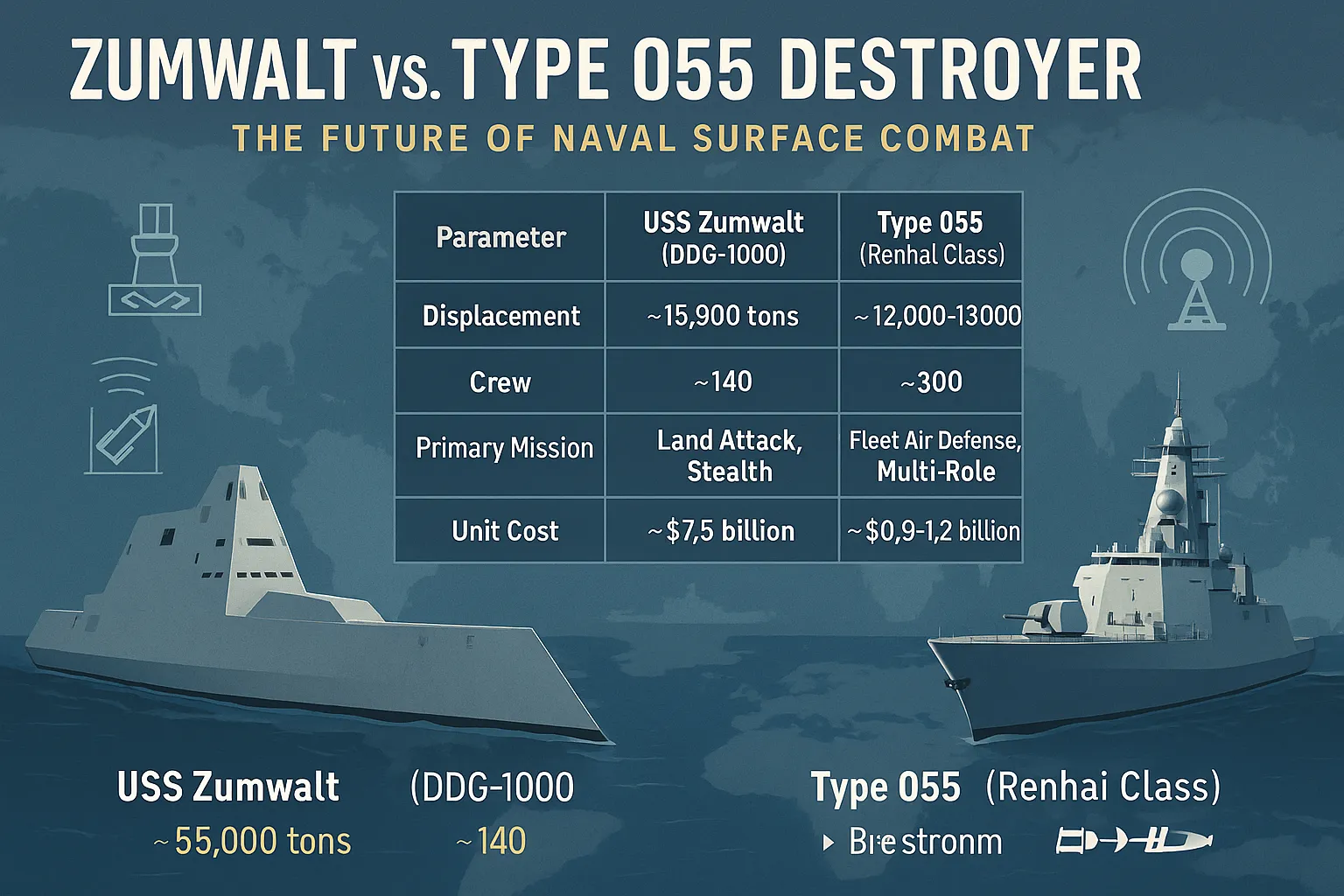
ParameterUSS Zumwalt (DDG-1000) 🇺🇸Type 055 (Renhai-class) 🇨🇳
Displacement~16,000 tons~13,000 tons
Length186 m~180 m
VLS Cells80 (Mk 57 PVLS)112 (Universal VLS)
PropulsionIntegrated Electric (~78 MW)COGAG Gas Turbines
Primary RoleHypersonic Strike / Surface FireFleet Air Defense / Multi-Role
Unit Cost~$4.0 Billion+~$1.0–$1.2 Billion (Est.)

Key Design Philosophy Differences

  • Zumwalt: Revolutionary technology demonstrator. Optimized for signature management (Stealth), automation, and electrical power margin.
  • Type 055: Evolutionary scaling. Optimized for missile volume, carrier-group integration, and scalable production.

3. Stealth and Signature Management

Zumwalt’s Ghost Profile

The Zumwalt achieves a “ghost-like” radar signature through its Tumblehome hull, enclosed deckhouse, and Peripheral VLS (PVLS). While exact RCS values are classified, open sources frequently compare its return to that of a small fishing boat, despite being 186 meters long.

Type 055’s Balanced Approach

The Type 055 incorporates stealth features like an enclosed integrated mast and angled superstructure, but prioritizes weapons capacity over absolute invisibility. It is “low observable,” but not a true “stealth ship” in the Zumwalt sense.

Verdict: Zumwalt wins on pure stealth. Type 055 wins on balancing stealth with utility.


4. Combat Systems and Firepower

Sensors: SPY-3 vs Type 346B

  • Zumwalt: Features the AN/SPY-3 Multi-Function Radar (X-band). Originally designed for horizon search and volume fire support, its role has shifted towards supporting precision strikes.
  • Type 055: Utilizes the massive Type 346B AESA Radar (S/C-band). Its larger aperture is optimized for long-range volume search and tracking ballistic missiles, similar to the US Aegis system.

The Missile Gap: 80 vs 112 Cells

The most critical disparity lies in volume.

  • Zumwalt (80 Cells): Uses the Mk 57 PVLS. While fewer in number, these cells are wider and deeper, designed to house massive future missiles.
  • Type 055 (112 Cells): Uses a “Universal VLS” capable of hot and cold launch. The sheer number of cells allows for a deeper magazine of air-defense interceptors (HHQ-9) and anti-ship missiles (YJ-18, YJ-21).
Critical Note (Hypersonic Shift): The Zumwalt’s cancelled 155mm AGS guns are being replaced. The ship is transitioning into the US Navy’s primary Hypersonic Strike Platform, carrying the Conventional Prompt Strike (CPS) weapon.

5. Propulsion: The Electric Advantage

The Zumwalt is built around an Integrated Electric Propulsion (IEP) system generating ~78 MW of power. This massive power margin is its “ace in the hole,” theoretically allowing it to host future Directed Energy Weapons (Lasers) that conventional ships like the Type 055 (Gas Turbine) cannot support without major refits.


6. Cost-Effectiveness: The Scale Problem

MetricZumwalt ClassType 055 Class
Fleet Size3 Ships (Capped)8+ Ships (Growing)
Cost Per VLS Cell~$50 Million~$9 Million (Est.)
Production StatusProgram EndedActive Mass Production

The Lesson: Revolutionary tech stacks (Zumwalt) compound risk. If scale collapses, per-unit cost skyrockets. Evolutionary tech stacks (Type 055) allow for affordable mass production.


7. Conclusion: Divergent Paths

Neither approach is “wrong”—they reflect different strategic needs.

  • The Zumwalt is a specialized sniper—a stealthy, high-tech platform now evolving into a hypersonic carrier.
  • The Type 055 is a line linebacker—a heavy hitter designed to protect carriers and project power in numbers.

The optimal future warship likely lies in the middle: blending Zumwalt’s power generation with Type 055’s production scalability.


❓ FAQ: Zumwalt vs Type 055

Q: Which ship is more powerful?
A: In a one-on-one duel, Zumwalt’s stealth gives it the first-shot advantage. However, in a fleet battle, Type 055’s superior missile capacity (112 vs 80 cells) and radar coverage make it a more impactful strategic asset.

Q: Is the Type 055 a cruiser or a destroyer?
A: While China calls it a destroyer (Type 055), the US Navy classifies it as a Cruiser (CG) due to its size (13,000 tons) and command capabilities.

Q: Does Zumwalt carry hypersonic missiles?
A: Not yet, but integration is underway. The US Navy is removing the 155mm gun turrets to install launchers for the Conventional Prompt Strike (CPS) hypersonic missile, expected by the late 2020s.
Tags: DDG-1000Hypersonic WeaponsMk 57 PVLSNaval WarfareRenhai ClassStealth WarshipType 055 destroyerUltiDefenseUS Navy vs PLANZumwalt Class

Related Posts

Indian Air Force LCA Tejas Mk-1A fighter jet soaring over the Himalayas, armed with indigenous Astra BVR missiles and equipped with an AESA radar nose cone.
Comparisons

LCA Tejas Mk-1A: India’s Indigenous 4.5-Gen Fighter & the JF-17 Rival

December 14, 2025
Split-screen illustration comparing the USS Gerald R. Ford (left) and China's Type 003 Fujian (right) aircraft carriers at sea.
Aircraft Carriers

USS Gerald R. Ford vs. Type 003 Fujian: The Supercarrier Showdown (2025 Analysis)

December 11, 2025
F/A-18F Super Hornet launching from carrier deck vs F-35C Lightning II waiting
Comparisons

F/A-18F Super Hornet vs. F-35C Lightning II: The Workhorse vs. The Future

December 9, 2025
Infographic comparing US Navy Virginia-class and Russian Yasen-M submarines. Highlights Virginia's pump-jet propulsor, acoustic stealth, and Tomahawk range (1,600 km) versus Yasen-M's larger size, Tsirkon hypersonic missiles, Kalibr, and Oniks loadout.
Comparisons

Virginia Class vs. Yasen-M

December 11, 2025
Patriot vs. S-400 vs. THAAD: A Technical Comparison of Ballistic Missile Defense Capabilities
Comparisons

Patriot vs. S-400 vs. THAAD: A Technical Comparison of Ballistic Missile Defense Capabilities

December 21, 2025
Side-by-side comparison of F-35 Lightning II stealth fighter and Eurofighter Typhoon jet representing stealth vs speed capabilities
Comparisons

F-35 vs. Eurofighter Typhoon: Stealth or Speed? The Ultimate Comparison

December 21, 2025
Next Post
Infographic comparing US Navy Virginia-class and Russian Yasen-M submarines. Highlights Virginia's pump-jet propulsor, acoustic stealth, and Tomahawk range (1,600 km) versus Yasen-M's larger size, Tsirkon hypersonic missiles, Kalibr, and Oniks loadout.

Virginia Class vs. Yasen-M

Leave a Reply Cancel reply

Your email address will not be published. Required fields are marked *

About

Ultidefense is a digital platform focused on modern defense, military technology, and strategic innovation.
We explore how advancements in aerospace, AI, cybersecurity, and autonomous systems are transforming the global defense landscape.
Our mission is to connect technical insight with strategic awareness, helping readers understand the technologies shaping modern security and warfare.
At Ultidefense, we believe knowledge is strength — and our goal is to deliver clear, factual, and forward-looking analysis on the systems, science, and strategies defining the future of defense.

Categories

  • Comparisons
  • Cyber Security & Electronic Warfare
  • Defense News
  • Defense Systems
    • Air Platforms
      • Attack Helicopters
      • Fighter Jets
      • Global Military Drones: UAV Systems, Autonomy, and Unmanned Warfare
      • Strategic Bombers
    • Future Tech & Innovations
      • Sensors and Avionics
    • Land Systems
      • Artillery & Firepower: Self-Propelled Guns, Rocket Systems, and Barrage Analysis
      • Main Battle Tanks: Armor, Firepower, and Modern MBT Comparisons
    • Missiles & Munitions
      • Strategic & Hypersonic Weapons
    • Space Warfare
      • Military Satellites & ISR
      • Spaceplanes & Launch Vehicles
  • Integrated Defense Systems
    • Air Defense Systems
  • Military Life
  • Naval Systems: Warships, Carriers, and Maritime Defense Technology
    • Aircraft Carriers
    • Submarines
  • Policy, Budget and Geopolitics
  • Unmanned Maritime Systems

Recent Posts

  • Which Military Boot Camp is the Hardest? All 6 US Branches Ranked
  • The SFAS Fallout: What Happens After You Fail Special Forces Selection
  • The Algorithm of War:The Anatomy of Conflict in 2050
  • Russia’s Avangard HGV: Breaking the Shield of Global Missile Defense

Newsletter

Pages

  • About Us
  • Home
  • Contact Us
  • Privacy Policies
  • Terms of Service
  • Disclaimer

© 2025 Defense Systems

Welcome Back!

Login to your account below

Forgotten Password?

Retrieve your password

Please enter your username or email address to reset your password.

Log In
No Result
View All Result
  • Defense Systems
    • Air Platforms
      • Fighter Jets
      • Drones
      • Attack Helicopters
      • Strategic Bombers
    • Land Systems
      • Main Battle Tanks
      • Artillery & Firepower
      • Infantry Fighting Vehicles
      • Military Logistics and Support Vehicles
      • Soldier Systems & Robotics: UGV, Exoskeleton, and Modern Infantry Integration
    • Integrated Defense Systems
      • Ballistic Missile Defense
      • Air Defense Systems
    • Missiles & Munitions
      • Air-to-Air & Anti-Ship Missiles
      • Cruise Missiles
      • Strategic & Hypersonic Weapons
    • Naval
      • Aircraft Carriers
      • Submarines
      • Surface Combatants
      • Unmanned Maritime Systems
    • Future Tech & Innovations
      • Sensors and Avionics
  • Comparisons
  • Space Warfare
    • Counter-Space & ASAT
    • Spaceplanes & Launch Vehicles
    • Military Satellites & ISR
  • Defense News
  • Military Life
  • Policy, Budget and Geopolitics
  • Cyber Security & Electronic Warfare

© 2025 Defense Systems