

1.Introduction: The Dawn of the Hypersonic ICBM Era
The deployment of the Avangard marks a decisive turning point in the evolution of strategic nuclear delivery systems. Unlike traditional intercontinental ballistic missiles (ICBMs), which follow predictable ballistic trajectories, Avangard introduces a fundamentally different concept: a maneuvering hypersonic glide vehicle (HGV) capable of evading modern missile defense architectures.
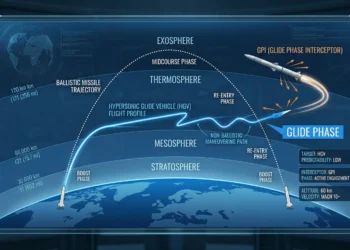
Developed under Russia’s classified Project 4202, Avangard is designed to be mounted atop heavy ICBMs, separating during the boost phase and transitioning into sustained hypersonic glide within the upper atmosphere. This shift—from ballistic descent to controlled atmospheric flight—represents a paradigm change in how nuclear payloads are delivered and defended against.
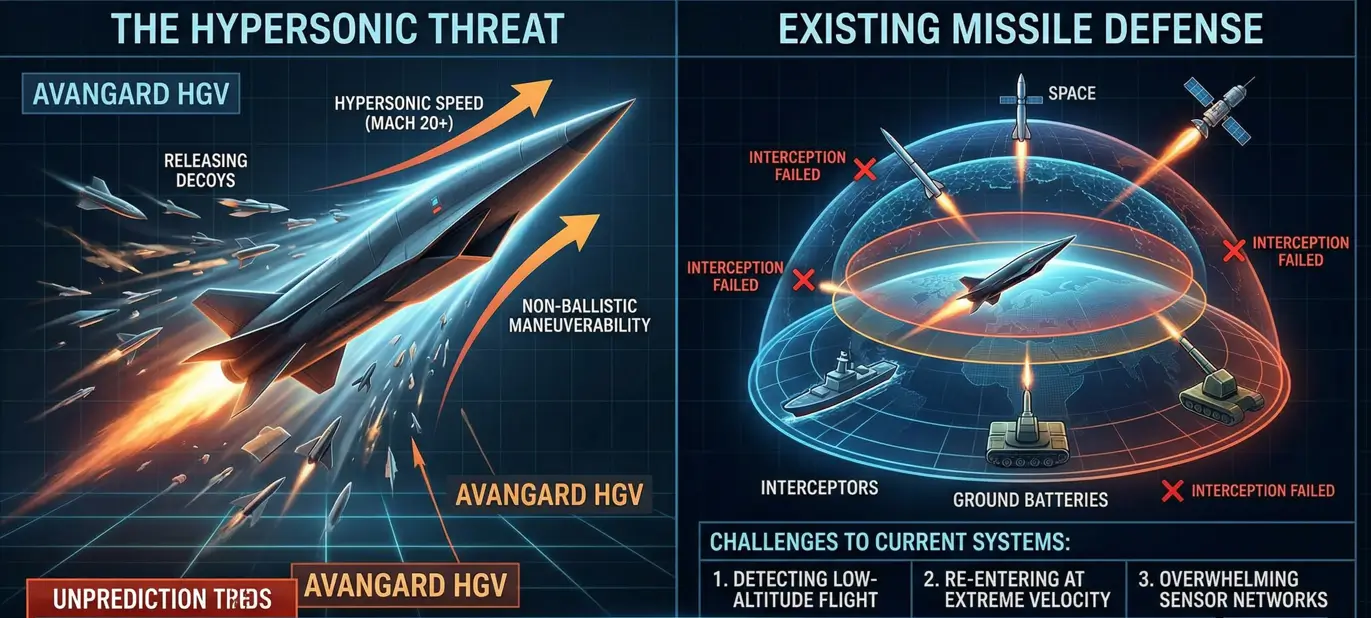
The strategic significance of Avangard lies not only in its speed, often cited in the range of Mach 20 to Mach 27, but in its ability to invalidate the core assumptions of existing missile defense systems. U.S. architectures such as the Ground-based Midcourse Defense rely heavily on predicting a target’s trajectory during midcourse flight. Avangard disrupts this model by continuously altering its path, transforming the engagement problem from one of prediction to one of real-time tracking under uncertainty.
The system gained global attention in March 2018, when Vladimir Putin unveiled a suite of so-called “next-generation strategic weapons” during his annual address to the Federal Assembly. In that speech, Avangard was presented not merely as a technological breakthrough, but as a strategic message: that Russia had developed capabilities capable of bypassing U.S. missile defense and restoring deterrence balance.
From a doctrinal perspective, Avangard is best understood as a response to decades of investment in missile defense by the United States. By ensuring that a nuclear payload can penetrate even advanced defensive layers, Russia reinforces its second-strike capability—a cornerstone of nuclear deterrence theory. In this sense, Avangard is not just a weapon system; it is a tool designed to preserve strategic parity in an era of evolving defense technologies.
At the same time, its emergence signals the beginning of what can be described as the hypersonic ICBM era, where speed, maneuverability, and atmospheric flight converge to challenge long-standing assumptions about interception feasibility. This raises a critical question that will shape the remainder of this analysis:
If Avangard can bypass today’s missile defenses, what kind of system is required to stop it?
Avangard represents more than a faster warhead—it redefines the physics and strategy of nuclear delivery. By combining hypersonic speed with maneuverability, it directly challenges the predictive foundations of existing missile defense systems and forces a complete rethink of interception strategies.
2.Technical Specifications: The Physics of Mach 27
Understanding the Avangard requires moving beyond conventional missile metrics and into the realm of extreme aerothermodynamics and high-speed maneuvering physics. At reported speeds of Mach 20 to Mach 27, Avangard operates in a regime where classical flight assumptions begin to break down, and thermal, structural, and guidance challenges become dominant factors.
Velocity and Altitude: Operating in the Hypersonic Envelope
Avangard’s reported velocity—between Mach 20 and Mach 27—places it among the fastest operational delivery systems ever developed. At these speeds, the vehicle travels at approximately 6–9 km per second, depending on altitude and atmospheric density.
Unlike traditional reentry vehicles that follow a steep ballistic descent from exo-atmospheric altitudes, Avangard transitions into a controlled glide phase within the upper atmosphere, typically estimated between:
- ~30 km to 100 km altitude bands
This altitude regime is critical:
- Too high → easier detection by space-based sensors
- Too low → excessive drag and thermal stress
Avangard operates in this “Goldilocks zone”, balancing survivability, maneuverability, and speed.
The Plasma Shield: Heat as Both Defense and Constraint
At hypersonic velocities, aerodynamic friction generates extreme heat—estimated to exceed 2,000°C on the vehicle’s surface. This leads to the formation of a plasma sheath, an ionized layer of gas surrounding the vehicle.
This plasma layer creates a paradox:
1. Defensive Advantage
- The plasma can absorb or distort radar signals, reducing detectability from ground-based radar systems
- It complicates tracking and targeting by traditional fire-control radars
2. Operational Limitation
- The same plasma layer can interfere with the vehicle’s own communications and guidance signals
- Maintaining stable navigation in this environment requires advanced inertial guidance and hardened electronics
In essence, the plasma sheath acts as both a protective cloak and a technical barrier, forcing trade-offs between stealth, control, and precision.
Maneuverability: The Core Advantage
What truly distinguishes Avangard from legacy reentry vehicles is its ability to perform sustained maneuvering at hypersonic speeds.
During the glide phase, the vehicle can execute:
- Vertical maneuvers (altitude changes)
- Horizontal maneuvers (cross-range deviations)
- Unpredictable trajectory adjustments
This maneuverability fundamentally breaks the logic of traditional missile defense.
Conventional interceptors rely on predicting where a target will be. Avangard ensures that:
- That prediction is constantly changing
- Small deviations early in flight create massive positional uncertainty downstream
At Mach 20+, even a slight lateral maneuver can shift the impact point by hundreds of kilometers over time.
Aerodynamic Control at Hypersonic Speeds
Maintaining control at such velocities is itself a major engineering challenge.
Avangard likely relies on a combination of:
- Lift-generating body design (lifting body aerodynamics)
- Control surfaces or reaction control systems
- Advanced materials capable of withstanding both thermal and mechanical stress
Unlike ballistic warheads, which are essentially passive during reentry, Avangard behaves more like a high-speed atmospheric vehicle, continuously interacting with aerodynamic forces.
The Real Technical Challenge: Stability Under Extremes
The true difficulty of hypersonic glide is not just achieving speed—it is maintaining:
- Structural integrity
- Thermal stability
- Guidance accuracy
All at the same time.
At Mach 20+, the vehicle experiences:
- Intense dynamic pressure
- Rapid thermal cycling
- Constant aerodynamic forces
This makes hypersonic glide a multi-variable engineering problem, where failure in any one domain—thermal protection, control, or guidance—can result in mission failure.
Avangard’s advantage is not just its speed—it is the combination of hypersonic velocity, sustained maneuverability, and extreme thermal conditions. Together, these factors create a target that is both difficult to track and even harder to intercept, pushing missile defense into a new and far more complex operational domain.
3.Launch Platforms: The Carriers of the Glide Vehicle
The Avangard is not a standalone missile. It is a payload system, dependent on powerful intercontinental ballistic missiles (ICBMs) to deliver it into the correct altitude and velocity envelope before it begins its hypersonic glide. This makes the launch platform a critical component of the overall weapon system—effectively the first stage of the hypersonic kill chain.
UR-100N UTTH (SS-19 Stiletto): The Initial Deployment Platform
The first operational deployments of Avangard have been carried aboard the
UR-100N UTTH.
Originally developed during the Cold War, this liquid-fueled ICBM has been модернизован to serve as a carrier for Avangard. Its role is to:
- Provide the initial boost phase acceleration
- Deliver the glide vehicle to exo-atmospheric altitude
- Release the payload at the correct trajectory for atmospheric reentry
Although legacy in origin, the UR-100N UTTH offers a proven and reliable platform, allowing Russia to field Avangard without waiting for next-generation missile systems to reach full operational readiness.
RS-28 Sarmat (Satan II): The Future Heavy Carrier
Looking ahead, Avangard is expected to be integrated with the
RS-28 Sarmat—Russia’s next-generation heavy ICBM.
Sarmat represents a significant leap in capability:
- Greater payload capacity (multiple warheads or HGVs)
- Extended range and flexible trajectories (including fractional orbital paths)
- Enhanced ability to deploy multiple independently maneuverable reentry vehicles (MIRVs) or hypersonic payloads
When paired with Avangard, Sarmat transforms into a strategic delivery platform capable of overwhelming and bypassing layered missile defenses.
This combination is particularly concerning for defense planners because it allows:
- Multiple hypersonic threats from a single launch
- Increased saturation potential against defensive systems
The Boost Phase: Setting the Conditions for Hypersonic Glide
The boost phase is often overlooked in discussions of hypersonic weapons, yet it is foundational to Avangard’s performance.
During this phase:
- The ICBM accelerates the payload to hypersonic velocity
- The system exits the dense lower atmosphere
- The glide vehicle is positioned on a trajectory suitable for controlled reentry
Once separation occurs:
- Avangard re-enters the upper atmosphere
- Transitions into lift-generating glide flight
- Begins maneuvering toward its target
The precision of this phase is critical. Any deviation in:
- Velocity
- Angle of release
- Altitude
can directly impact the glide vehicle’s ability to maintain stable hypersonic flight.
Strategic Implication: A Hybrid Delivery System
The Avangard system effectively combines:
- Ballistic missile propulsion (boost phase)
- Hypersonic aerodynamic flight (glide phase)
This hybrid architecture creates a delivery system that:
- Retains the global reach of ICBMs
- Gains the maneuverability of atmospheric vehicles
From a defense standpoint, this is particularly problematic because it blurs the line between ballistic and non-ballistic threats, complicating detection, classification, and interception.
Survivability and Launch Flexibility
By using silo-based ICBMs like UR-100N UTTH and future Sarmat deployments, Russia ensures:
- High readiness levels
- Hardened launch infrastructure
- Rapid response capability in a crisis scenario
Additionally, the ability of Sarmat to follow non-traditional trajectories—including south polar routes—further complicates early warning and tracking for U.S. defense systems.
Avangard’s effectiveness begins with its launch platform. By pairing a maneuvering hypersonic glide vehicle with powerful ICBMs like UR-100N UTTH and RS-28 Sarmat, Russia creates a hybrid system that combines global reach with unpredictable flight behavior—significantly complicating detection, tracking, and interception.
4. Why Legacy Defenses Fail: The Targeting Problem
The core problem Avangard presents to legacy missile defense is not raw speed alone. The deeper issue is that most existing homeland missile defense architectures were built around a different target model: a ballistic reentry vehicle following a largely predictable path through midcourse and terminal flight. The U.S. Missile Defense Agency has repeatedly described hypersonic glide vehicles as threats that travel at exceptional speeds with unpredictable flight paths, and has stated plainly that, without further development, current systems will not have the capability to address advanced threats such as hypersonic glide vehicles.
Defeating GMD: Why Predictable-Parabola Logic Breaks Down
The Ground-based Midcourse Defense system was designed to engage ballistic missile warheads during midcourse, when they are flying through space on trajectories that can be modeled and updated with relatively stable assumptions. Avangard changes that geometry. Rather than remaining on a classical ballistic arc, it uses a nonballistic trajectory and, as Senate testimony on missile defense noted, spends most of its flight at altitudes below GMD’s engagement envelope. That means the problem is not simply “a faster target,” but a target that denies the defender the flight regime on which GMD was built.
This is why legacy interceptors struggle conceptually against Avangard. A ballistic-defense kill chain depends on being able to estimate where the target will be minutes from now. A maneuvering hypersonic glide vehicle continuously erodes that estimate. Even if a defender detects the object, the fire-control solution can decay rapidly because the target is no longer obeying the assumptions of a predictable exo-atmospheric arc. The 2019 Missile Defense Review described Russian and Chinese hypersonic systems as having unpredictable flight paths that challenge existing defensive systems, and later MDA budget documents made the same point more bluntly: maneuvering missiles such as hypersonic glide vehicles challenge existing defenses because they travel on unpredictable trajectories.
The Sensor Gap: Why Tracking Avangard Is So Hard
Avangard also exploits a major sensor architecture weakness. Hypersonic glide vehicles fly lower than traditional ballistic warheads but much faster than cruise missiles, operating in an atmospheric band that is especially difficult for terrestrial radars to monitor continuously. CSIS notes that the main attraction of hypersonic weapons is their ability to sustain high speeds at altitudes below those of most ballistic missiles while maneuvering, typically in the rough band of 20 to 60 kilometers. That flight profile creates a tracking challenge because the target can stay below or near the limits of some radar coverage for longer, while still moving too fast for conventional air-defense assumptions.
From the U.S. defense perspective, this is the “sensor gap” that has driven investment in space-based tracking. In its FY2022 budget briefing, MDA said HBTSS was needed to provide fire-control quality data to track both dim ballistic threats and global maneuvering hypersonic threats. That language is important. It means the department does not view the hypersonic problem as solvable by detection alone; it requires continuous, weapons-quality track custody. If the track is intermittent, delayed, or insufficiently precise, the shooter is effectively blind.
Compression of the Decision Window
Avangard does not merely complicate intercept mechanics; it compresses the decision window for national leadership and missile defense operators. Because the vehicle can maneuver at hypersonic speed in the atmosphere, warning, classification, track confirmation, engagement planning, and shot execution must all happen under greater uncertainty and in less time than for a traditional ballistic attack. Independent analyses of hypersonic systems consistently point to reduced warning time and increased stress on command-and-control processes, while the Pentagon’s own missile defense posture has shifted toward more integrated, adaptable defenses precisely because the threat environment has become more complex and time-sensitive.
That matters strategically as much as technically. A defense architecture that receives less warning, has lower track confidence, and must decide faster is inherently easier to saturate and easier to confuse. In practice, Avangard’s value to Russia is not that it makes interception mathematically impossible in every circumstance. Its value is that it degrades confidence in the defender’s ability to detect early, track cleanly, and make timely engagement decisions. In deterrence terms, that can be almost as important as physical penetrability itself.
Legacy missile defenses fail against Avangard because they were built for a different kind of target. A maneuvering hypersonic glide vehicle flying below traditional midcourse engagement geometry breaks predictive tracking, exposes radar coverage gaps, and compresses decision time—turning missile defense from a trajectory problem into a real-time sensor and command problem.
5. Strategic Role: Striking the Heart of the Nuclear Triad
Avangard is not just a technical response to missile defense. It is a strategic instrument designed to preserve Russia’s ability to threaten the most heavily defended elements of an adversary’s nuclear posture and national command structure. In that sense, its role is inseparable from the logic of the nuclear triad, second-strike survivability, and the long-running offense-defense competition between Moscow and Washington.
Bypassing the “Shield”
From the Russian perspective, Avangard is meant to do one thing above all: penetrate missile defense. When Vladimir Putin unveiled Russia’s new strategic systems in his March 1, 2018 address, he explicitly framed them as a response to U.S. withdrawal from the ABM Treaty and subsequent missile defense development, arguing that Russia had created weapons capable of overcoming those defenses.
That strategic message matters as much as the platform itself. Avangard is intended to signal that no matter how sophisticated U.S. defensive architectures become, Russia retains the ability to place a nuclear payload on target. In deterrence terms, that means Avangard is designed not simply to destroy defended targets, but to undermine confidence in the shield itself. If the defender cannot be certain that missile defense will work, the political and strategic value of that defense declines sharply.
Second-Strike Capability: Preserving Retaliatory Credibility
The most important strategic function of Avangard is to reinforce second-strike capability. A credible nuclear deterrent depends on the adversary believing that even after a first strike, enough survivable forces remain to deliver an unacceptable retaliatory blow. Avangard strengthens that logic by giving Russia a delivery system specifically optimized to defeat interception attempts and preserve retaliatory penetration against a sophisticated defense environment. This fits the broader stability model in which mutual vulnerability remains central to nuclear deterrence among major powers.
In practical terms, Avangard is meant to assure Russian planners that a retaliatory strike would still get through even if the United States continued investing in layered missile defenses. That makes it strategically valuable not because it replaces the triad, but because it hardens the credibility of one leg of the strategic offensive force against future defensive improvements.
Strategic Stability and Arms Control
Avangard also sits directly inside the modern arms-control debate. Although hypersonic systems are often discussed as novel or treaty-disruptive weapons, multiple U.S. defense and strategic analyses have noted that Avangard, because it is deployed on an existing intercontinental ballistic missile, is captured under New START accounting rules. That means it counts toward treaty limits on deployed strategic delivery systems and warheads rather than existing wholly outside the arms-control framework.
That said, Avangard still complicates strategic stability in a broader sense. Even when a weapon is technically accountable under an arms-control treaty, it can alter perceptions of vulnerability, compress warning timelines, and intensify pressure for countermeasures. The New START framework recognized the interrelationship between strategic offensive arms and strategic defensive arms, and Russian concerns about U.S. missile defense have remained central to its strategic rhetoric. Avangard should therefore be understood as both a treaty-accountable system and a political signal that Moscow sees offensive modernization as necessary to preserve deterrence under evolving defensive conditions.
Striking the Heart of the Triad
At the strategic level, Avangard is aimed less at battlefield use than at the core architecture of nuclear deterrence. It is part of Russia’s effort to ensure that hardened command centers, missile fields, and other high-value strategic targets remain vulnerable despite advances in missile defense. That is why its significance extends beyond engineering performance. Avangard is a tool for preserving coercive credibility against the most protected targets in an adversary’s nuclear ecosystem.
Its real strategic power lies here: not in making defense literally impossible, but in making defense insufficiently reliable to erode Russia’s confidence in retaliatory capability.
Avangard’s strategic role is to preserve Russia’s ability to penetrate U.S. defenses and guarantee a credible retaliatory strike. It is both a weapon and a message: even in an era of expanding missile defense, Moscow intends to keep the core logic of nuclear deterrence intact by ensuring that the shield can still be broken.
6. Vulnerabilities and Limitations: Is Avangard Truly Unstoppable?
For all of its strategic value, the Avangard should not be treated as a flawless or unlimited capability. Open-source defense analysis consistently portrays Avangard as a major challenge to missile defense, but not as a system exempt from engineering tradeoffs, production constraints, or operational uncertainty. Even CSIS’s missile profile notes unresolved technical hurdles tied to control surfaces and heat shielding, while also pointing out that Russia shifted carrier plans in part because of financial constraints around related programs.
Thermal Stress: The Hidden Cost of Hypersonic Flight
The same hypersonic flight regime that gives Avangard its penetration advantage also imposes severe physical stress on the vehicle. Russian officials themselves have acknowledged that the vehicle’s surface temperature can reach roughly 2,000°C, which is consistent with the extreme aerothermal environment expected during sustained atmospheric glide. At those temperatures, the challenge is not merely avoiding burn-through; it is preserving structural integrity, control authority, and material performance over the entire flight profile. Heat shielding is therefore not just a protective shell—it is a mission-critical limiting factor.
This matters because hypersonic glide is a tradeoff between speed, maneuver, and survivability. The more aggressively a vehicle maneuvers in the atmosphere, the more it can increase thermal and mechanical loading. That does not mean Avangard cannot perform such maneuvers; it means the system is constrained by the same physics that govern every hypersonic platform. In practical terms, its skin, thermal protection system, and control architecture must survive not only peak heating but prolonged and uneven stress across the glide path. That is a real vulnerability, even if the precise tolerances remain classified. The broader hypersonic literature also emphasizes that these systems derive some of their value from flying in a difficult thermal regime—but that same regime complicates reliability and sustainment.
Guidance Challenges: Precision Inside a Plasma Cloud
Avangard’s plasma sheath is often described as a defensive feature because it can degrade radar observation, but it also creates a major guidance and communications problem for the attacker. A plasma layer can interfere with radio-frequency transmission and complicate the vehicle’s own ability to communicate or receive updates during the most intense portions of flight. That means precision must rely heavily on hardened onboard guidance, inertial systems, and extremely robust control logic. In other words, the same plasma that helps mask the vehicle externally can also make the vehicle harder to manage internally.
There is also a basic operational constraint here: maneuverability is only useful if it can be executed with sufficient control and confidence. Hypersonic glide vehicles are not magic. They must balance navigation accuracy, thermal survivability, and aerodynamic control while flying at extraordinary speed through a hostile atmospheric environment. Defense analyses from CSIS and Arms Control Association materials describe these weapons as difficult to intercept, but they do not suggest that perfect precision under all conditions is cost-free or technically trivial. That is the key point: Avangard may complicate interception, but doing so requires Russia to solve one of the hardest guidance problems in modern aerospace.
The Cost Factor: Can Russia Scale It?
Another major limitation is economic. Avangard is not just a warhead; it is a specialized strategic system requiring advanced materials, demanding manufacturing tolerances, a heavy ICBM boost architecture, and a relatively small deployment ecosystem. Open-source reporting summarized by CSIS indicates that Russia originally considered other missile pairings before delays and financial constraints pushed the program toward the silo-based SS-19 and later the Sarmat path. That does not negate Avangard’s capability, but it does suggest that deployment choices have been shaped by affordability and industrial practicality—not simply by pure technical preference.
That has direct implications for scale. It is one thing to field a limited number of strategic hypersonic systems for deterrence signaling; it is another to mass-produce them in quantities large enough to fundamentally transform the strategic balance on cost alone. Broader analyses of hypersonic weapons stress that these are expensive, technically demanding systems, and that both offensive and defensive hypersonic competitions are shaped by industrial and budgetary constraints as much as by engineering ambition. Avangard is therefore best understood as a high-end penetrator for strategic deterrence, not as an infinitely scalable missile class.
So, Is It Unstoppable?
The most accurate answer is no—but it is also not easy to stop. Avangard appears optimized to exploit current gaps in tracking, interception geometry, and decision time, which makes it exceptionally difficult for today’s legacy defenses. But “difficult to stop” is not the same as “physically unstoppable.” Its performance depends on the survivability of its thermal protection, the robustness of its guidance under plasma conditions, and Russia’s ability to sustain production of a very complex strategic weapon. The existence of these constraints does not eliminate the threat. It puts the threat in realistic analytical terms
Avangard is a formidable penetrator, but it is not unconstrained. Extreme heat, plasma-induced guidance challenges, and the cost of producing HGV-equipped strategic missiles all impose real limits on how reliably and how broadly Russia can field the system.
7. The U.S. Response: Countering the Avangard Threat
Washington’s response to Avangard has increasingly centered on a simple conclusion: legacy homeland missile defense was not built for a maneuvering hypersonic glide vehicle, so the answer cannot be limited to upgrading old interceptors alone. Over the past several budget cycles, the U.S. response has taken shape around two parallel lines of effort: first, building a space-based tracking layer capable of maintaining custody of a hypersonic target; second, developing new interceptors and future technologies that can engage more complex strategic threats. MDA’s recent budget materials continue to describe hypersonic defense as a sensor-to-shooter architecture problem rather than a single-missile problem.
Space-Based Sensor Layers: The Only Viable Tracking Solution
The most important shift in U.S. thinking is the recognition that terrestrial radars alone are insufficient against a target like Avangard. Hypersonic glide vehicles fly in an altitude band that is too low for traditional exo-atmospheric missile defense assumptions, yet too fast and maneuverable for conventional air-defense tracking logic. That is why the Pentagon has placed such emphasis on the Hypersonic and Ballistic Tracking Space Sensor (HBTSS) effort and the broader move toward proliferated low Earth orbit sensing. MDA has stated that HBTSS is intended to provide fire-control quality data against dim ballistic threats and global maneuvering hypersonic threats, which is exactly the kind of tracking fidelity required for a system like Avangard.
This is not just about seeing the target once. It is about preserving continuous track custody from detection through potential engagement. In practical terms, U.S. planners have concluded that only a space-based layer can maintain the persistence, geometry, and revisit rate needed to support a shot opportunity against a maneuvering HGV. Ground and sea radars still matter, but they are increasingly being treated as supporting nodes inside a larger, space-enabled kill chain rather than as the backbone of hypersonic tracking.
Next-Generation Interceptors: Restoring Homeland Defense Credibility
On the interceptor side, the most important U.S. strategic missile defense modernization effort is the Next Generation Interceptor (NGI) program. NGI is primarily aimed at improving homeland defense against advanced long-range missile threats, especially more sophisticated ballistic missile raids and future countermeasure environments. The Missile Defense Agency describes NGI as the eventual replacement for the current Ground-Based Interceptor fleet, with improved reliability, discrimination, and capability against evolving threats.
That said, NGI should be described carefully in the Avangard context. Publicly, NGI is not presented as a dedicated Avangard killer in the same way that Glide Phase Interceptor is discussed for regional hypersonic defense. Its main role is to restore credibility to homeland missile defense against more advanced strategic threats generally. Still, from a strategic standpoint, NGI matters because it reflects the broader U.S. effort to avoid letting offensive modernization render homeland defense obsolete. In other words, even if NGI is not a one-to-one answer to Avangard’s glide-phase profile, it is part of the wider architecture Washington is building to keep strategic defenses relevant.
Directed-Energy Defenses: Long-Term Option, Not Near-Term Shield
Directed-energy systems, especially high-energy lasers, remain part of the long-term U.S. conversation on countering hypersonic threats, but they are still better understood as a future possibility than an operational answer today. The Congressional Research Service has repeatedly noted that directed-energy weapons could, in theory, offer advantages such as deep magazines and low cost per shot, but significant technical hurdles remain in power generation, beam control, atmospheric propagation, and range.
For a target like Avangard, the appeal of directed energy is obvious: if a laser could deposit sufficient energy on a hypersonic vehicle during a vulnerable phase, it might avoid some of the kinematic challenges facing traditional interceptors. But that remains highly conditional. In current policy and budget reality, directed energy is not the primary U.S. answer to Avangard. The real near-term response is still better sensing, faster data fusion, and more capable interceptors. Lasers belong more to the future hedge category than to the present defensive shield.
The Real U.S. Strategy: Architecture Over Symmetry
The deeper U.S. response is not strictly symmetric. Washington does not need to field an exact mirror image of Avangard in order to counter its strategic effect. Instead, the U.S. approach is trending toward asymmetric defense: building a tracking and engagement architecture that makes hypersonic penetration less certain, more visible, and ultimately less destabilizing. That includes space sensors, improved command-and-control, interceptor modernization, and regional hypersonic defense programs such as Glide Phase Interceptor for other classes of threats. MDA’s own framing increasingly treats hypersonic defense as an integrated architecture challenge spanning sensing, command, and engagement.
That distinction matters. Russia built Avangard to break the shield. The U.S. response is not just to build a thicker shield, but to build a smarter one—one that relies on persistent tracking, resilient decision-making, and layered defensive options rather than a single silver-bullet interceptor.
The U.S. response to Avangard is centered on architecture, not rhetoric. Space-based tracking through HBTSS and related sensor layers is the most plausible path to solving the tracking problem, while NGI strengthens the broader homeland defense posture and directed-energy concepts remain a longer-term hedge rather than a near-term operational answer.
8. Conclusion: The New Reality of Strategic Competition
The emergence of the Avangard signals more than a technological milestone—it marks a shift in the underlying logic of strategic competition. For decades, missile defense and offensive nuclear systems evolved in a relatively stable framework: ballistic trajectories were predictable, early warning systems were optimized for those trajectories, and deterrence rested on a balance between offensive capability and defensive limitation.
Avangard disrupts that equilibrium.
By combining hypersonic speed, sustained maneuverability, and atmospheric glide, it challenges the very assumptions on which legacy missile defense systems were built. The result is not the immediate obsolescence of missile defense, but a clear demonstration that existing architectures are no longer sufficient on their own.
A System That Changes the Rules—But Not the Game
It would be analytically incorrect to describe Avangard as a “game-ending” weapon. Nuclear deterrence has always been adaptive. Every major technological shift—from MIRVs to stealth bombers—initially appeared to upset the balance, only to be absorbed into a new strategic equilibrium.
Avangard fits this pattern.
What it changes is not the existence of deterrence, but the conditions under which deterrence operates:
- Less reliance on predictable trajectories
- Greater emphasis on real-time tracking and data fusion
- Increased pressure on decision timelines
In this sense, Avangard accelerates an ongoing transition toward a more dynamic and uncertain strategic environment.
Symmetric vs. Asymmetric Response: The U.S. Path Forward
The United States now faces a fundamental strategic choice:
1. Symmetric Response
Develop its own hypersonic delivery systems to mirror adversary capabilities.
2. Asymmetric Defense
Invest in architectures that neutralize the advantages of hypersonic weapons without replicating them.
Current U.S. policy suggests a hybrid approach, but with a clear emphasis on asymmetric defense:
- Space-based tracking (HBTSS and proliferated LEO constellations)
- Advanced interceptors (NGI, GPI in regional contexts)
- Integrated command-and-control networks
This reflects a broader understanding: the decisive factor will not be who builds the fastest weapon, but who builds the most effective system-of-systems.
The End of Hypersonic Dominance?
The early narrative around hypersonic weapons framed them as “unstoppable”—a class of systems that rendered missile defense obsolete. That narrative is already evolving.
Avangard demonstrates that:
- Hypersonic systems can complicate defense significantly
- But they also introduce new constraints and dependencies
At the same time, U.S. and allied efforts show that:
- Tracking challenges can be addressed through space-based architectures
- Interception, while difficult, is not theoretically impossible
- Defense is shifting from platform-centric to architecture-centric design
The Emerging Strategic Reality
Looking toward the 2030s, the competition will likely be defined by:
- Persistent global tracking from space
- Layered and distributed defense architectures
- Faster decision cycles under uncertainty
- Continued interaction between offensive innovation and defensive adaptation
In this environment, no single system—whether Avangard or its future counterparts—will dominate on its own. Advantage will belong to the side that can integrate sensing, decision-making, and engagement into a coherent, resilient operational framework.
Avangard does not end missile defense—it forces its evolution. The future of strategic competition will not be decided by speed alone, but by which side can best control the full kill chain, from detection to interception, in an increasingly complex and time-compressed battlespace.