• Login
UltiDefense: Military Tech Comparisons & Modern Warfare Analysis
  • Defense Systems
    • Air Platforms
      • Fighter Jets
      • Drones
      • Attack Helicopters
      • Strategic Bombers
    • Land Systems
      • Main Battle Tanks
      • Artillery & Firepower
      • Infantry Fighting Vehicles
      • Military Logistics and Support Vehicles
      • Soldier Systems & Robotics: UGV, Exoskeleton, and Modern Infantry Integration
    • Integrated Defense Systems
      • Ballistic Missile Defense
      • Air Defense Systems
    • Missiles & Munitions
      • Air-to-Air & Anti-Ship Missiles
      • Cruise Missiles
      • Strategic & Hypersonic Weapons
    • Naval
      • Aircraft Carriers
      • Submarines
      • Surface Combatants
      • Unmanned Maritime Systems
    • Future Tech & Innovations
      • Sensors and Avionics
  • Comparisons
  • Space Warfare
    • Counter-Space & ASAT
    • Spaceplanes & Launch Vehicles
    • Military Satellites & ISR
  • Defense News
  • Military Life
  • Policy, Budget and Geopolitics
  • Cyber Security & Electronic Warfare
No Result
View All Result
Defense News
No Result
View All Result

Home - Comparisons - Virginia Class vs. Yasen-M

Virginia Class vs. Yasen-M

Alejandro Bennett by Alejandro Bennett
December 11, 2025
in Comparisons, Submarines
0
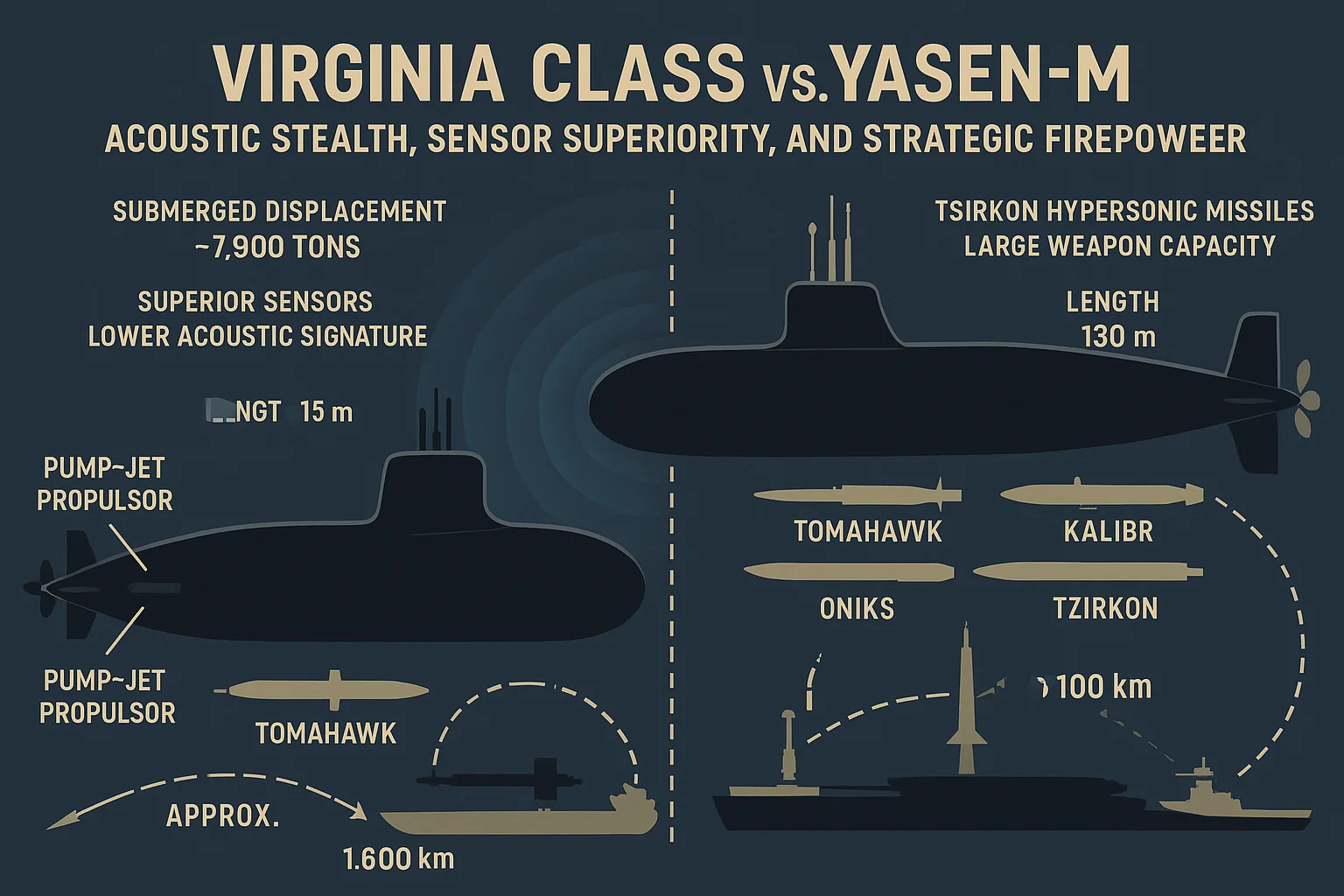
Infographic comparing US Navy Virginia-class and Russian Yasen-M submarines. Highlights Virginia's pump-jet propulsor, acoustic stealth, and Tomahawk range (1,600 km) versus Yasen-M's larger size, Tsirkon hypersonic missiles, Kalibr, and Oniks loadout.

A visual breakdown of the key differences between the US Virginia-class and Russian Yasen-M attack submarines. The infographic highlights the Virginia's acoustic stealth advantages against the Yasen-M's strategic firepower, including Tsirkon hypersonic missiles.

165
SHARES
2.1k
VIEWS
Share on Twitter

Introduction: The Resurgence of the Silent War

Submarine warfare is undergoing a new renaissance. After decades of relative quiet following the end of the Cold War, the world’s two leading submarine powers — the United States and Russia — are once again shaping the future of undersea combat through two very different platforms: the Virginia-class (SSN-774) and the Yasen-M (Project 885M) nuclear attack submarines.

These submarines embody fundamentally different design philosophies:

READ ALSO

LCA Tejas Mk-1A: India’s Indigenous 4.5-Gen Fighter & the JF-17 Rival

USS Gerald R. Ford vs. Type 003 Fujian: The Supercarrier Showdown (2025 Analysis)

  • Virginia Class: Exceptional acoustic stealth, superior sensors, modular payload options, and high multi-mission flexibility.
  • Yasen-M: Massive firepower, large internal volume for weapons, and the integration of Tsirkon hypersonic missiles, making it one of the most heavily armed SSNs in service.

Core Thesis: While the Virginia class remains the gold standard in acoustic stealth and sensor performance, the Yasen-M presents a strategic challenge to U.S. naval dominance through overwhelming firepower and long-range strike capability.


The Tale of the Tape (Comparison Table)

ParameterVirginia Class (Block IV/V) 🇺🇸Yasen-M (Project 885M) 🇷🇺
Submerged Displacement~7,900 tons / 10,200 tons (Block V)~13,800 tons
Length115 m / 140 m (Block V)130 m
Crew13290 (High Automation)
Primary MissionASW, Intel, Covert StrikeCarrier Hunting, Strategic Strike
Cruise MissilesTomahawk TLAM Block VKalibr, Oniks, Tsirkon (Hypersonic)
VLS Capacity12 tubes (Block IV) / 40 tubes (Block V)32-40 VLS Cells (Mixed Loadout)
Maximum Speed25+ knots (Silent)35+ knots (Sprint)
Operational Status24+ in service5 in service, 6 building

1. Acoustic Stealth: The Currency of the Deep

Acoustic stealth is the true currency of undersea warfare. In this domain, the Virginia class is widely regarded as the quietest operational SSN in the world.

Virginia-Class Acoustic Innovations

  • Pump-Jet Propulsor: Unlike traditional propellers, the pump-jet greatly reduces cavitation noise, allowing the Virginia to move faster while remaining silent.
  • Isolated Decks: Machinery is mounted on “floating rafts” to stop vibrations from reaching the hull.
  • Anechoic Coating: Next-gen rubber tiles absorb incoming sonar pings.

Yasen-M Acoustic Profile

The Yasen-M is a massive leap forward from the noisy Soviet-era boats.

Expert Assessment: Western intelligence suggests that Yasen-M is the quietest submarine Russia has ever built. However, due to its larger double-hull design, it is generally judged to be slightly louder than the Virginia at high speeds, though potentially equal at low “creep” speeds.


2. The Hunter’s Eye: Sensor Superiority

Virginia-Class SONAR Suite

The US Navy relies on the AN/BQQ-10 sonar suite, utilizing:

  • Large Aperture Bow (LAB) Array: A massive U-shaped passive sensor.
  • LWWAA (Lightweight Wide Aperture Array): Fiber-optic sensors along the hull flanks.
  • Advantage: The “Open Architecture” software allows the Virginia to update its threat library like an iPhone app, keeping it ahead of threats.

Yasen-M SONAR System

The Yasen-M utilizes the massive MGK-600 Irtysh-Amfora spherical bow sonar. Russian doctrine prioritizes powerful Active Sonar modes and long-range detection to target Carrier Strike Groups.


3. Firepower: VPM vs. Hypersonics

Virginia Block V: The Volume King

Standard Virginias carried only 12 Tomahawks. The new Block V changes the game with the Virginia Payload Module (VPM).

  • The VPM adds an 84-foot section to the hull with four massive tubes.
  • Total Firepower: Increases to 40 Cruise Missiles per boat.
  • Future Proof: These tubes are large enough to carry future US Hypersonic missiles (CPS).

Yasen-M: The Hypersonic Sniper

While Virginia waits for hypersonics, Yasen-M already has them.

  • 3M22 Tsirkon (Zircon): Capable of Mach 9 speeds, this missile makes the Yasen-M a deadly threat to surface ships. Current US defenses struggle to intercept it.
  • Kalibr & Oniks: A mixed loadout allows it to strike land targets 2,500km away.

Final Verdict: Stealth vs. Strike

The Virginia Block V and Yasen-M represent two different philosophies:

  • Virginia Advantage: It is the ultimate “Hunter-Killer.” Superior stealth and sensors make it the winner in a submarine-vs-submarine duel (ASW).
  • Yasen-M Advantage: It is the ultimate “Carrier Killer.” Its hypersonic missiles and high speed allow it to threaten high-value surface targets better than any other sub.

In a direct confrontation, the submarine that hears the other first wins. For now, that edge still belongs to the Virginia.


❓ FAQ: Virginia vs Yasen-M

Q: Which submarine is quieter?
A: The Virginia-class is generally considered quieter, especially at tactical speeds, due to its pump-jet propulsor and advanced isolation rafting.

Q: Can the Virginia class fire hypersonic missiles?
A: Not yet. The Block V’s Virginia Payload Module (VPM) is designed to carry the future “Conventional Prompt Strike” (CPS) hypersonic missiles, likely entering service in the late 2020s.

Q: Does Russia have more Yasen-M submarines than the US has Virginias?
A: No. As of 2025, the US operates over 20 Virginia-class boats, while Russia has fewer than 6 operational Yasen-M class boats.
Tags: Acoustic StealthNaval WarfareSSN KillerSubmarine ComparisonTsirkon MissileUS Navy vs Russian NavyVirginia Class Block VVirginia Payload ModuleYasen-M Project 885M

Related Posts

Indian Air Force LCA Tejas Mk-1A fighter jet soaring over the Himalayas, armed with indigenous Astra BVR missiles and equipped with an AESA radar nose cone.
Comparisons

LCA Tejas Mk-1A: India’s Indigenous 4.5-Gen Fighter & the JF-17 Rival

December 14, 2025
Split-screen illustration comparing the USS Gerald R. Ford (left) and China's Type 003 Fujian (right) aircraft carriers at sea.
Aircraft Carriers

USS Gerald R. Ford vs. Type 003 Fujian: The Supercarrier Showdown (2025 Analysis)

December 11, 2025
F/A-18F Super Hornet launching from carrier deck vs F-35C Lightning II waiting
Comparisons

F/A-18F Super Hornet vs. F-35C Lightning II: The Workhorse vs. The Future

December 9, 2025
Zumwalt vs Type 055: Diverging Doctrines in 21st Century Naval Architecture
Comparisons

Zumwalt vs Type 055: Diverging Doctrines in 21st Century Naval Architecture

December 12, 2025
Patriot vs. S-400 vs. THAAD: A Technical Comparison of Ballistic Missile Defense Capabilities
Comparisons

Patriot vs. S-400 vs. THAAD: A Technical Comparison of Ballistic Missile Defense Capabilities

December 21, 2025
Side-by-side comparison of F-35 Lightning II stealth fighter and Eurofighter Typhoon jet representing stealth vs speed capabilities
Comparisons

F-35 vs. Eurofighter Typhoon: Stealth or Speed? The Ultimate Comparison

December 21, 2025
Next Post
Mk 41 and Mk 57 PVLS: The Evolution of Naval VLS Systems and Hypersonic Missile Integration

Mk 41 and Mk 57 PVLS: The Evolution of Naval VLS Systems and Hypersonic Missile Integration

Leave a Reply Cancel reply

Your email address will not be published. Required fields are marked *

About

Ultidefense is a digital platform focused on modern defense, military technology, and strategic innovation.
We explore how advancements in aerospace, AI, cybersecurity, and autonomous systems are transforming the global defense landscape.
Our mission is to connect technical insight with strategic awareness, helping readers understand the technologies shaping modern security and warfare.
At Ultidefense, we believe knowledge is strength — and our goal is to deliver clear, factual, and forward-looking analysis on the systems, science, and strategies defining the future of defense.

Categories

  • Comparisons
  • Cyber Security & Electronic Warfare
  • Defense News
  • Defense Systems
    • Air Platforms
      • Attack Helicopters
      • Fighter Jets
      • Global Military Drones: UAV Systems, Autonomy, and Unmanned Warfare
      • Strategic Bombers
    • Future Tech & Innovations
      • Sensors and Avionics
    • Land Systems
      • Artillery & Firepower: Self-Propelled Guns, Rocket Systems, and Barrage Analysis
      • Main Battle Tanks: Armor, Firepower, and Modern MBT Comparisons
    • Missiles & Munitions
      • Strategic & Hypersonic Weapons
    • Space Warfare
      • Military Satellites & ISR
      • Spaceplanes & Launch Vehicles
  • Integrated Defense Systems
    • Air Defense Systems
  • Military Life
  • Naval Systems: Warships, Carriers, and Maritime Defense Technology
    • Aircraft Carriers
    • Submarines
  • Policy, Budget and Geopolitics
  • Unmanned Maritime Systems

Recent Posts

  • Which Military Boot Camp is the Hardest? All 6 US Branches Ranked
  • The SFAS Fallout: What Happens After You Fail Special Forces Selection
  • The Algorithm of War:The Anatomy of Conflict in 2050
  • Russia’s Avangard HGV: Breaking the Shield of Global Missile Defense

Newsletter

Pages

  • About Us
  • Home
  • Contact Us
  • Privacy Policies
  • Terms of Service
  • Disclaimer

© 2025 Defense Systems

Welcome Back!

Login to your account below

Forgotten Password?

Retrieve your password

Please enter your username or email address to reset your password.

Log In
No Result
View All Result
  • Defense Systems
    • Air Platforms
      • Fighter Jets
      • Drones
      • Attack Helicopters
      • Strategic Bombers
    • Land Systems
      • Main Battle Tanks
      • Artillery & Firepower
      • Infantry Fighting Vehicles
      • Military Logistics and Support Vehicles
      • Soldier Systems & Robotics: UGV, Exoskeleton, and Modern Infantry Integration
    • Integrated Defense Systems
      • Ballistic Missile Defense
      • Air Defense Systems
    • Missiles & Munitions
      • Air-to-Air & Anti-Ship Missiles
      • Cruise Missiles
      • Strategic & Hypersonic Weapons
    • Naval
      • Aircraft Carriers
      • Submarines
      • Surface Combatants
      • Unmanned Maritime Systems
    • Future Tech & Innovations
      • Sensors and Avionics
  • Comparisons
  • Space Warfare
    • Counter-Space & ASAT
    • Spaceplanes & Launch Vehicles
    • Military Satellites & ISR
  • Defense News
  • Military Life
  • Policy, Budget and Geopolitics
  • Cyber Security & Electronic Warfare

© 2025 Defense Systems