
• Login
UltiDefense: Military Tech Comparisons & Modern Warfare Analysis
  • Defense Systems
    • Air Platforms
      • Fighter Jets
      • Drones
      • Attack Helicopters
      • Strategic Bombers
    • Land Systems
      • Main Battle Tanks
      • Artillery & Firepower
      • Infantry Fighting Vehicles
      • Military Logistics and Support Vehicles
      • Soldier Systems & Robotics: UGV, Exoskeleton, and Modern Infantry Integration
    • Integrated Defense Systems
      • Ballistic Missile Defense
      • Air Defense Systems
    • Missiles & Munitions
      • Air-to-Air & Anti-Ship Missiles
      • Cruise Missiles
      • Strategic & Hypersonic Weapons
    • Naval
      • Aircraft Carriers
      • Submarines
      • Surface Combatants
      • Unmanned Maritime Systems
    • Future Tech & Innovations
      • Sensors and Avionics
  • Comparisons
  • Space Warfare
    • Counter-Space & ASAT
    • Spaceplanes & Launch Vehicles
    • Military Satellites & ISR
  • Defense News
  • Military Life
  • Policy, Budget and Geopolitics
  • Cyber Security & Electronic Warfare
No Result
View All Result
Defense News
No Result
View All Result

Home - Comparisons - F/A-18F Super Hornet vs. F-35C Lightning II: The Workhorse vs. The Future

F/A-18F Super Hornet vs. F-35C Lightning II: The Workhorse vs. The Future

George Schouten by George Schouten
December 9, 2025
in Comparisons
0
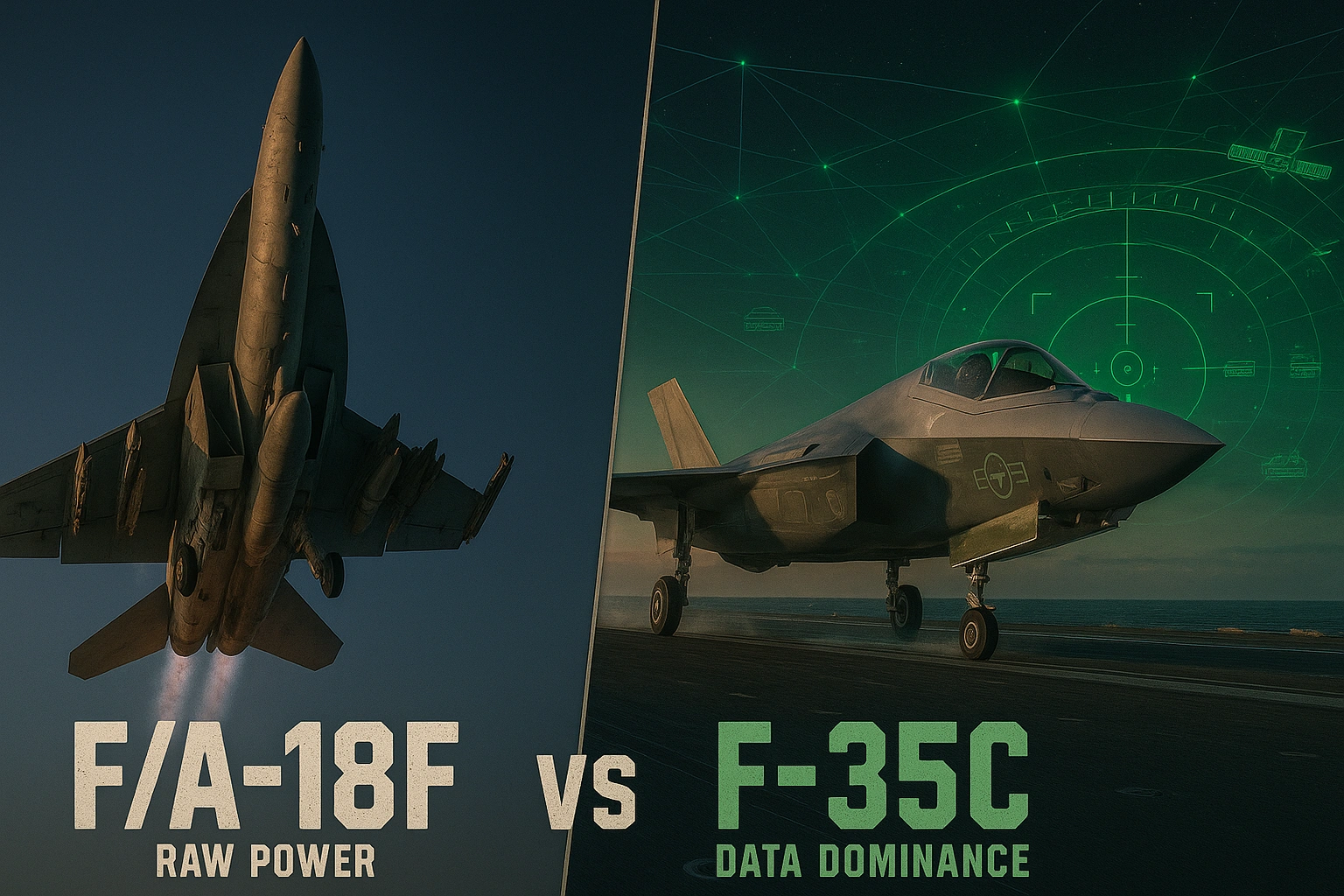
F/A-18F Super Hornet launching from carrier deck vs F-35C Lightning II waiting

The Workhorse and The Future: A Super Hornet Block III launches while an F-35C prepares for duty.

155
SHARES
1.9k
VIEWS
Share on Twitter

The year 2025 marks the end of an era. Boeing has announced the winding down of the F/A-18 production line, signaling the sunset of one of the most successful naval fighters in history. But the “Rhino” isn’t going quietly. With the F/A-18F Super Hornet Block III upgrade, the Super Hornet is more capable than ever.

The F/A-18F Super Hornet Block III is set to redefine naval combat capabilities.

On the other side of the flight deck sits the F-35C Lightning II—the stealthy, single-engine future of the US Navy.

For a carrier commander, the dilemma is real: Do you want a jet that can haul massive amounts of ordnance (Hornet), or a jet that can disappear from enemy radar (Lightning)?

In this Super Hornet vs. F-35C analysis, we break down the final battle for the carrier deck.

This analysis highlights the capabilities of the F/A-18F Super Hornet Block III in comparison to its competitors.

With advancements in technology, the F/A-18F Super Hornet Block III boasts improved avionics and weapon systems.


Technical Specifications: The Beast vs. The Ghost

FeatureF/A-18F Super Hornet (Block III)F-35C Lightning II (Carrier Variant)
RoleMulti-Role Workhorse (The Truck)Stealth Strike / Node (The Assassin)
Engine2x GE F414-400 (Reliable Twin Power)1x P&W F135-PW-400 (Most Powerful Single)
SpeedMach 1.8Mach 1.6
Range (Combat)~500 nm (Internal) / Extended w/ Tanks>600 nm (Internal Fuel Only)
Payload11 Hardpoints (Heavy External Load)4 Internal + 6 External (Stealth Mode is Light)
StealthReduced RCS (Block III), but VisibleVLO (Day 1 Stealth)
CockpitAdvanced Cockpit System (Touchscreen)Panoramic Touchscreen & HMDS Helmet
Flight CostLower (~$30,000/hr)Higher (~$45,000+/hr)
Unit Cost~$70 Million~$102 Million

1. The Philosophy: “Bomb Truck” vs. “Sniper”

The Super Hornet: The Bomb Truck

The F/A-18F isn’t afraid to be seen. Its job is to carry everything.

  • Capacity: It has 11 weapon stations. It can carry stand-off missiles (SLAM-ER), anti-ship missiles (LRASM), and laser-guided bombs simultaneously.

  • Buddy Tanking: Unique to the Hornet, it can carry fuel pods to refuel other jets in mid-air. The F-35C cannot do this. The Hornet is the “Gas Station” of the fleet.

  • Two Heads are Better: The “F” model is a two-seater. A Weapon Systems Officer (WSO) in the back manages the complex targeting and drone coordination, while the pilot flies.

The F-35C: The Sniper

The F-35C is designed to go where the Hornet cannot: Inside the enemy’s bubble.

  • Stealth Advantage: With its weapons tucked internally, the F-35C can penetrate advanced S-400 air defenses, identify targets, and destroy them before the enemy knows a war has started.

  • Sensor Node: It gathers data and sends it back to the carrier group. An F-35C can spot a ship 200 miles away and guide a missile launched from a Super Hornet to hit it.


2. Block III Upgrades: Teaching an Old Dog New Tricks

Upgrades in the F/A-18F Super Hornet Block III ensure it remains competitive against newer models.

Why is the Hornet still relevant in 2025? Because of Block III.

Boeing didn’t just repaint the jet; they reinvented it.

  1. 10,000 Hour Life: The airframe is reinforced to last decades longer.

  2. Advanced Cockpit System: The old buttons are gone. A massive 10×19 inch touchscreen (similar to the F-35) now dominates the dashboard.

  3. Reduced RCS: New coatings make it harder to spot, though not truly “stealth.”

  4. Networked: It can now “talk” to the F-35 via advanced data links, acting as a “loyal wingman” to the stealth jet.

    The F/A-18F Super Hornet Block III is now equipped with advanced surveillance technologies.


3. The Carrier Reality: Cost & Availability

Here is the brutal truth of naval logistics:

  • The F-35C is expensive. Not just to buy, but to fly. Its stealth coating requires delicate maintenance after saltwater exposure.

  • The Super Hornet is rugged. It is built to be abused. It is cheaper to operate, easier to fix, and you can generate more sorties (flights) per day with Hornets than with F-35s.

    In terms of operational versatility, the F/A-18F Super Hornet Block III outperforms many competitors.

The Navy’s Mix: The current doctrine isn’t “Either/Or.” It’s “High/Low Mix.” The F-35C kicks down the door (Day 1), and the Super Hornets follow with trucks full of bombs to finish the job (Day 2-30).

The legacy of the F/A-18F Super Hornet Block III continues to influence modern naval strategies.


Conclusion: A Legend Retires?

As the production line closes in late 2025, the F/A-18F Super Hornet solidifies its legacy. It is not the fastest, nor the stealthiest. But it is the most dependable naval strike fighter ever built.

  • Choose the F-35C if you need to survive in a high-threat, missile-dense environment.

    Ultimately, the F/A-18F Super Hornet Block III remains a critical asset for naval operations.

  • READ ALSO

    LCA Tejas Mk-1A: India’s Indigenous 4.5-Gen Fighter & the JF-17 Rival

    USS Gerald R. Ford vs. Type 003 Fujian: The Supercarrier Showdown (2025 Analysis)

  • Choose the F/A-18F if you need to deliver 15,000 lbs of explosives to a target and refuel your wingman on the way home.

The Verdict: The King is dead (production ending). Long live the King.


❓ FAQ: Super Hornet vs F-35C

The F/A-18F Super Hornet Block III showcases a blend of power and precision.

Q: Can a Super Hornet shoot down an F-35C?

A: In a visual dogfight (WVR)? Yes. The Super Hornet has incredible low-speed nose authority. But the F-35C would likely kill the Hornet from 50 miles away before the Hornet ever saw it.

The presence of the F/A-18F Super Hornet Block III ensures versatility in combat scenarios.

Q: Why is the F/A-18 called “Rhino”?

A: To distinguish it from the smaller, older “Legacy Hornet” (A/C models) on the carrier deck. The “Super” Hornet is much heavier and has a “boxier” nose—like a Rhino.

Q: Is the F-14 Tomcat better than both?

A: Only in movies! The F-14 was faster, but the Super Hornet is infinitely more reliable, carries smarter weapons, and has far better electronics.


💬 The Final Launch

Production ends this year. Do you think the US Navy is making a mistake by going all-in on stealth, or will the Super Hornet be missed?

As we bid farewell to the production of the F/A-18F Super Hornet Block III, its legacy lives on.

Comment below: Team Rhino 🦏 or Team Stealth ⚡?

Which will you choose: the innovative F/A-18F Super Hornet Block III or the stealthy alternative?
Tags: BoeingCarrier AviationF-35C Lightning IIF/A-18F Super HornetLockheed MartinMilitary TechnologyNaval FightersSuper Hornet Block IIITop GunUltiDefenseUS Navy

Related Posts

Indian Air Force LCA Tejas Mk-1A fighter jet soaring over the Himalayas, armed with indigenous Astra BVR missiles and equipped with an AESA radar nose cone.
Comparisons

LCA Tejas Mk-1A: India’s Indigenous 4.5-Gen Fighter & the JF-17 Rival

December 14, 2025
Split-screen illustration comparing the USS Gerald R. Ford (left) and China's Type 003 Fujian (right) aircraft carriers at sea.
Aircraft Carriers

USS Gerald R. Ford vs. Type 003 Fujian: The Supercarrier Showdown (2025 Analysis)

December 11, 2025
Infographic comparing US Navy Virginia-class and Russian Yasen-M submarines. Highlights Virginia's pump-jet propulsor, acoustic stealth, and Tomahawk range (1,600 km) versus Yasen-M's larger size, Tsirkon hypersonic missiles, Kalibr, and Oniks loadout.
Comparisons

Virginia Class vs. Yasen-M

December 11, 2025
Zumwalt vs Type 055: Diverging Doctrines in 21st Century Naval Architecture
Comparisons

Zumwalt vs Type 055: Diverging Doctrines in 21st Century Naval Architecture

December 12, 2025
Patriot vs. S-400 vs. THAAD: A Technical Comparison of Ballistic Missile Defense Capabilities
Comparisons

Patriot vs. S-400 vs. THAAD: A Technical Comparison of Ballistic Missile Defense Capabilities

December 21, 2025
Side-by-side comparison of F-35 Lightning II stealth fighter and Eurofighter Typhoon jet representing stealth vs speed capabilities
Comparisons

F-35 vs. Eurofighter Typhoon: Stealth or Speed? The Ultimate Comparison

December 21, 2025
Next Post
Chengdu J-20 Mighty Dragon stealth fighter flying over ocean showcasing canard delta wing configuration

Chengdu J-20 Mighty Dragon: Paper Tiger or 5th-Gen Monster?

Leave a Reply Cancel reply

Your email address will not be published. Required fields are marked *

About

Ultidefense is a digital platform focused on modern defense, military technology, and strategic innovation.
We explore how advancements in aerospace, AI, cybersecurity, and autonomous systems are transforming the global defense landscape.
Our mission is to connect technical insight with strategic awareness, helping readers understand the technologies shaping modern security and warfare.
At Ultidefense, we believe knowledge is strength — and our goal is to deliver clear, factual, and forward-looking analysis on the systems, science, and strategies defining the future of defense.

Categories

  • Comparisons
  • Cyber Security & Electronic Warfare
  • Defense News
  • Defense Systems
    • Air Platforms
      • Attack Helicopters
      • Fighter Jets
      • Global Military Drones: UAV Systems, Autonomy, and Unmanned Warfare
      • Strategic Bombers
    • Future Tech & Innovations
      • Sensors and Avionics
    • Land Systems
      • Artillery & Firepower: Self-Propelled Guns, Rocket Systems, and Barrage Analysis
      • Main Battle Tanks: Armor, Firepower, and Modern MBT Comparisons
    • Missiles & Munitions
      • Strategic & Hypersonic Weapons
    • Space Warfare
      • Military Satellites & ISR
      • Spaceplanes & Launch Vehicles
  • Integrated Defense Systems
    • Air Defense Systems
  • Military Life
  • Naval Systems: Warships, Carriers, and Maritime Defense Technology
    • Aircraft Carriers
    • Submarines
  • Policy, Budget and Geopolitics
  • Unmanned Maritime Systems

Recent Posts

  • Which Military Boot Camp is the Hardest? All 6 US Branches Ranked
  • The SFAS Fallout: What Happens After You Fail Special Forces Selection
  • The Algorithm of War:The Anatomy of Conflict in 2050
  • Russia’s Avangard HGV: Breaking the Shield of Global Missile Defense

Newsletter

Pages

  • About Us
  • Home
  • Contact Us
  • Privacy Policies
  • Terms of Service
  • Disclaimer

© 2025 Defense Systems

Welcome Back!

Login to your account below

Forgotten Password?

Retrieve your password

Please enter your username or email address to reset your password.

Log In
No Result
View All Result
  • Defense Systems
    • Air Platforms
      • Fighter Jets
      • Drones
      • Attack Helicopters
      • Strategic Bombers
    • Land Systems
      • Main Battle Tanks
      • Artillery & Firepower
      • Infantry Fighting Vehicles
      • Military Logistics and Support Vehicles
      • Soldier Systems & Robotics: UGV, Exoskeleton, and Modern Infantry Integration
    • Integrated Defense Systems
      • Ballistic Missile Defense
      • Air Defense Systems
    • Missiles & Munitions
      • Air-to-Air & Anti-Ship Missiles
      • Cruise Missiles
      • Strategic & Hypersonic Weapons
    • Naval
      • Aircraft Carriers
      • Submarines
      • Surface Combatants
      • Unmanned Maritime Systems
    • Future Tech & Innovations
      • Sensors and Avionics
  • Comparisons
  • Space Warfare
    • Counter-Space & ASAT
    • Spaceplanes & Launch Vehicles
    • Military Satellites & ISR
  • Defense News
  • Military Life
  • Policy, Budget and Geopolitics
  • Cyber Security & Electronic Warfare

© 2025 Defense Systems