

It began as a partnership in the 1980s under the “Future European Fighter Aircraft” program. It ended as the fiercest rivalry in modern aviation history.
Understanding the differences between the Rafale F4 vs Typhoon Tranche 4 is crucial for defense enthusiasts and military strategists alike.
When France withdrew from the consortium to pursue its own path, two distinct 4.5th Generation fighters were born: the Dassault Rafale and the Eurofighter Typhoon.
In 2025, with the roll-out of the Rafale F4 Standard and the Typhoon Tranche 4, the gap between their philosophies has never been wider.
The upcoming advancements in the Rafale F4 vs Typhoon Tranche 4 are set to redefine aerial combat.
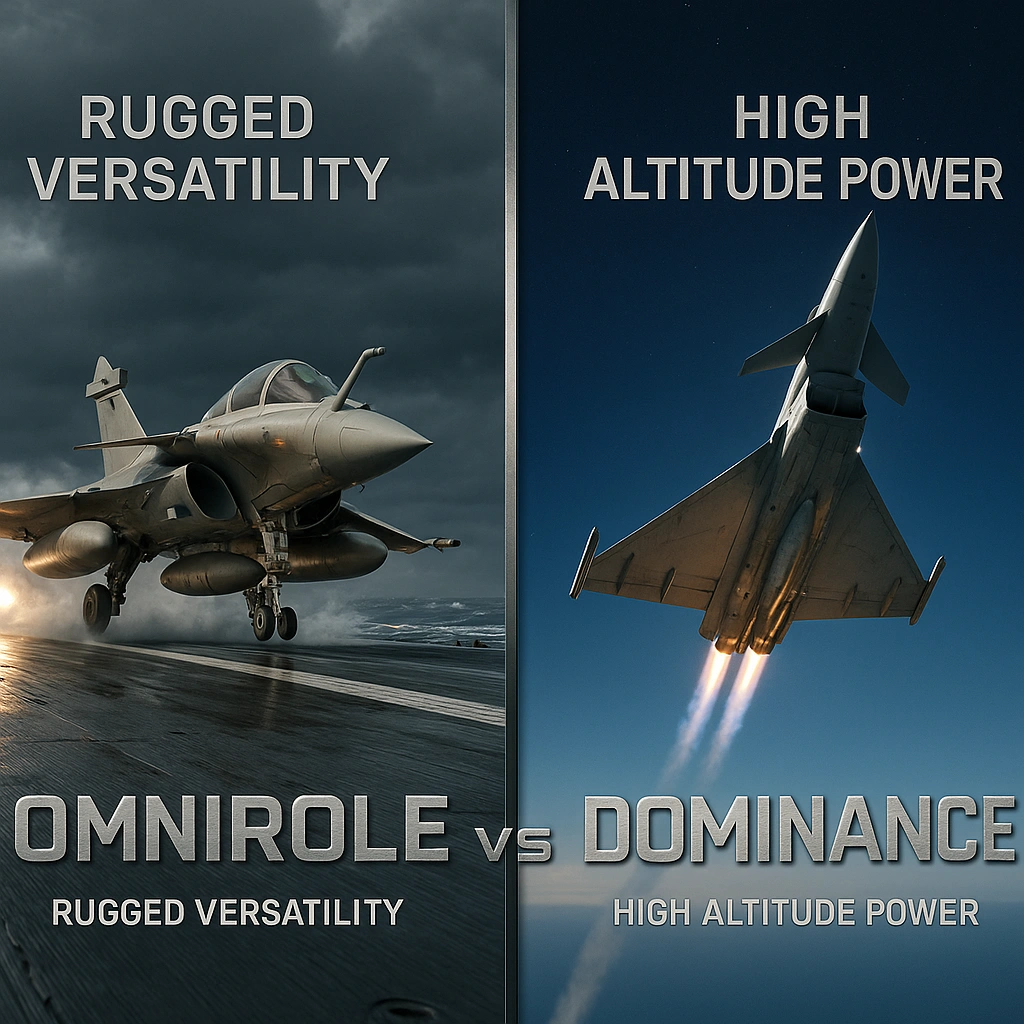
The Rafale is the “Omnirole” Swiss Army Knife—designed to operate from aircraft carriers and perform nuclear deterrence. The Typhoon is the “Kinetic Beast”—a thoroughbred interceptor designed to dominate the stratosphere.
In a head-to-head clash of engineering, does French finesse beat multinational muscle? Let’s dive into the ultimate comparison of the Rafale F4 vs Typhoon Tranche 4 and explore their capabilities.
In the battle of the Rafale F4 vs Typhoon Tranche 4, both aircraft showcase distinct advantages that highlight their engineering prowess.
Technical Specifications: The Sibling Rivals
Both jets share DNA (Canard-Delta wings, twin engines), but their evolutions have prioritized different metrics.
| Feature | Dassault Rafale (F4 Standard) | Eurofighter Typhoon (Tranche 4) |
| Philosophy | Omnirole (Do Everything) | Air Superiority (Speed First) |
| Engine | 2x Snecma M88 (17,000 lbf each) | 2x Eurojet EJ200 (20,000+ lbf each) |
| Radar | RBE2-AA AESA (Battle Mature) | Captor-E / ECRS Mk2 (New EA Capability) |
| Max Speed | Mach 1.8 | Mach 2.0+ (Superior Supercruise) |
| Ceiling | 50,000 ft | 65,000 ft (Higher & Faster) |
| Weapons (A2A) | Meteor + MICA (IR/RF) | Meteor + ASRAAM / IRIS-T |
| Carrier Ops | Yes (Rafale M variant) | No (Land-based only) |
| Flight Cost | Low (~$18,000 / hour) | High (~$60,000 / hour) |
| Hardpoints | 14 (Heavy Load – 9.5 Tons) | 13 (Medium Load – 9.0 Tons) |
1. The Kinetic Gap: Raw Power vs. Agility
Rafale F4 vs Typhoon Tranche 4: A Closer Look at Their Competencies
The Typhoon: The King of Energy
If you ask a pilot which jet they want for a high-altitude interception, they will undeniably choose the Typhoon. Its Eurojet EJ200 engines are arguably the best 4th-generation engines in existence. They allow the Typhoon to “Supercruise” (fly supersonic without afterburners) effortlessly and climb rapidly to 65,000 ft.
Advantage: In a Beyond Visual Range (BVR) fight, the Typhoon can launch its Meteor missiles from higher and faster, giving the missile more kinetic energy to reach further targets.
The Rafale: The King of the Merge
The Rafale doesn’t try to outrun the Typhoon; it outmaneuvers it. Its “close-coupled” canard design allows it to perform incredible maneuvers at low speeds and high angles of attack. It acts as a “bomb truck” that can defend itself.
The ongoing debate of Rafale F4 vs Typhoon Tranche 4 continues to captivate the military aviation community.
Advantage: If the fight gets close (dogfight) or goes down to low altitudes, the Rafale’s nose authority and instant turn rate are superior.
2. The Radar Revolution: RBE2 vs. ECRS Mk2
For years, the Rafale held the advantage with its RBE2-AA AESA radar, which has been in service for over a decade. It is mature, reliable, and integrated perfectly with the SPECTRA electronic warfare suite.
As the Rafale F4 vs Typhoon Tranche 4 comparison heats up, each aircraft’s capabilities become increasingly relevant.
But in 2025, the Typhoon strikes back with the ECRS Mk2 (European Common Radar System).
The Game Changer: The ECRS Mk2 isn’t just a radar; it’s a high-powered Electronic Attack weapon. It features a swashplate (mechanically repositionable AESA) that provides a wider field of view than the fixed plate on the Rafale.
The Verdict: The Rafale’s radar is a proven, compact solution. The Typhoon’s new radar is a massive powerhouse designed to jam and suppress enemy air defenses (SEAD).
3. The Strategic Edge: Carrier Capability & Independence
This is the single biggest differentiator that defines the Rafale’s global success.
Evaluating the Rafale F4 vs Typhoon Tranche 4 can help in determining future air combat strategies.
Because France needed to replace its naval fighters, the Rafale was built from day one to withstand the brutal forces of catapult launches and arrested landings on aircraft carriers.
Why it matters: This reinforced airframe makes the Rafale incredibly rugged. It can operate from short, damaged runways or highways where the delicate Typhoon might struggle.
Independence: Buying a Rafale means dealing only with France. Buying a Typhoon means dealing with four nations (UK, Germany, Italy, Spain), which can sometimes lead to political delays in exports or upgrades.
4. The Wallet War: Operational Costs
Ultimately, the Rafale F4 vs Typhoon Tranche 4 represents a pivotal moment in modern military aviation.
This is often the deciding factor for export customers like India, Indonesia, and Egypt.
For many, the choice between Rafale F4 vs Typhoon Tranche 4 boils down to specific mission requirements.
Data indicates a significant disparity in operating costs:
Rafale: ~$18,000 – $22,000 per flight hour.
Eurofighter: ~$50,000 – $60,000+ per flight hour.
For an air force operating a fleet of 50 jets, the Rafale offers massive long-term savings, allowing for more pilot training hours and better readiness rates.
Conclusion: Which Philosophy Wins?
The “Divorce” produced two winners for two different missions.
Choose the Dassault Rafale if: You want a Strategic Asset. A jet that can take off from a carrier, deliver nuclear weapons (if applicable), conduct deep strikes, and fight its way home, all while keeping logistics simple and costs low.
In summary, the Rafale F4 vs Typhoon Tranche 4 debate underscores the evolving nature of combat aircraft.
Choose the Eurofighter Typhoon if: You want an Air Dominance Fighter. If your primary mission is to clear the skies of enemy threats at Mach 2 and utilize the most powerful radar in its class to suppress enemy defenses.
The Verdict: The Rafale is the better multi-role warplane. The Typhoon is the superior air superiority machine.
The ongoing rivalry of Rafale F4 vs Typhoon Tranche 4 will continue to shape air force strategies for years to come.
💬 Join the Debate
Do you prefer the specialized power of the Typhoon or the versatile genius of the Rafale?
Sound off in the comments: Team Rafale 🇫🇷 or Team Typhoon 🇪🇺?
What are your thoughts on the latest developments in the Rafale F4 vs Typhoon Tranche 4 saga?