

1. Introduction: The Terrestrial Bottleneck
Rare earth elements — the lanthanide series plus scandium and yttrium — underpin everything from precision-guided munitions to electric vehicle motors and wind turbine generators. Of the roughly 120 million tonnes of identified terrestrial REE reserves, approximately 60% are located in China, with the remainder concentrated in Brazil, Russia, Vietnam, and Australia.
This geographic monopoly became a strategic crisis during China’s 2009–2011 export restrictions, which exposed severe supply chain vulnerabilities for the United States, Japan, and the EU. The core problem is not physical scarcity. It is that extraction and processing are ecologically devastating and politically toxic in Western democracies, giving China a structural advantage it has exploited deliberately.
The U.S. Department of Defense 2023 Critical Minerals Strategy and the EU’s Critical Raw Materials Act (CRMA, 2024) both treat supply chain diversification as a national security imperative. The longer-term solution increasingly points off-planet.
2. Target Regions and Planetary Geology
2.1 The Moon: KREEP Basalts and the Procellarum Basin
The Moon is the first logical logistics target due to its proximity and the relative completeness of orbital survey data. The most strategically significant geological formation is the KREEP layer — an acronym for Potassium (K), Rare Earth Elements (REE), and Phosphorus (P).
Formation mechanism. During the Moon’s first 100 million years, a global Lunar Magma Ocean (LMO) crystallized from the outside in. Heavy minerals like olivine and pyroxene sank early, while incompatible elements — REE, thorium, phosphorus — remained concentrated in the residual melt. As the LMO solidified, this enriched liquid was trapped between the crust and mantle, forming the KREEP basalt layer. Partial melting and subsequent volcanic activity brought portions of this material to the surface.
Key regions. Gamma-ray spectrometer data from the Lunar Prospector and SELENE/Kaguya orbiters identified the highest KREEP and thorium concentrations in:
- Oceanus Procellarum — the largest and youngest mare region; highest concentrations of neodymium (Nd), samarium (Sm), and cerium (Ce)
- Mare Imbrium — volcanic floor overlain by KREEP basalt flows
- South Pole–Aitken (SPA) Basin — surface concentrations are lower, but deep excavated material remains incompletely characterized
Neodymium and samarium concentrations in Procellarum KREEP terrain may reach 10–15 times the average terrestrial crustal abundance. These figures are derived from surface remote sensing; depth profiles require in-situ drilling.
2.2 Asteroids: Differentiated Bodies and Metallic Cores
Asteroids are remnants of planetary formation — some primitive and undifferentiated, others the exposed metallic cores of bodies that melted and separated early in solar system history.
M-type (metallic) asteroids. Composed primarily of iron-nickel alloys, M-type asteroids are thought to be remnant cores of differentiated parent bodies. Psyche 16, approximately 220 km across, is the largest known metallic asteroid. NASA’s Psyche mission (launched 2023) is directly characterizing its composition. Mid-to-heavy lanthanides — dysprosium, terbium, holmium — are expected at elevated concentrations, though current estimates remain based on remote spectroscopy and will be refined by mission data.
C-type (carbonaceous) asteroids. Lower in REE concentration but rich in water ice, carbon, and volatile compounds. The OSIRIS-REx sample return from Bennu confirmed composition consistent with carbonaceous chondrite meteorites. Water content makes C-types strategically valuable for life support and propellant production at future outposts.
Processing advantage. The near-zero gravity environment eliminates the need for water-based hydrometallurgical processing. Magnetic mass spectrometers, electrostatic separation, and solar furnace pyrometallurgy can achieve separation efficiencies that would be physically impossible on Earth.
2.3 Mars: Volcanic Differentiation and Hydrothermal Deposits
Mars has a more complex geological history than the Moon or asteroids, with evidence of significant water activity. The Tharsis and Elysium volcanic plateaus underwent fractional crystallization and likely hydrothermal activity, creating conditions analogous to terrestrial REE-bearing carbonatite and pegmatite deposits. Curiosity rover XRF data from Gale Crater basalts show REE patterns comparable to oceanic island basalts on Earth.
Mars is not a practical near-term mining target. Viable operations depend on sustained surface infrastructure that does not yet exist. Short-to-medium-term strategy focuses on the Moon and near-Earth objects (NEOs).
3. REE Applications in Space Systems
3.1 Ion Propulsion
Gridded ion thrusters used in deep space probes — and planned for future crewed vehicles — require samarium-cobalt (SmCo₅, Sm₂Co₁₇) or neodymium-iron-boron (Nd₂Fe₁₄B) permanent magnets to generate stable magnetic fields. These alloys maintain resistance to demagnetization at operating temperatures up to 250–350°C. Performance validated on Dawn and Hayabusa-2 confirms there is currently no substitute material for long-duration space propulsion.
3.2 Radiation Shielding
Spacecraft bound for Jupiter (Europa Clipper) and beyond require protection from high-energy charged particles. Gadolinium (Gd) and samarium (Sm) alloys, which have among the highest neutron capture cross-sections of any element, are being evaluated as shielding components in high-flux radiation environments. Active R&D continues for both space and nuclear medicine applications.
3.3 Deep Space Optical Communications
NASA’s Deep Space Optical Communications (DSOC) experiment, conducted aboard the Psyche spacecraft, demonstrated data rates 10 to 100 times higher than radio-frequency systems. The enabling component is erbium-doped fiber amplifiers (EDFA), where erbium ions amplify photons at the 1550 nm telecommunications window. No comparable substitute exists at operational scale.
3.4 High-Temperature Superconductors
Next-generation space power systems and electromagnetic shielding architectures are evaluating rare earth barium copper oxide (REBCO) high-temperature superconductors, incorporating yttrium (Y), gadolinium (Gd), and samarium (Sm). This technology has direct relevance to both onboard power generation and electromagnetic systems in hypersonic vehicles.
4. Military Applications
| Element | Key Compound / Alloy | Military Application | Strategic Advantage |
|---|---|---|---|
| Neodymium (Nd) | Nd₂Fe₁₄B magnets | Precision guidance, servo motors, actuators | Millisecond fin deflection under extreme G-forces; high-torque motor in minimal volume |
| Dysprosium (Dy) | Dy-doped NdFeB | Hypersonic vehicle structures, jet engine components | Prevents demagnetization above 400°C, extending operational temperature range |
| Terbium (Tb) | Terfenol-D (TbFe₂) | Sonar systems, magnetostrictive actuators | Ultra-precise acoustic signal generation for submarine warfare; structural health monitoring |
| Yttrium (Y) | Y₃Al₅O₁₂ (YAG) | Solid-state laser weapons (DEW) | Continuous-wave output above 10 kW for cruise missile and drone interdiction |
| Lanthanum (La) | LaAlO₃, LaB₆ | Night vision optics, infrared sensors | Broadband anti-reflective coatings; detection sensitivity against low-contrast targets |
| Europium (Eu) | EuO, Eu-doped phosphors | IFF (Identification Friend or Foe) systems | UV-invisible identity markers; authentication of military hardware |
| Gadolinium (Gd) | Gd-based neutron absorbers | Nuclear reactor control, radiation shielding | High neutron capture cross-section; compact submarine and floating platform reactors |
| Holmium (Ho) | HoFe₂ magnets | Magnetic targeting systems, precision geodesy | Record magnetic field density in small volume; compact high-power electromagnets |
4.1 Hypersonic Weapons
Hypersonic glide vehicles (HGV) and scramjet-powered hypersonic cruise missiles (HCM) traveling above Mach 5 experience aerodynamic heating that drives surface temperatures above 1,200°C. Standard NdFeB magnets demagnetize at 80°C. Dysprosium and terbium additions raise this threshold above 200°C. The design constraints of the U.S. AGM-183A ARRW and Russia’s Avangard programs both reflect this material limitation as a direct system performance boundary.
4.2 Directed Energy Weapons
The U.S. Navy’s LaWS program and Lockheed Martin’s HELIOS system have demonstrated combat-effective laser performance at 60–150 kW. Energy efficiency and thermal management at this power level are directly dependent on the purity and thermal properties of the laser gain medium. Scaling to mass production makes high-purity yttrium and erbium a strategic procurement problem, not merely a materials science one.
4.3 Quantum Sensors and GPS-Denied Navigation
Atomic interferometers used in inertial navigation — resistant to GPS jamming — require erbium and ytterbium (Yb) doped laser sources for atom cooling and trapping. This technology enables precision guidance for munitions operating in denied or contested electromagnetic environments, which is the operating assumption for near-peer conflict scenarios.
5. Geopolitical Competition and Legal Framework
5.1 China’s Position
China is not only dominant in terrestrial REE mining; it is an active competitor in space resource access. Chang’e 4 and 5 missions collected significant data on KREEP basalt distribution near the lunar south pole. The overlap between CNSA’s post-2030 crewed lunar program target zones and the highest KREEP concentration areas in the Procellarum region is not coincidental. Integration between CNSA and the People’s Liberation Army Strategic Support Force (PLASSF) reflects the explicit military-civil fusion (军民融合) doctrine applied to space resources.
5.2 Artemis Accords and the Legal Gap
The 1967 Outer Space Treaty prohibits national sovereignty claims over celestial bodies but leaves a clear gap on resource ownership. The U.S. Space Resources Act (2015) and Luxembourg’s equivalent (2017) filled this gap by establishing that extracted resources can be privately owned. The Artemis Accords framework, signed by 43 nations as of 2025, attempts to build multilateral norms around resource utilization — but Russia and China are not signatories. This legal bifurcation is the foundation for future disputes over lunar mining rights.
5.3 Strategic Competition Scenarios
Establishing dual-use (civilian/military) infrastructure that restricts access to specific KREEP-rich lunar regions is legally contested but practically effective as a de facto exclusion mechanism. The strategic value of the lunar south pole water ice deposits for propellant and life support accelerates the race to establish physical presence. The Pentagon’s 2024 Space Defense Strategy explicitly frames access to space resources within national security discourse.
6. Extraction and Processing Technologies
6.1 Solar Thermal Pyrometallurgy
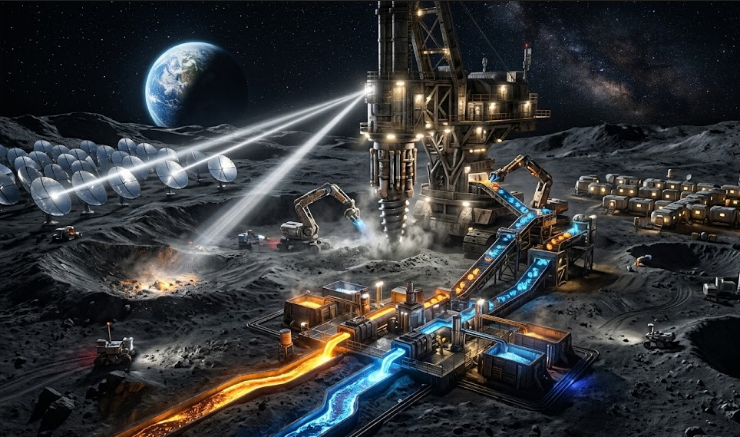
Concentrating mirror arrays (Cassegrain collectors) focus solar radiation onto regolith surfaces, achieving local temperatures above 1,600°C. Elements with different melting and boiling points can be partially separated through controlled thermal gradients. This approach is fully consistent with In-Situ Resource Utilization (ISRU) principles. The main engineering challenge is transporting and deploying precision optical infrastructure in a high-dust, high-vacuum environment.
6.2 Plasma Dissociation and Mass Spectrometric Refining
Regolith samples are ionized by microwave or radio-frequency plasma sources in vacuum. The resulting ions are deflected by linear magnetic separators according to their mass-to-charge ratio (m/z) and directed to separate collection plates — a scaled-up adaptation of time-of-flight mass spectrometry (ToF-MS). Theoretical purity levels are high; practical scale-up remains under active research.
6.3 Robotic Autonomous Mining
NASA’s RASSOR (Regolith Advanced Surface Systems Operations Robot) and ESA’s ISRU demonstration missions have tested robotic regolith handling prototypes on Earth. Autonomous navigation systems using millimeter-wave radar and LiDAR have demonstrated reliable operation under low-light, high-dust conditions. Near-term priority is water and oxygen extraction rather than REE mining — but the same infrastructure is directly transferable.
6.4 In-Orbit Processing and Return Economics
Returning raw lunar concentrate to Earth requires escaping the Moon’s gravity well, which is energetically costly. The more economical architecture uses electromagnetic mass drivers to launch raw material to orbital refinery stations at Earth-Moon Lagrange points. Refined high-value REE concentrate is then either returned to Earth or used directly in orbital manufacturing. Economic viability depends on continued reduction in launch costs. Falcon 9 and Starship pricing trajectories suggest the threshold could be crossed within 15–20 years.
7. Economic Framework
7.1 Market Values and the Break-Even Threshold
Heavy REE spot prices — dysprosium and terbium in particular — range from $500,000 to $2,000,000 per tonne and are highly sensitive to supply disruptions. At SpaceX Starship’s target launch cost (~$10/kg to orbit) combined with declining lunar surface operations costs, small quantities of high-value REE could cross the economic break-even threshold. Current estimates do not yet fully account for initial infrastructure capital expenditure and operational risk.
7.2 Market Impact and the Price Paradox
Large-scale off-Earth REE production entering the market would suppress terrestrial prices — which directly undermines return-on-investment calculations. Goldman Sachs and McKinsey analysts have described this as the “resource abundance devaluation trap.” The realistic value proposition for space REE is therefore not price competition but supply chain resilience premium: guaranteed access independent of geopolitical leverage. Governments, not commodity markets, are the likely first buyers.
8. Conclusion
REE deposits on the Moon, asteroids, and Mars have the potential to reshape both the economics of advanced manufacturing and the structural balance of military power on Earth. The Moon’s Procellarum KREEP terrain is the most accessible near-term target. Metallic asteroids offer higher concentration potential with lower gravity penalties. Mars remains a long-horizon objective.
The timeline breaks down as follows. In the short term (2025–2035), the priority is lunar south pole water ice extraction and ISRU infrastructure — directly transferable to KREEP processing. In the medium term (2035–2050), robotic precursor missions to near-Earth metallic asteroids will test economic models at scale. In the long term (2050+), permanent crewed mining outposts in the Procellarum basin represent a decisive inflection point in planetary resource control.
The Artemis program and the Pentagon’s strategic space vision make clear that controlling access to these resources generates advantage both in orbit and on Earth. Whoever holds the supply chain — whether through geopolitical monopoly on Earth or physical presence off it — holds a structural lever over the defense industries of every other nation.
A sober caveat is warranted. Technical and economic barriers are real. The international legal framework is unresolved. And any single state’s attempt to establish unilateral control over off-Earth resources will generate multilateral legal and political friction that cannot be engineered away. The true transformative impact of space REE mining will most likely emerge from strategic ambiguity rather than from any single actor’s dominance.
Technical Note
In-orbit refinery process prototypes discussed in this article are being tested in microgravity aboard the International Space Station (ISS) under the MISSE (Materials International Space Station Experiment) and ISPR (International Standard Payload Rack) programs. Plasma dissociation module data from ISS microgravity testing was first presented publicly in a NASA JPL technical briefing in late 2023.
References
- Lawrence, D.J. et al. (1998). Global elemental maps of the Moon: The Lunar Prospector gamma-ray spectrometer. Science, 281(5382), 1484–1489.
- Elkins-Tanton, L.T. (2012). Magma oceans in the inner Solar System. Annual Review of Earth and Planetary Sciences, 40, 113–139.
- U.S. Department of Defense (2023). Critical Minerals Strategy: Securing Supply Chains for a Resilient Defense Industrial Base. Washington DC.
- European Commission (2024). Critical Raw Materials Act — Regulation (EU) 2024/1252. Brussels.
- Sanchez, J.P. & McInnes, C.R. (2011). Asteroid resource accessibility and humanity’s future in space. Acta Astronautica, 68(1-2), 571–578.
- Artemis Accords (2020/2025). Principles for Cooperation in the Civil Exploration and Use of the Moon, Mars, Comets, and Asteroids. NASA / U.S. Department of State.
- Lewis, J.S. (1997). Mining the Sky: Untold Riches from the Asteroids, Comets, and Planets. Addison-Wesley.
- Goldman Sachs Global Investment Research (2022). Carbonomics: The Clean Energy Transition and Critical Minerals Supply.