

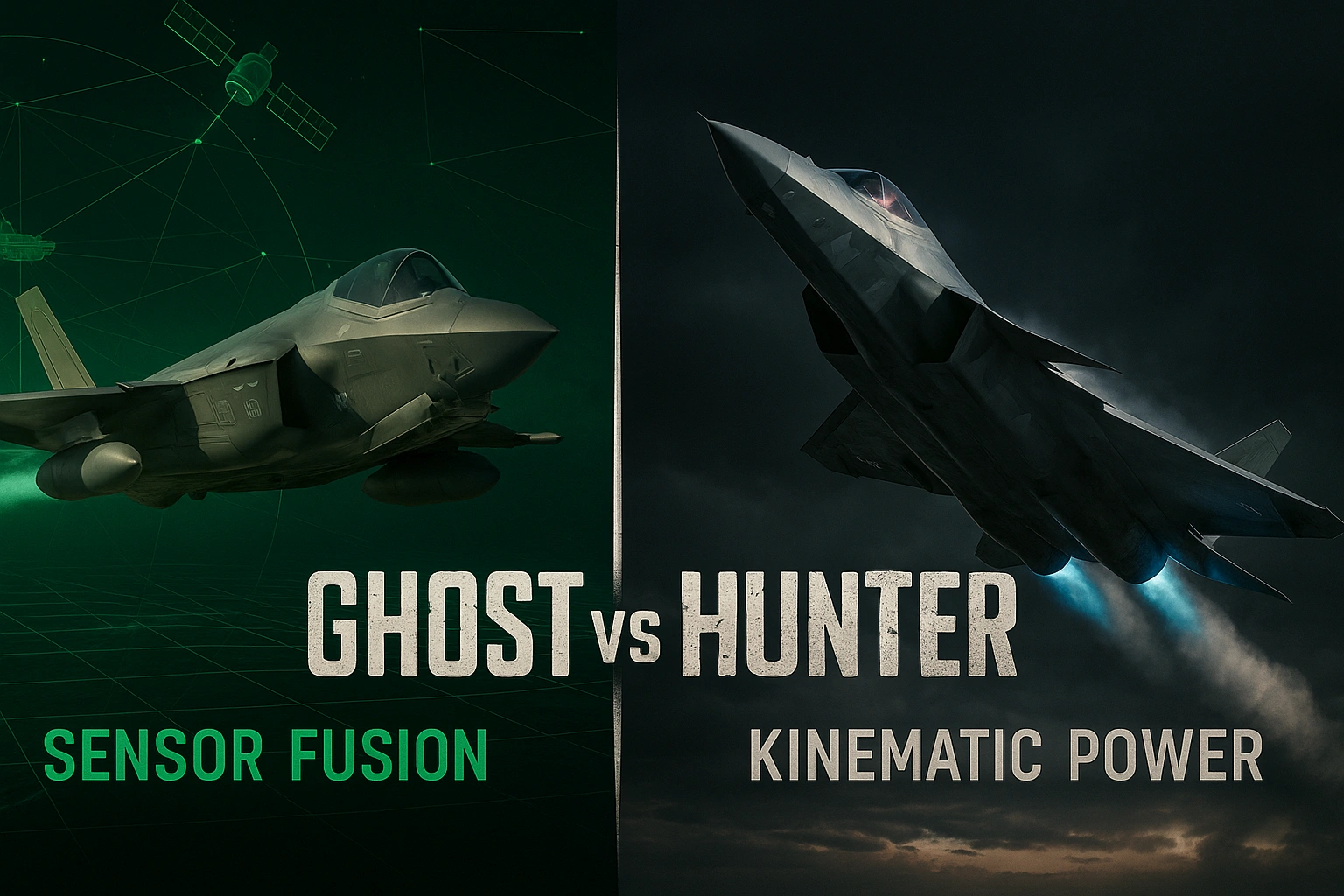
It is the classic duel of the 21st century: The American Ghost versus The Russian Hunter. This battle, often referred to as the F-35 vs Su-57, showcases the best of both aircraft.
The ongoing comparison of the F-35 vs Su-57 highlights their design philosophies and operational roles in modern warfare.
The F-35 Lightning II and the Sukhoi Su-57 Felon are often compared as equals in the “5th Generation” arena. Yet, to treat them as mirror images is a fatal mistake. They represent two starkly different approaches to the concept of air warfare, born from two opposing military doctrines. In this analysis, we will explore the F-35 vs Su-57 dynamics.
As we dive deeper into the F-35 vs Su-57 rivalry, it becomes clear that these jets are not just aircraft; they symbolize the future of aerial combat.
The F-35 was designed as an offensive penetrating strike asset for the US and NATO allies, prioritizing invisibility and sensor fusion (network-centric warfare).1
The Su-57, conversely, was developed primarily as a defensive interceptor, focusing on high speed, supreme maneuverability (via thrust vectoring), and raw kinetic power to counter threats like the F-35.
In this UltiDefense Deep Dive, we put these two superpower fighters under the microscope. Does the Russian bear have the claws to catch the American eagle, or will it be destroyed before it even sees the threat?
This article delves deep into the F-35 vs Su-57 debate, providing insights into their capabilities and performance.
The F-35 vs Su-57 debate is not merely technical; it reflects the strategic priorities of their respective nations.
Technical Specifications: Side-by-Side Comparison
Before analyzing the tactics, we must respect the physics.
| Category | Metric | Lockheed Martin F-35 (USA) | Sukhoi Su-57 Felon (Russia) |
| Philosophy | Mission Focus | Penetrating Strike & Sensor Node | Air Superiority & Interceptor |
| Engine | Configuration | Single (P&W F135) | Twin (Saturn AL-41F1 / Izdeliye 30) |
| Stealth | RCS (Est.) | Ultra Low (~0.0015 m² – Golf Ball) | Low (~0.1 – 0.5 m² – Clean Fighter) |
| Speed | Max Speed | Mach 1.6 | Mach 2.0+ (Mach 1.3 Supercruise) |
| Agility | Maneuverability | Good (High AoA) | Extreme (3D Thrust Vectoring) |
| Sensors | Radar Suite | AN/APG-81 (Sensor Fusion Focus) | N036 Byelka (5-Radar Array Strategy) |
| Range | Combat Radius | ~1,200 km (Internal Fuel) | >1,500 km (Long Range Patrol) |
| Cost | Flight Hour | High (~$35,000 – $45,000) | Moderate (~$25,000 – $30,000) |
| Production | Inventory | High (1,000+ Delivered) | Very Low (<50 Operational) |
1. The Stealth Gap: Why the F-35 is “Invisible”
In the context of the F-35 vs Su-57, stealth capabilities are paramount for survival in hostile environments.
The defining difference lies in their skin.
The F-35 Lightning II is built from the molecular level up for stealth. Its S-duct air intakes hide the engine fan blades (a major radar reflector), and its RAM (Radar Absorbent Material) coating is the most advanced in the world. On a radar screen, an F-35 looks like a metal golf ball.
The Su-57 Felon struggles here.
Western analysts have long pointed out the Su-57’s exposed engine nacelles, lack of S-ducts, and visible rivets on early production models. While it is far stealthier than a 4th-gen jet (like the Su-35), it is not in the same league as the F-35 or F-22.
The Verdict: The F-35 can operate deep inside enemy airspace. The Su-57 cannot rely on invisibility to survive against advanced SAM systems.
2. The Dogfight: Where the Su-57 Reigns Supreme
When discussing the F-35 vs Su-57 dogfighting capabilities, the advantages of agility become apparent.
If the stealth fails and the two jets meet within Visual Range (WVR), the script flips entirely.
The Su-57 features 3D Thrust Vectoring Control (TVC). Its engine nozzles can move independently in all directions. This allows the Su-57 to perform the famous “Pugachev’s Cobra” or turn flat on a dime, defying traditional aerodynamics.
The F-35 is capable—it has excellent high Angle of Attack (AoA) authority—but it is not an energy fighter. It bleeds speed in tight turns. In a prolonged 1-on-1 dogfight, the Su-57’s superior kinematics and power would likely overwhelm the F-35.
The Verdict: In a knife fight, bet on the Russian brawler.
3. The Sensor Battle: Fusion vs. Arrays
Here lies the most interesting tactical divergence.
F-35: The All-Seeing Eye
The F-35 relies on Sensor Fusion.2 Its AN/APG-81 radar, combined with the EOTS (Electro-Optical Targeting System) and DAS (360-degree cameras), creates a “God’s Eye View” for the pilot.3 The F-35 doesn’t just see a target; it identifies it, shares it with the fleet, and calculates the perfect kill shot, often without turning on its own radar (using passive sensors).
The F-35 vs Su-57 debate also revolves around the evolution of sensor technologies in combat scenarios.
Su-57: The Anti-Stealth Hunter
Russia knows it is behind in stealth, so it invested in detection. The Su-57 carries the N036 Byelka radar system, which uniquely includes L-Band radars on the wings.4
Why L-Band? L-Band radars are theoretically better at detecting stealth aircraft fighter-sized targets than the standard X-Band radars.
The Catch: While the Su-57 might “see” that something is out there with L-Band, it lacks the precision to lock a missile onto it. It knows the F-35 is present, but it can’t necessarily kill it.
4. The Production Reality: The “Paper Tiger” Problem
Understanding the production realities of the F-35 vs Su-57 gives insight into military readiness and capability.
We cannot discuss 2025 without discussing numbers.
F-35: Lockheed Martin has delivered over 1,000 units.5 They are flying in the US, UK, Israel, Japan, Norway, and beyond. It is a mature, battle-ready ecosystem.
Su-57: Due to sanctions and manufacturing hurdles, Russia has struggled to produce the Su-57 in meaningful numbers.6 Estimates suggest fewer than 40-50 operational units exist.
Strategic Impact: Even if the Su-57 were technically superior (which is debatable), it would be outnumbered 20-to-1 in any hypothetical conflict.
Conclusion: Stealth or Kinematics?
The choice between the F-35 vs Su-57 ultimately hinges on the strategic needs of the forces employing them.
The F-35 vs. Su-57 rivalry illustrates the post-Cold War divergence.
As the F-35 vs Su-57 comparison continues, emerging technologies will further shape future engagements.
The implications of the F-35 vs Su-57 rivalry extend beyond the battlefield into political and economic domains.
The F-35 is a “Network Platform.” It is designed to be part of a massive, invisible hive mind that dismantles the enemy before they even know they are at war. It delivers an invisible punch.
The Su-57 is a “Gladiator.” It is designed with the speed (Mach 2+), range, and maneuverability to intercept stealth threats and survive chaotic merges.
The Verdict:
If the F-35 pilot does their job correctly, the Su-57 will explode without ever seeing its opponent.
In summary, the ongoing F-35 vs Su-57 rivalry not only highlights technological advancements but also reflects broader military strategies.
If the Su-57 pilot manages to survive the first missile volley and drag the F-35 into a merge, the American pilot is in the fight of their life.
❓ FAQ: F-35 vs Su-57
This debate on the F-35 vs Su-57 will influence future aircraft designs and military doctrines.
Q: Can the Su-57 detect the F-35?
A: Yes, but with caveats. The Su-57’s IRST (Infrared Search and Track) can detect the heat of the F-35’s engine, and its L-Band radars can detect the presence of a stealth jet.7 However, getting a weapons-grade lock (firing solution) on an F-35 at long range remains extremely difficult.
Q: Is the Su-57 faster than the F-35?
A: Yes, significantly. The Su-57 can reach speeds over Mach 2.0 and is capable of Supercruise (supersonic flight without afterburners).8 The F-35 is limited to Mach 1.6 and relies on afterburners for supersonic speed, which burns fuel rapidly.
Q: Why does the Su-57 have exposed screws?
A: This is often cited as a manufacturing defect. Unlike the F-35, which uses advanced robotic manufacturing to ensure smooth stealth coatings, the Su-57 has shown varying build quality, with exposed rivets that can reflect radar waves, compromising its stealth.
💬 Join the Debate
The Ghost or The Hunter? In a future conflict, does superior speed beat superior stealth?
The F-35 vs Su-57 discussion remains critical in understanding modern warfare dynamics.
Sound off in the comments: Team Lightning 🇺🇸 or Team Felon 🇷🇺?