

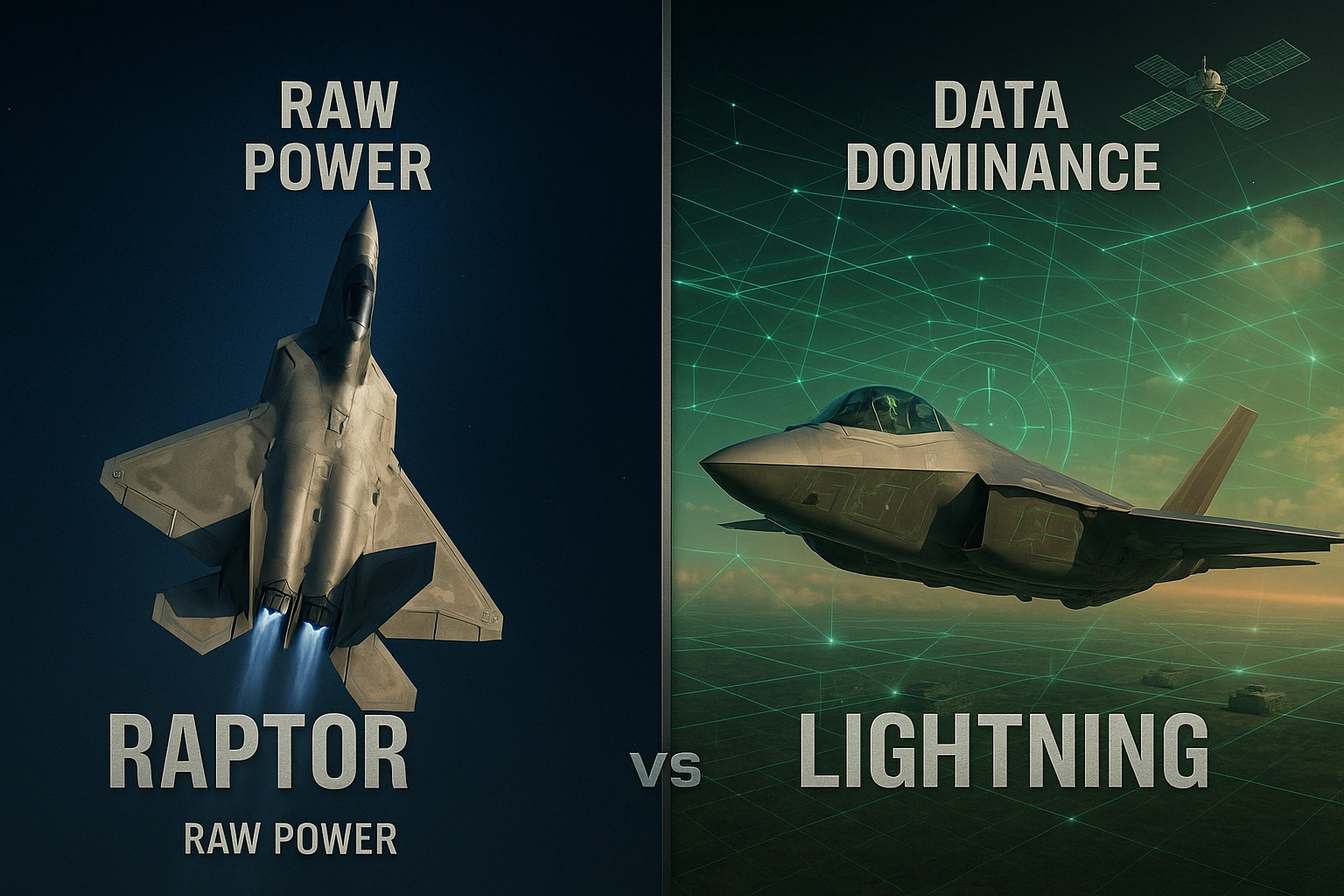
Executive Summary: The question “F-22 vs F-35: which is better?” sounds simple—but it is fundamentally flawed. The F-22 Raptor and F-35 Lightning II are not direct rivals; each is optimized for a different mission within the modern kill chain. The F-22 is designed to dominate air-to-air combat through superior kinematics and stealth, while the F-35 is built to manage the battlespace through sensor fusion, strike capability, and networked warfare.
This question reflects a common misconception that newer multi-role fighters automatically replace specialized air-dominance platforms.
The Kinetic King vs. The Digital Quarterback
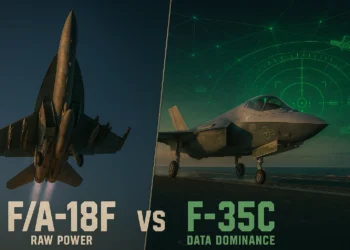
In the debate of F-22 vs F-35, numbers rarely tell the full story. One is a specialized air-superiority assassin; the other is a multi-role flying data center. To understand why the USAF needs both, we must look beyond brochure statistics and into design philosophy.
Core Thesis: The F-22 is the “Door Kicker” designed to survive Day One of a high-end war. The F-35 is the “Backbone” designed to prosecute targets and distribute data to the entire force.
Short answer: The F-22 is superior for air dominance and dogfighting, while the F-35 is superior for strike missions, sensor fusion, and networked warfare. There is no single “better” fighter—only better tools for specific missions.
1. Technical Specifications: Head-to-Head
The F-22 prioritizes speed and altitude to maximize missile range. The F-35 prioritizes fuel load and internal sensors.
| Feature | F-22 Raptor (Air Dominance) 🦅 | F-35 Lightning II (Multi-Role) ⚡ |
|---|---|---|
| Primary Role | Air Superiority / Dominance | Strike / Sensor Fusion / Command |
| Radar | AN/APG-77 (Air-to-Air Optimized) | AN/APG-81 (Air/Ground Balanced) |
| Max Speed | Mach 2.25 (High Altitude) | Mach 1.6 (Dash) |
| Supercruise | Yes (> Mach 1.5 sustained) | No |
| Thrust Vectoring | 2D Vectoring (Pitch Axis) | None |
| Data Link | IFDL (Low Probability of Detection) | MADL (High Bandwidth) |
| Stealth Focus | All-Aspect / Wideband | Frontal Optimization / Maintainability |
| Unit Cost | Program Ended (~$140M+) | ~$82.5M (F-35A flyaway cost) |
2. The Kinetic Advantage: Why the F-22 Owns the Dogfight
If combat collapses into a visual-range engagement (WVR), the F-22 is unrivaled. Its design follows Energy-Maneuverability Theory.
Thrust Vectoring & Altitude
The F-22 features 2D thrust-vectoring nozzles capable of ±20° movement. Combined with its very high operating altitude (official USAF fact sheets state “above 50,000 ft”), this allows missiles like the AIM-120D to be launched with significantly higher kinetic energy than those fired from lower altitudes.
Supercruise
The Raptor can sustain Mach 1.5+ without afterburners, allowing it to:
- Close distance rapidly.
- Disengage faster than opponents can pursue.
- Reduce infrared signature by avoiding afterburner plume.
3. The Digital Advantage: Why the F-35 Shapes the War
The F-35 was built around situational awareness. It is best described as a sensor node that happens to carry weapons.
Sensor Fusion
The F-35 fuses data from the AN/APG-81 radar, EOTS, and DAS into a single real-time picture projected directly onto the pilot’s helmet—reducing workload and accelerating kill-chain decisions.
The Silent Communication Gap
The F-22 and F-35 do not share a common native, stealth-optimized data link.
- F-22: Uses IFDL (designed in the 90s for extreme stealth).
- F-35: Uses MADL (modern high-bandwidth sensor-fusion network).
As a result, low-observable data exchange typically requires a gateway or translation node. This reflects the different technological eras in which the two aircraft were conceived.
Real-World Combat: Theory vs. Reality
Technical specs are theoretical until tested in combat. Both aircraft have proven their worth in distinct theaters.
F-22: The Silent Deterrent
The F-22 made its combat debut in Syria (2014), not in a dogfight, but using its advanced sensors to map the battlefield for non-stealthy allies. More recently, USAF F-22s deployed to the Pacific and Middle East have served as a “strategic deterrent,” discouraging adversaries from engaging simply by being present.
F-35: The First Kill
The Israeli Air Force (IAF) became the first to use the F-35 “Adir” in combat, confirming operational strikes in the Middle East as early as 2018. The platform proved it could penetrate sophisticated Russian-made air defense systems (like the S-300/S-400) that would threaten older jets.
4. Stealth Reality: Maintenance vs Performance
- F-22: Extremely effective but maintenance-intensive low-observable coatings.
- F-35: Designed with more durable, field-sustainable stealth materials for prolonged operations.
5. Why You Can’t Buy the F-22 (The Obey Amendment)
In FY1998, Congress adopted the Obey Amendment, restricting the use of appropriated funds to approve or license the export of the F-22 Raptor.
2025 Status: Block 4 & The Sunset of the Raptor
As of late 2024/2025, the landscape is shifting:
- F-35 Block 4 / TR-3: The F-35 is currently undergoing its most critical update—Technology Refresh 3 (TR-3). This hardware upgrade unlocks “Block 4” capabilities, including advanced electronic warfare suites, new weapons integration (like the Meteor missile), and vastly improved processing power.
- F-22’s Final Chapter: While the USAF plans to eventually replace the F-22 with the Next Generation Air Dominance (NGAD) platform, the Raptor is receiving mid-life updates (including new external fuel tanks and sensor pods) to maintain superiority until the 2030s.
Can the F-35 Replace the F-22?
Short answer: No—at least not entirely.
The F-35 was never designed to replace the F-22 on a one-for-one basis. The Raptor occupies a unique niche as a pure air-dominance platform, optimized for high-altitude interception, supercruise, and kinetic air-to-air combat. These characteristics cannot be replicated by a multi-role aircraft without significant trade-offs.
However, within the context of a modern, networked kill chain, the F-35 can partially assume some of the F-22’s roles. By detecting threats first, sharing targeting data across the force, and enabling long-range missile engagements, the F-35 reduces the frequency with which traditional dogfights even occur.
Bottom line: The F-35 does not replace the F-22—it changes the conditions under which the F-22 is needed.
6. Bottom Line: The Hammer and the Scalpel
- F-22: The Hammer — clears the skies.
- F-35: The Scalpel — finds, fuses, and guides the kill.
In modern warfare, you don’t choose one. You send the F-22 to kick down the door—and the F-35 to run the war inside.