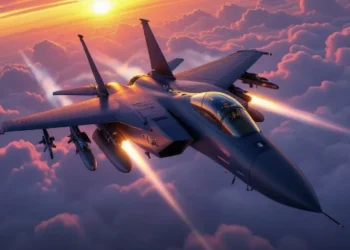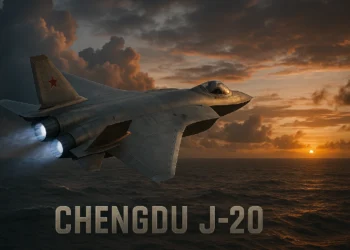


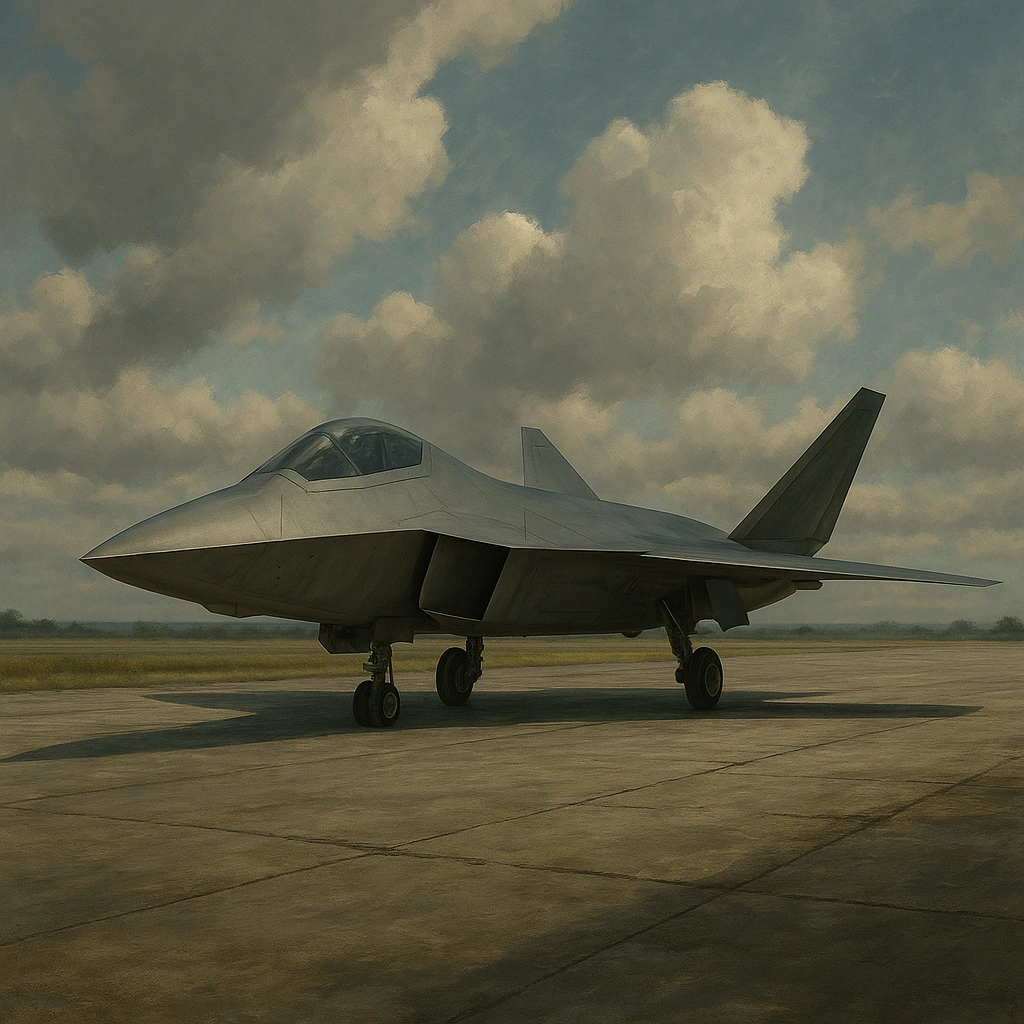
The F-22 Raptor remains the most dominant air-superiority fighter ever built, but its roots lie in late 1980s technology. Against rising near-peer competitors—especially China’s PLAAF—the U.S. Air Force acknowledges that simply upgrading the Raptor is no longer enough.
That’s why the USAF launched the Next Generation Air Dominance (NGAD) Program, described by the Department of Defense as a:
“Family of Systems designed to ensure air superiority in the 2030s and beyond.”
NGAD is not just a fighter. It is an ecosystem. At the center is the 6th Generation manned jet, surrounded by autonomous drones, advanced sensors, quantum-secure networks, and directed-energy weapons.
What Does “6th Generation” Actually Mean?
Unlike the leap from 4th to 5th gen, 6th generation aviation is not defined by stealth alone. It represents an integration of revolutionary technologies:
- Multi-spectrum stealth (Beyond just radar evasion)
- Artificial intelligence (AI) copilots
- Directed-energy weapons (Lasers/Microwaves)
- Autonomous loyal wingmen
- Self-healing structures
- Quantum-resistant communications
These are not futuristic fantasies—many are already under development through U.S. Air Force and DARPA programs.
1. Multi-Spectral Stealth: The Next Advantage
The NGAD fighter is expected to be stealthy not just in X-band radar like the F-22/F-35, but across the entire spectrum: L-band, VHF/UHF radar, Infrared (IR) emissions, and passive RF tracking.
This requires advanced meta-material structures and plasma-suppression designs currently explored by DARPA.
2. AI Pilot Assistance: A Second Brain
NGAD will incorporate AI-driven battle management—a direct result of DARPA’s Air Combat Evolution (ACE) program. The AI will:
- Predict enemy maneuvers in real-time.
- Manage sensor fusion across dozens of inputs.
- Conduct defensive maneuvers autonomously if the pilot is overwhelmed.
This turns the pilot into a mission commander, not just an aircraft operator.
3. Directed-Energy Weapons (Lasers)
The U.S. Air Force Research Laboratory (AFRL) is testing airborne lasers in the 100–300 kW range. NGAD is expected to deploy laser-based missile-defense turrets and High-Power Microwave (HPM) systems to fry enemy drone electronics.
This could allow NGAD to burn incoming missiles mid-flight—something no U.S. fighter has ever done. (Source: AFRL)
4. Quantum Technology: The Hidden Backbone
China is heavily investing in quantum radar. NGAD is America’s answer. The platform will likely utilize:
- Quantum-Resistant Communication: Using Quantum Key Distribution (QKD) for unbreakable data links.
- Quantum Navigation: Ensuring the jet remains navigationally accurate even if GPS is jammed or destroyed.
- Quantum Noise Generation: To confuse next-gen enemy radar systems.
5. Collaborative Combat Aircraft (CCA)
This is one of the most transformative elements of the NGAD Program. The fighter will fly with 3–5 autonomous AI-powered drones, each capable of electronic warfare, reconnaissance, or even kamikaze strikes.
Related Analysis:
These drones function similarly to loitering munitions. To understand how these systems work, read our detailed report:
👉 What Are Loitering Munitions? The Rise of Kamikaze Drones
Why Will NGAD Cost Hundreds of Millions?
Early USAF projections indicate a staggering $300–$450 million per aircraft. Why is the price tag so high?
- Laser Integration: Extremely expensive to power and cool within a stealth airframe.
- Self-Healing Composites: Advanced materials that repair micro-cracks are far beyond today’s RAM coatings.
- Supercomputing: NGAD will likely operate with massive onboard computing power (1,000+ TOPS).
- The Wingmen: Each CCA drone costs an estimated $15–25 million.
When Is NGAD Coming? (Timeline)
According to official Air Force statements and GAO reporting:
- 2024–2025: Advanced Prototyping phase.
- 2026–2027: Classified flight testing.
- 2030–2032: Initial Operational Capability (IOC).
The USAF has confirmed that at least one full-scale flight demonstrator has already flown, mirroring the secretive origins of the F-117 and B-2.
Conclusion: A New Era of Air Dominance
The NGAD Program transforms U.S. airpower in revolutionary ways. It moves away from the concept of a single “dogfighter” jet to a System-of-Systems approach where AI, lasers, and quantum computing converge.
NGAD is not merely the replacement for the F-22 Raptor—it is the reinvention of air superiority for the next 50 years.