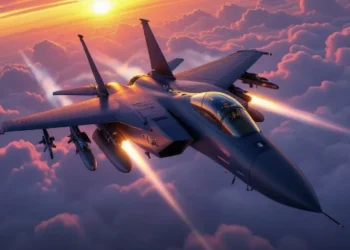


The F-22 Raptor is not just a fighter jet; it is the apex predator of modern aviation. As the world’s first fifth-generation fighter, it set the standard for air dominance. However, in late 2025, the narrative has shifted from “unmatched dominance” to a race against time, evolving threats like China’s J-20, and the impending transition to the Next Generation Air Dominance (NGAD) system.
From the skies over Syria to the historic Operation Midnight Hammer in 2025, this analysis covers the combat record, the massive “Super Raptor” upgrade package, and the harsh reality of its production numbers.
Table of Contents
1. Combat Legacy: From Syria to Operation Midnight Hammer (2014-2025)
For years, critics claimed the F-22 was a “hangar queen” that never saw real war. The last decade has shattered that myth.
Operation Midnight Hammer (June 2025)
In June 2025, the F-22 Raptor solidified its legend during Operation Midnight Hammer. In a massive strike package of 125 aircraft targeting advanced threats in the Middle East (Iran), F-22s served as the “invisible shield.”
- Role: Raptors penetrated deep into contested airspace, using their sensors to identify and jam enemy radars, effectively clearing a safe corridor for B-2 Spirit bombers.
- Performance: Zero losses were recorded. The operation demonstrated the F-22’s ability to act as a “quarterback,” directing 4th-gen fighters and suppressing S-300/S-400 batteries.
Record-Breaking Kill (2024)
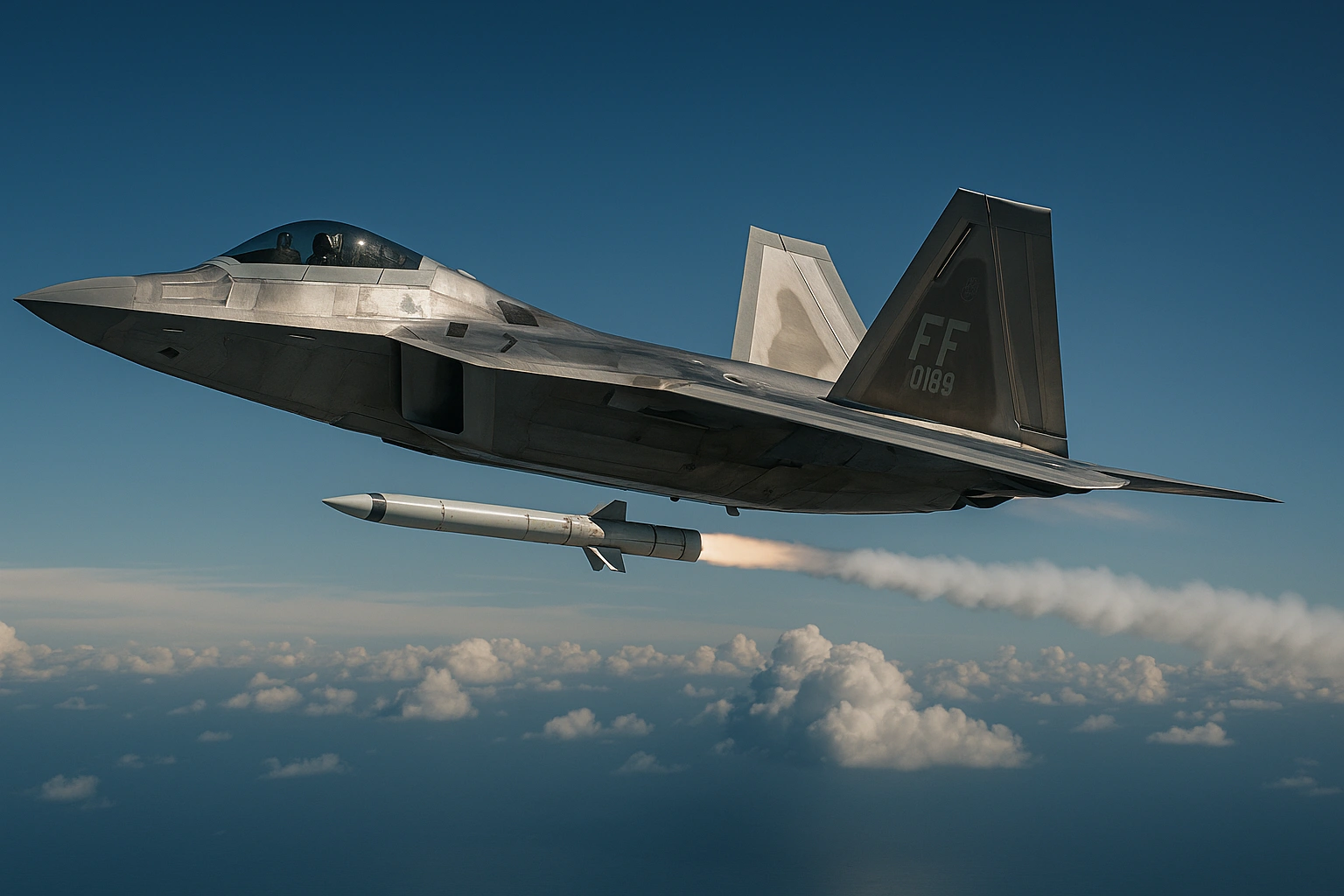
In late 2024, an F-22 successfully intercepted a target using an AIM-120D AMRAAM at extreme range, surpassing the previous record held by an F-15C. This validated the Raptor’s ability to engage threats long before they even know they are being tracked.
2. The 2025 “Super Raptor” Upgrade Package
To maintain dominance until the 2030s, the USAF initiated a massive modernization effort in the FY26 budget ($90.34 million for viability upgrades).
New Sensors & Stealth
- IRDS ($270 Million): In January 2025, Lockheed Martin was awarded a contract to integrate the Infrared Defensive System (IRDS), replacing legacy sensors to detect heat signatures of stealthy adversaries.
- IRST Pods: 30 specialized Infrared Search and Track (IRST) pods were ordered in 2025, with deliveries expected by mid-2028. These allow the F-22 to track enemy stealth jets without turning on its own radar.
- Multi-Spectral Coating: A new mirror-like coating, spotted at Edwards AFB, is being applied to reduce visibility against infrared and optical sensors.
Weapons & Range
- AIM-260 JATM: Integration is underway for the AIM-260 Joint Advanced Tactical Missile, designed to out-range China’s PL-15.
- Stealth Fuel Tanks: New “low-drag” external tanks and pylons are being fielded to extend the Raptor’s range without significantly compromising its stealth profile.
3. F-22 vs J-20 Mighty Dragon: Quality vs Quantity
The most searched defense topic of 2025 remains the F-22 vs J-20 comparison. While the F-22 remains the superior individual fighter, the strategic balance is shifting.
| Feature | F-22 Raptor (USA) | J-20 Mighty Dragon (China) |
|---|---|---|
| Fleet Size (2025) | ~185 (Fixed) | 270 – 800 (Rapidly Growing) |
| Stealth (RCS) | Superior (All-Aspect) | Strong Frontal, Weaker Side/Rear |
| Kinematics | TVC + Supercruise (Mach 1.8) | Fast, but less agile (Interceptor role) |
| Main Threat | Readiness Rates | Massive Numbers & PL-15 Missile |
The Verdict: In a 1-on-1 dogfight, the F-22’s thrust vectoring and superior stealth guarantee a win. However, China’s ability to field three J-20s for every single F-22 creates a dangerous “numbers game” that quality alone may not solve.
4. The NGAD Transition: Enter the F-47
The reign of the Raptor has an expiration date. In March 2025, the USAF officially selected Boeing as the prime contractor for the NGAD fighter, designated the F-47.
- The Plan: The USAF intends to replace the F-22 fleet on a one-for-one basis with 185+ F-47s starting in the early 2030s.
- Budget: The 2026 budget allocated $3.5 billion to accelerate F-47 development.
- Capabilities: The F-47 promises 1,000+ nm combat range (solving the Pacific distance problem) and native control of autonomous drone wingmen (CCA).
5. Program Reality: Costs & Readiness Crisis
Despite its prowess, the F-22 fleet is fragile.
- Readiness Crisis: In 2024, the Mission Capable Rate dropped to roughly 40%, meaning less than half the fleet was combat-ready at any given moment due to lack of spare parts and stealth coating maintenance.
- The Block 20 Debate: The USAF has repeatedly tried to retire 32 older “Block 20” training aircraft to save money. However, Congress blocked this in the FY25 and FY26 acts, demanding they be upgraded to combat standards—a costly endeavor Lockheed Martin is currently analyzing.
- Production Cap: Total production was capped at 195 aircraft (187 operational + 8 test) when the line closed in 2011, a decision now viewed by many as a strategic error.
6. Technical Specifications & Variants
The “Four S’s” of Dominance: Stealth, Supercruise, Super-Maneuverability, and Sensor Fusion.
- Crew: 1
- Engines: 2 × Pratt & Whitney F119-PW-100 (35,000 lbf thrust each) with 2D Thrust Vectoring
- Max Speed: Mach 2.25 (Supercruise: Mach 1.82)
- Service Ceiling: 65,000 ft
- Combat Radius: ~460 nm (Internal Fuel)
Weapons Capacity (Internal)
- Air-to-Air: 6 × AIM-120C/D AMRAAM + 2 × AIM-9M/X Sidewinder
- Gun: 1 × 20mm M61A2 Vulcan (480 rounds)
7. FAQ – Export Bans & More
Why can’t the F-22 be exported?
The Obey Amendment, passed by Congress in 1998, specifically bans the export of the F-22 Raptor to protect its stealth technology and source codes. Even close allies like Israel and Japan were denied purchase.
How many F-22s were built?
A total of 195 aircraft were built: 8 test airframes and 187 operational fighters. The production line was shut down in 2011.
Has the F-22 been used in combat?
Yes. Its combat debut was in Syria (2014) against ISIS targets. More recently, it played a pivotal role in Operation Midnight Hammer (2025) against Iranian integrated air defenses.
Can the F-22 still dogfight?
Absolutely. Thanks to its thrust-vectoring nozzles (which move ±20 degrees), it possesses “super-maneuverability,” allowing it to perform high-G turns and post-stall maneuvers that would stall other jets.
What is the difference between Block 20 and Block 35?
Block 20 Raptors are early-production jets largely used for training and lack full combat coding / advanced weapons integration. Block 30/35 are the fully combat-capable frontline fighters flying today.
(Read more about the future of air warfare in our analysis of the Boeing F-47 NGAD Program.)