
• Login
UltiDefense: Military Tech Comparisons & Modern Warfare Analysis
  • Defense Systems
    • Air Platforms
      • Fighter Jets
      • Drones
      • Attack Helicopters
      • Strategic Bombers
    • Land Systems
      • Main Battle Tanks
      • Artillery & Firepower
      • Infantry Fighting Vehicles
      • Military Logistics and Support Vehicles
      • Soldier Systems & Robotics: UGV, Exoskeleton, and Modern Infantry Integration
    • Integrated Defense Systems
      • Ballistic Missile Defense
      • Air Defense Systems
    • Missiles & Munitions
      • Air-to-Air & Anti-Ship Missiles
      • Cruise Missiles
      • Strategic & Hypersonic Weapons
    • Naval
      • Aircraft Carriers
      • Submarines
      • Surface Combatants
      • Unmanned Maritime Systems
    • Future Tech & Innovations
      • Sensors and Avionics
  • Comparisons
  • Space Warfare
    • Counter-Space & ASAT
    • Spaceplanes & Launch Vehicles
    • Military Satellites & ISR
  • Defense News
  • Military Life
  • Policy, Budget and Geopolitics
  • Cyber Security & Electronic Warfare
No Result
View All Result
Defense News
No Result
View All Result

Home - Comparisons - F-22 vs. F-35: Why “Which Is Better?” Is the Wrong Question

F-22 vs. F-35: Why “Which Is Better?” Is the Wrong Question

George Schouten by George Schouten
December 16, 2025
in Comparisons
0
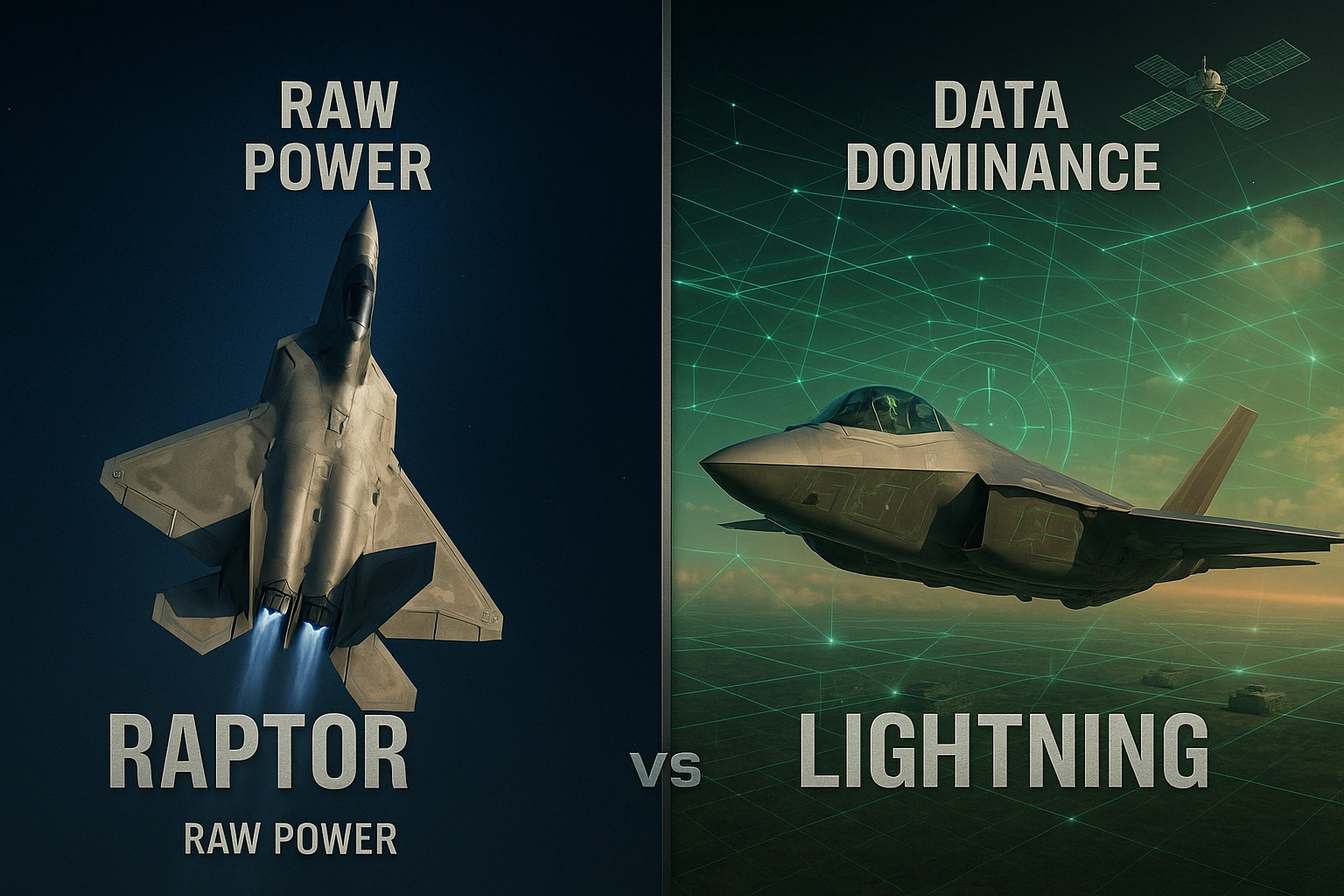
F-22 Raptor thrust vectoring vs F-35 Lightning II sensor fusion capabilities comparison

The Kinetic King vs. The Digital Quarterback: F-22 Raptor (Left) and F-35 Lightning II (Right).

171
SHARES
2.1k
VIEWS
Share on Twitter

Executive Summary: The question “F-22 vs F-35: which is better?” sounds simple—but it is fundamentally flawed. The F-22 Raptor and F-35 Lightning II are not direct rivals; each is optimized for a different mission within the modern kill chain. The F-22 is designed to dominate air-to-air combat through superior kinematics and stealth, while the F-35 is built to manage the battlespace through sensor fusion, strike capability, and networked warfare.

This question reflects a common misconception that newer multi-role fighters automatically replace specialized air-dominance platforms.

READ ALSO

LCA Tejas Mk-1A: India’s Indigenous 4.5-Gen Fighter & the JF-17 Rival

USS Gerald R. Ford vs. Type 003 Fujian: The Supercarrier Showdown (2025 Analysis)


The Kinetic King vs. The Digital Quarterback

In the debate of F-22 vs F-35, numbers rarely tell the full story. One is a specialized air-superiority assassin; the other is a multi-role flying data center. To understand why the USAF needs both, we must look beyond brochure statistics and into design philosophy.

Core Thesis: The F-22 is the “Door Kicker” designed to survive Day One of a high-end war. The F-35 is the “Backbone” designed to prosecute targets and distribute data to the entire force.

Short answer: The F-22 is superior for air dominance and dogfighting, while the F-35 is superior for strike missions, sensor fusion, and networked warfare. There is no single “better” fighter—only better tools for specific missions.


1. Technical Specifications: Head-to-Head

The F-22 prioritizes speed and altitude to maximize missile range. The F-35 prioritizes fuel load and internal sensors.

FeatureF-22 Raptor (Air Dominance) 🦅F-35 Lightning II (Multi-Role) ⚡
Primary RoleAir Superiority / DominanceStrike / Sensor Fusion / Command
RadarAN/APG-77 (Air-to-Air Optimized)AN/APG-81 (Air/Ground Balanced)
Max SpeedMach 2.25 (High Altitude)Mach 1.6 (Dash)
SupercruiseYes (> Mach 1.5 sustained)No
Thrust Vectoring2D Vectoring (Pitch Axis)None
Data LinkIFDL (Low Probability of Detection)MADL (High Bandwidth)
Stealth FocusAll-Aspect / WidebandFrontal Optimization / Maintainability
Unit CostProgram Ended (~$140M+)~$82.5M (F-35A flyaway cost)

2. The Kinetic Advantage: Why the F-22 Owns the Dogfight

If combat collapses into a visual-range engagement (WVR), the F-22 is unrivaled. Its design follows Energy-Maneuverability Theory.

Thrust Vectoring & Altitude

The F-22 features 2D thrust-vectoring nozzles capable of ±20° movement. Combined with its very high operating altitude (official USAF fact sheets state “above 50,000 ft”), this allows missiles like the AIM-120D to be launched with significantly higher kinetic energy than those fired from lower altitudes.

Supercruise

The Raptor can sustain Mach 1.5+ without afterburners, allowing it to:

  • Close distance rapidly.
  • Disengage faster than opponents can pursue.
  • Reduce infrared signature by avoiding afterburner plume.

3. The Digital Advantage: Why the F-35 Shapes the War

The F-35 was built around situational awareness. It is best described as a sensor node that happens to carry weapons.

Sensor Fusion

The F-35 fuses data from the AN/APG-81 radar, EOTS, and DAS into a single real-time picture projected directly onto the pilot’s helmet—reducing workload and accelerating kill-chain decisions.

The Silent Communication Gap

The F-22 and F-35 do not share a common native, stealth-optimized data link.

  • F-22: Uses IFDL (designed in the 90s for extreme stealth).
  • F-35: Uses MADL (modern high-bandwidth sensor-fusion network).

As a result, low-observable data exchange typically requires a gateway or translation node. This reflects the different technological eras in which the two aircraft were conceived.


Real-World Combat: Theory vs. Reality

Technical specs are theoretical until tested in combat. Both aircraft have proven their worth in distinct theaters.

F-22: The Silent Deterrent

The F-22 made its combat debut in Syria (2014), not in a dogfight, but using its advanced sensors to map the battlefield for non-stealthy allies. More recently, USAF F-22s deployed to the Pacific and Middle East have served as a “strategic deterrent,” discouraging adversaries from engaging simply by being present.

F-35: The First Kill

The Israeli Air Force (IAF) became the first to use the F-35 “Adir” in combat, confirming operational strikes in the Middle East as early as 2018. The platform proved it could penetrate sophisticated Russian-made air defense systems (like the S-300/S-400) that would threaten older jets.

4. Stealth Reality: Maintenance vs Performance

  • F-22: Extremely effective but maintenance-intensive low-observable coatings.
  • F-35: Designed with more durable, field-sustainable stealth materials for prolonged operations.

5. Why You Can’t Buy the F-22 (The Obey Amendment)

In FY1998, Congress adopted the Obey Amendment, restricting the use of appropriated funds to approve or license the export of the F-22 Raptor.


2025 Status: Block 4 & The Sunset of the Raptor

As of late 2024/2025, the landscape is shifting:

  • F-35 Block 4 / TR-3: The F-35 is currently undergoing its most critical update—Technology Refresh 3 (TR-3). This hardware upgrade unlocks “Block 4” capabilities, including advanced electronic warfare suites, new weapons integration (like the Meteor missile), and vastly improved processing power.
  • F-22’s Final Chapter: While the USAF plans to eventually replace the F-22 with the Next Generation Air Dominance (NGAD) platform, the Raptor is receiving mid-life updates (including new external fuel tanks and sensor pods) to maintain superiority until the 2030s.

Can the F-35 Replace the F-22?

Short answer: No—at least not entirely.

The F-35 was never designed to replace the F-22 on a one-for-one basis. The Raptor occupies a unique niche as a pure air-dominance platform, optimized for high-altitude interception, supercruise, and kinetic air-to-air combat. These characteristics cannot be replicated by a multi-role aircraft without significant trade-offs.

However, within the context of a modern, networked kill chain, the F-35 can partially assume some of the F-22’s roles. By detecting threats first, sharing targeting data across the force, and enabling long-range missile engagements, the F-35 reduces the frequency with which traditional dogfights even occur.

Bottom line: The F-35 does not replace the F-22—it changes the conditions under which the F-22 is needed.


6. Bottom Line: The Hammer and the Scalpel

  • F-22: The Hammer — clears the skies.
  • F-35: The Scalpel — finds, fuses, and guides the kill.

In modern warfare, you don’t choose one. You send the F-22 to kick down the door—and the F-35 to run the war inside.
Which aircraft would win in a dogfight?

In a visual-range engagement (WVR), the F-22 Raptor has the clear advantage due to its 2D thrust vectoring and superior thrust-to-weight ratio.

Is the F-35 stealthier than the F-22?

Generally, the F-22 is considered to have a smaller all-aspect Radar Cross Section (RCS). However, the F-35 possesses superior stealth technology in terms of maintenance durability and infrared signature suppression.

Can the F-35 supercruise?

No. The F-35 can reach Mach 1.6 for short “dash” periods using afterburners, but it cannot sustain supersonic flight without afterburners like the F-22 can.

Why did the US stop building the F-22?

Production ended in 2011 due to high costs, the lack of a peer air-to-air rival at the time, and the focus on the multi-role F-35 program.

Why is the F-22 not exported?

The export of the F-22 is restricted by the Obey Amendment to protect its classified stealth technologies.
Tags: 5th Generation FighterAir SuperioritybestDefense TechnologyLockheed MartinMilitary AviationMulti-Role FighterpopularStealth AircraftUS Air ForceUSAF

Related Posts

Indian Air Force LCA Tejas Mk-1A fighter jet soaring over the Himalayas, armed with indigenous Astra BVR missiles and equipped with an AESA radar nose cone.
Comparisons

LCA Tejas Mk-1A: India’s Indigenous 4.5-Gen Fighter & the JF-17 Rival

December 14, 2025
Split-screen illustration comparing the USS Gerald R. Ford (left) and China's Type 003 Fujian (right) aircraft carriers at sea.
Aircraft Carriers

USS Gerald R. Ford vs. Type 003 Fujian: The Supercarrier Showdown (2025 Analysis)

December 11, 2025
F/A-18F Super Hornet launching from carrier deck vs F-35C Lightning II waiting
Comparisons

F/A-18F Super Hornet vs. F-35C Lightning II: The Workhorse vs. The Future

December 9, 2025
Infographic comparing US Navy Virginia-class and Russian Yasen-M submarines. Highlights Virginia's pump-jet propulsor, acoustic stealth, and Tomahawk range (1,600 km) versus Yasen-M's larger size, Tsirkon hypersonic missiles, Kalibr, and Oniks loadout.
Comparisons

Virginia Class vs. Yasen-M

December 11, 2025
Zumwalt vs Type 055: Diverging Doctrines in 21st Century Naval Architecture
Comparisons

Zumwalt vs Type 055: Diverging Doctrines in 21st Century Naval Architecture

December 12, 2025
Patriot vs. S-400 vs. THAAD: A Technical Comparison of Ballistic Missile Defense Capabilities
Comparisons

Patriot vs. S-400 vs. THAAD: A Technical Comparison of Ballistic Missile Defense Capabilities

December 21, 2025
Next Post
A US Air Force F-22 Raptor stealth fighter jet flying at supersonic speed, showcasing its metallic stealth coating.

F 22 Raptor

Leave a Reply Cancel reply

Your email address will not be published. Required fields are marked *

About

Ultidefense is a digital platform focused on modern defense, military technology, and strategic innovation.
We explore how advancements in aerospace, AI, cybersecurity, and autonomous systems are transforming the global defense landscape.
Our mission is to connect technical insight with strategic awareness, helping readers understand the technologies shaping modern security and warfare.
At Ultidefense, we believe knowledge is strength — and our goal is to deliver clear, factual, and forward-looking analysis on the systems, science, and strategies defining the future of defense.

Categories

  • Comparisons
  • Cyber Security & Electronic Warfare
  • Defense News
  • Defense Systems
    • Air Platforms
      • Attack Helicopters
      • Fighter Jets
      • Global Military Drones: UAV Systems, Autonomy, and Unmanned Warfare
      • Strategic Bombers
    • Future Tech & Innovations
      • Sensors and Avionics
    • Land Systems
      • Artillery & Firepower: Self-Propelled Guns, Rocket Systems, and Barrage Analysis
      • Main Battle Tanks: Armor, Firepower, and Modern MBT Comparisons
    • Missiles & Munitions
      • Strategic & Hypersonic Weapons
    • Space Warfare
      • Military Satellites & ISR
      • Spaceplanes & Launch Vehicles
  • Integrated Defense Systems
    • Air Defense Systems
  • Military Life
  • Naval Systems: Warships, Carriers, and Maritime Defense Technology
    • Aircraft Carriers
    • Submarines
  • Policy, Budget and Geopolitics
  • Unmanned Maritime Systems

Recent Posts

  • Which Military Boot Camp is the Hardest? All 6 US Branches Ranked
  • The SFAS Fallout: What Happens After You Fail Special Forces Selection
  • The Algorithm of War:The Anatomy of Conflict in 2050
  • Russia’s Avangard HGV: Breaking the Shield of Global Missile Defense

Newsletter

Pages

  • About Us
  • Home
  • Contact Us
  • Privacy Policies
  • Terms of Service
  • Disclaimer

© 2025 Defense Systems

Welcome Back!

Login to your account below

Forgotten Password?

Retrieve your password

Please enter your username or email address to reset your password.

Log In
No Result
View All Result
  • Defense Systems
    • Air Platforms
      • Fighter Jets
      • Drones
      • Attack Helicopters
      • Strategic Bombers
    • Land Systems
      • Main Battle Tanks
      • Artillery & Firepower
      • Infantry Fighting Vehicles
      • Military Logistics and Support Vehicles
      • Soldier Systems & Robotics: UGV, Exoskeleton, and Modern Infantry Integration
    • Integrated Defense Systems
      • Ballistic Missile Defense
      • Air Defense Systems
    • Missiles & Munitions
      • Air-to-Air & Anti-Ship Missiles
      • Cruise Missiles
      • Strategic & Hypersonic Weapons
    • Naval
      • Aircraft Carriers
      • Submarines
      • Surface Combatants
      • Unmanned Maritime Systems
    • Future Tech & Innovations
      • Sensors and Avionics
  • Comparisons
  • Space Warfare
    • Counter-Space & ASAT
    • Spaceplanes & Launch Vehicles
    • Military Satellites & ISR
  • Defense News
  • Military Life
  • Policy, Budget and Geopolitics
  • Cyber Security & Electronic Warfare

© 2025 Defense Systems