

Introduction
Modern naval warfare no longer revolves around guns or even radar—it revolves around the silent steel cells buried deep inside a ship’s deck. Vertical Launch Systems (VLS) have become the true currency of firepower, defining how far a navy can strike and how long a fleet can survive in combat.
Vertical Launch Systems (VLS), which replaced conventional gun-based artillery in naval air defense and strike warfare, have revolutionized the firepower of modern destroyers and cruisers. This article compares the globally prevalent Mk 41 VLS with the innovative Mk 57 Peripheral Vertical Launch System (PVLS) found on the U.S. Zumwalt-class destroyers.
The analysis focuses on their design philosophies, technical specifications, survivability under battle damage, and suitability for next-generation weapons such as hypersonic cruise missiles.
Methodology
This comparison is based on a rigorous review of defense industry technical reports, academic publications, and current defense sector news. Quantitative and qualitative analyses were performed on the cell measurements, placement arrangement, damage isolation, and missile launch methods of the Mk 41 and Mk 57 systems.
Mk 41 VLS: Evolution and the Global Standard
Developed in the 1980s, the Mk 41 stands out for its modular structure, widespread use across multiple ship classes (from Arleigh Burke to Aegis Ashore), and inherent flexibility. It has become the de facto global standard for Western-style surface combatants.
- Advantages: Global standardization, compatibility with a wide range of missiles (SM-2/3/6, ESSM, Tomahawk), relatively lower installation and integration costs, and proven reliability in combat and peacetime operations.
- Limitations: Due to its central and compact placement below the main deck, damage survivability is limited against direct hits. A major explosion inside a central VLS block can be catastrophic for the ship’s structure and crew.
- Launch Method: Hot-launch concept with shared exhaust management, which simplifies integration but increases the risk of sympathetic detonation if venting fails.
Mk 57 PVLS: Next-Generation Survivability
Specifically developed for the Zumwalt class (DDG-1000), the Mk 57 PVLS was designed from the ground up around survivability and growth potential for future large-volume weapons.
- Advantages: Superior damage isolation (survivability). Each cell module is located along the ship’s outer edges (periphery). If a missile explodes in the tube, the blast force is directed outward, away from the ship’s vital spaces, dramatically improving crew and platform survivability.
- Capacity: A larger cell diameter and slightly greater depth compared to Mk 41, enabling integration of heavier and bulkier future munitions, including larger-diameter surface-to-air or land-attack missiles.
- Drawbacks: Higher unit cost, structural complexity, and the fact that it is currently limited to the Zumwalt class, which restricts economies of scale and worldwide adoption.
- Design Philosophy: Decentralized, compartmentalized launchers integrated into the ship’s tumblehome hull, contributing to both stealth and damage control.
Technical Comparison Table
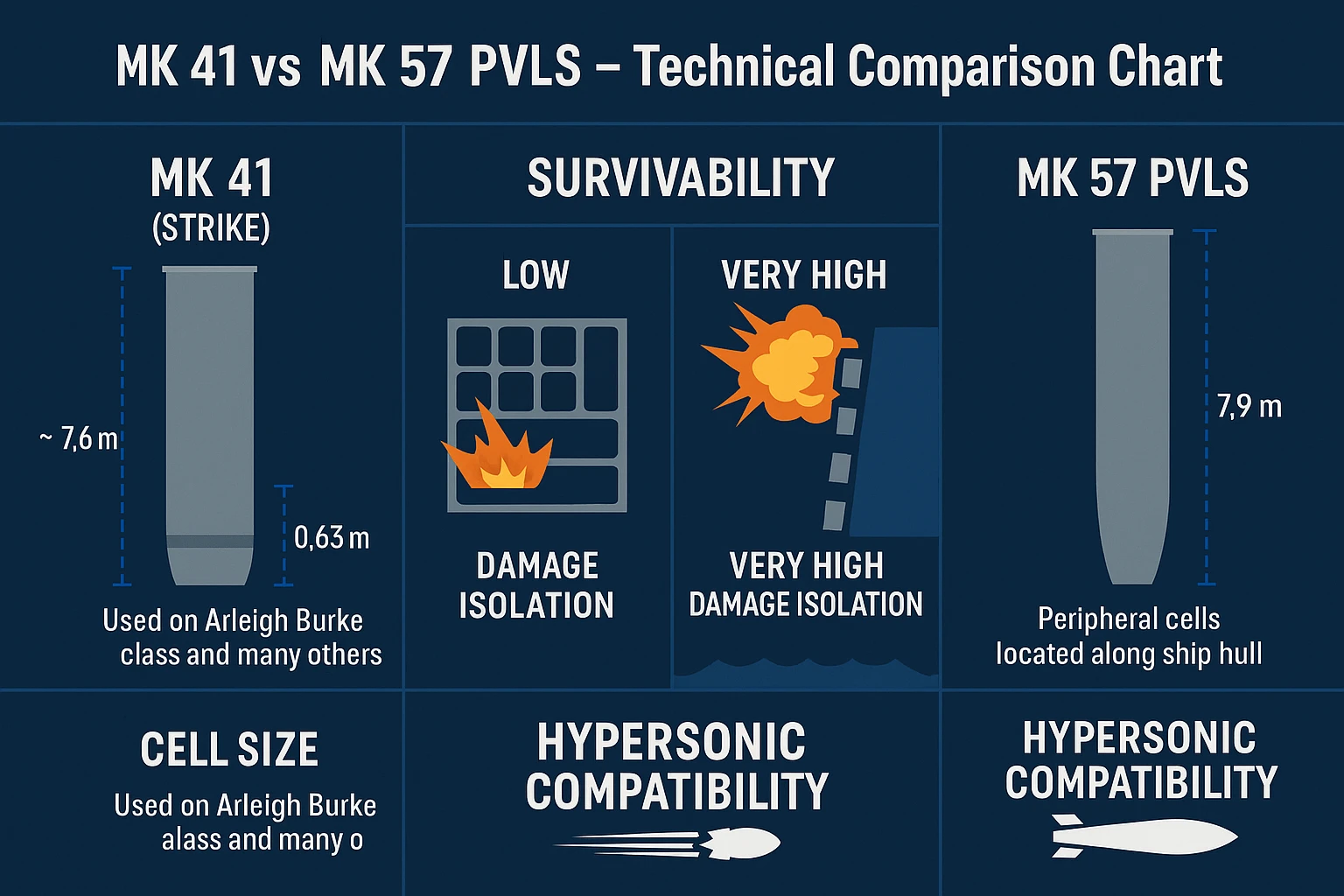
| Feature | Mk 41 (Strike Version) | Mk 57 PVLS |
|---|---|---|
| Applied Ship Classes | Arleigh Burke, Ticonderoga, KDX-III, Aegis Ashore | Zumwalt (DDG-1000) |
| Number of Cells (Typical Configuration) | 32, 64, 96, or 128 | 80 (Total) |
| Cell Depth | ~7.6 m | ~7.9 m |
| Cell Diameter | ~0.63 m (25 in) | ~0.71 m (28 in) |
| Placement | Central blocks (fore and aft) | Peripheral (outer hull edges) |
| Damage Isolation | Low to moderate | Very High |
| Launch Method | Hot launch with shared exhaust | Hot launch with independent venting |
Global VLS Context: How Mk 41 and Mk 57 Compare Internationally
To understand the strategic significance of Mk 41 and Mk 57, it is useful to place them in the context of other major VLS families in service worldwide.
| System | Country | Approx. Diameter | Launch Type |
|---|---|---|---|
| Mk 41 | United States / Allies | ~650 mm (25 in) | Hot launch |
| Mk 57 PVLS | United States (Zumwalt) | ~710 mm (28 in) | Hot launch, peripheral |
| Universal VLS (Type 055) | China | ~850 mm | Cold / hot hybrid |
| SYLVER A70 | France / Italy | ~700 mm | Cold launch |
| UKSK | Russia | ~720+ mm | Universal VLS for cruise missiles |
This broader picture shows that while the Mk 41 remains the most widely fielded system, newer designs—Mk 57, China’s Universal VLS, and Russia’s UKSK—are optimized around larger-diameter missiles and future growth potential.
Weakness Assessment
Both systems present trade-offs between survivability, cost, and upgrade potential. The table below summarizes their key weaknesses and strengths in a directly comparable way.
| Aspect | Mk 41 | Mk 57 PVLS |
|---|---|---|
| Resistance to Internal Explosion | Relatively poor; central magazine damage can be catastrophic. | Excellent; blast is vented outward through the hull. |
| Future Weapon Growth (Diameter/Volume) | Limited by 25 in cell diameter. | Strong; larger diameter and depth. |
| Fleet Integration | Global standard; used by dozens of ships and navies. | Zumwalt-only; no cross-fleet standardization. |
| Cost per Cell | Lower; mature production line. | Higher; specialized modules and limited production. |
| Structural Complexity | Simpler central block integration. | More complex integration into the outer hull sections. |
Future Perspective: The Hypersonic Challenge
The Mk 41 system, due to its cell size limitations, is not inherently compatible with large-diameter hypersonic missiles. As navies transition toward hypersonic and quasi-ballistic sea-launched weapons, this presents a strategic risk: ships built around legacy VLS dimensions may struggle to field next-generation long-range strike systems without major structural modifications.
The strategic risk is clear: fleets that cannot fit hypersonic weapons into their existing VLS cells will face either expensive refits or the need for entirely new ship classes. In that sense, the Mk 41, despite its enormous success, carries a built-in obsolescence pressure over the long term.
Strategic Note: While the Mk 57 is larger than the Mk 41, even it is too small for the massive Conventional Prompt Strike (CPS) hypersonic missiles. Consequently, the U.S. Navy is removing the 155 mm AGS guns on Zumwalt destroyers to install dedicated “Large Missile Vertical Launch Systems” to accommodate these strategic weapons. However, the Mk 57 remains ideal for future Hypersonic Cruise Missiles (HCM) that are too wide for the Mk 41.
It is worth noting that China’s Type 055 Destroyer utilizes a “Universal VLS” with an even larger diameter (around 850 mm) than the Mk 57, theoretically allowing it to cold-launch significantly larger ballistic or quasi-ballistic missiles (like the YJ-21) without specialized modifications. In terms of raw volume, this gives the PLAN a powerful growth path for heavy anti-ship and land-attack weapons.
FAQ
Why is the Mk 57 considered safer than the Mk 41?
The Mk 57 PVLS places each launcher module along the ship’s periphery, with individual blast paths directing explosive force outward, away from the ship’s vital spaces. In contrast, Mk 41 cells are grouped in large central blocks, where an internal explosion has a higher chance of causing catastrophic structural damage.
Can the Mk 41 launch hypersonic missiles?
In its current configuration, the Mk 41 is not well suited for large-diameter hypersonic weapons due to its 25 inch cell diameter. Some smaller hypersonic or quasi-hypersonic designs may be adapted, but the system was not originally designed with these weapons in mind.
Why did the Zumwalt class adopt the Mk 57 instead of the Mk 41?
The Zumwalt program emphasized survivability, growth margin, and integration of future strike and air-defense weapons. The Mk 57’s larger cell volume and peripheral placement aligned better with those design goals than reusing the legacy Mk 41 architecture.
Will the Mk 41 still be relevant in 2040 and beyond?
Yes. Due to its massive installed base, compatibility with a wide range of existing missiles, and lower cost, the Mk 41 will likely remain in service for decades. However, it may increasingly share the fleet with larger, next-generation VLS families optimized for hypersonic and very-long-range weapons.
Conclusion
The Mk 41 VLS will remain the global standard for many years, thanks to its versatility, maturity, and cost-effectiveness. It powered the shift from gun-centric surface combatants to missile-centric fleets and enabled the Aegis revolution.
However, the rapidly evolving threat environment—especially the rise of hypersonic and heavy long-range strike weapons—highlights the growing importance of survivable, growth-oriented systems like the Mk 57 PVLS. Peripheral placement, larger cell volume, and superior damage isolation reflect where naval architecture is headed.
Ultimately, the evolution of VLS technology confirms a core maxim of modern naval warfare: the strategic authority of the missile now dictates the design of the ship. The navies that adapt their launch systems to future weapons will control not just the seas, but the ranges at which wars are decided.