

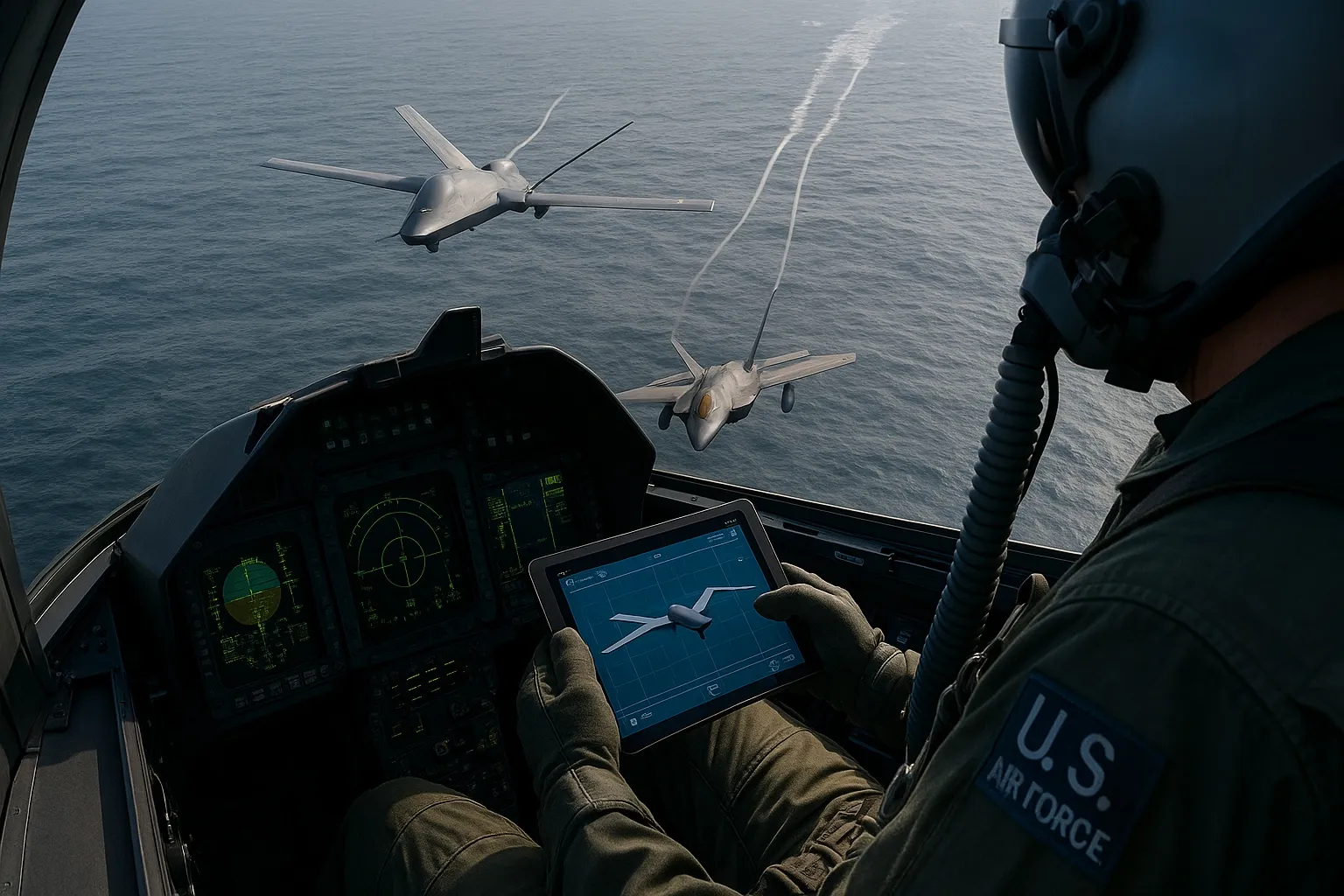
NEVADA TEST AND TRAINING RANGE — In a landmark demonstration that redefines modern air combat, a U.S. Air Force F-22 Raptor pilot has successfully controlled a General Atomics MQ-20 Avenger drone directly from the cockpit.
Utilizing open-architecture software developed by Lockheed Martin and a secure data link by L3Harris, the pilot issued real-time tactical commands to the autonomous drone via a tablet interface. This test is a critical milestone for the Air Force’s Collaborative Combat Aircraft (CCA) program.
The Engineering Breakthrough: How They Did It
This wasn’t just a radio call; it was a software revolution. Integrating new tech into the F-22’s legacy systems has historically been difficult. However, this test utilized:
- Open Systems Architecture (OSA): Allowing third-party software to run on the F-22’s hardware without rewriting the jet’s core code.
- Tablet-Based Interface: The pilot used a handheld device to assign routes, sensor tasks, and formation commands to the MQ-20.
- L3Harris Data Link: A high-bandwidth, low-latency link that resists electronic jamming.
From “Dogfighter” to “Battlefield Commander”
This test validates the “One Pilot – Many Drones” doctrine. The MQ-20 Avenger is a jet-powered, stealth-capable UCAV (Unmanned Combat Aerial Vehicle). Controlling it from an F-22 proves that future pilots will manage “swarms” rather than flying alone.
From “Dogfighter” to “Battlefield Commander”
This test validates the “One Pilot – Many Drones” doctrine. The MQ-20 Avenger is a jet-powered, stealth-capable UCAV (Unmanned Combat Aerial Vehicle). Controlling it from an F-22 proves that future pilots will manage “swarms” rather than flying alone.
This concept paves the way for the Next Generation Air Dominance (NGAD) ecosystem, where manned fighters act as the quarterback for a team of robotic wingmen.
Tactical Advantages: The “Loyal Wingman” Concept
This Manned-Unmanned Teaming (MUM-T) capability offers four distinct advantages:
- Extended Sensors: The drone can fly ahead into dangerous airspace to detect targets, keeping the F-22 stealthy and safe.
- Kinetic Strike: The F-22 identifies the target; the drone fires the weapon.
- Electronic Warfare Screen: The drone acts as a jammer/decoy to break enemy air defenses.
- Expendability: Losing a drone is tactical; losing an F-22 pilot is strategic.
“This integration is an operational leap. The MQ-20 is no longer just a drone; it is a tactical extension of the pilot’s will.” — General Atomics Statement
Strategic Impact: Countering China’s J-20
This test is a direct message to near-peer adversaries. As China develops its own loyal wingman concepts for the J-20, the U.S. is accelerating its CCA program to ensure air superiority in the 2030s.
The lesson from Nevada is clear: “In the future of air combat, jets don’t fight alone—networks do.”