
• Login
UltiDefense: Military Tech Comparisons & Modern Warfare Analysis
  • Defense Systems
    • Air Platforms
      • Fighter Jets
      • Drones
      • Attack Helicopters
      • Strategic Bombers
    • Land Systems
      • Main Battle Tanks
      • Artillery & Firepower
      • Infantry Fighting Vehicles
      • Military Logistics and Support Vehicles
      • Soldier Systems & Robotics: UGV, Exoskeleton, and Modern Infantry Integration
    • Integrated Defense Systems
      • Ballistic Missile Defense
      • Air Defense Systems
    • Missiles & Munitions
      • Air-to-Air & Anti-Ship Missiles
      • Cruise Missiles
      • Strategic & Hypersonic Weapons
    • Naval
      • Aircraft Carriers
      • Submarines
      • Surface Combatants
      • Unmanned Maritime Systems
    • Future Tech & Innovations
      • Sensors and Avionics
  • Comparisons
  • Space Warfare
    • Counter-Space & ASAT
    • Spaceplanes & Launch Vehicles
    • Military Satellites & ISR
  • Defense News
  • Military Life
  • Policy, Budget and Geopolitics
  • Cyber Security & Electronic Warfare
No Result
View All Result
Defense News
No Result
View All Result

Home - Air Platforms - 5th Gen vs. 6th Gen Fighter Jets: The Key Differences That Change Air Warfare

5th Gen vs. 6th Gen Fighter Jets: The Key Differences That Change Air Warfare

George Schouten by George Schouten
November 20, 2025
in Air Platforms
0
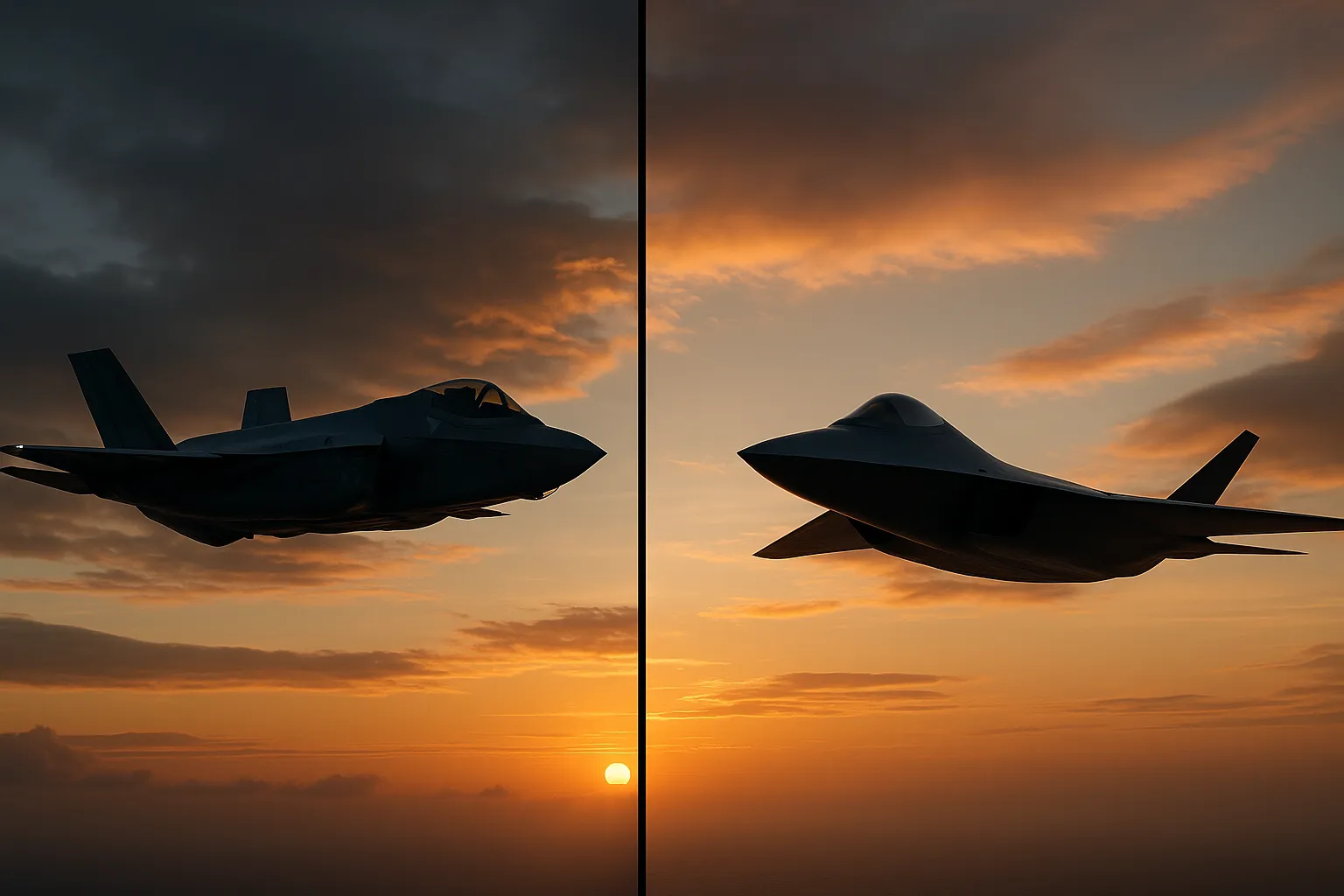
5th gen vs 6th gen fighter comparison
163
SHARES
2k
VIEWS
Share on Twitter

Introduction

When examining 5th Gen vs. 6th Gen Fighter Jets, it becomes clear that the standard of air superiority established by the F-22 Raptor and F-35 Lightning II has remained unrivaled for years.

However, a new paradigm is approaching: NGAD (Next Generation Air Dominance), Tempest (GCAP), FCAS, and China’s J-XX 6th generation platform.

READ ALSO

Ka-52 Alligator Deep Dive: The Only Attack Helicopter with Ejection Seats?

AH-64E Apache Guardian: The World’s Most Advanced Attack Helicopter (2026 Guide)

Today, most people ask:

“Will the 6th generation be faster?”

No.

In modern aerial combat, speed is no longer the primary determinant.

The real revolution lies in:

  • ➡️ AI-driven mission management
  • ➡️ Network-native architecture (not just network-centric)
  • ➡️ Manned-Unmanned Teaming (MUM-T / CCA / Loyal Wingmen)
  • ➡️ Megawatt-class power management for directed energy weapons
  • ➡️ Adaptive cycle engine technology
  • ➡️ Broadband VLO (Very-Low Observable) skin morphing

What Defines a 5th Generation Fighter?

The 5th generation is defined by two critical platforms: the F-22 Raptor and the F-35 Lightning II.

In engineering literature, these aircraft are defined by three core characteristics:

1. Stealth Geometry + Low Observable (LO) Coatings

  • Radar Cross Section (RCS): 0.001–0.005 m² (Size of a marble).
  • Surface Coating: RAM (Radar Absorbent Material) + serrated panel joints.
  • Benefit: Drastically reduces detection range by enemy radar → First detection advantage.

2. Sensor Fusion

The F-35’s sensor layer consists of:

  • AN/APG-81 AESA Radar
  • DAS (AN/AAQ-37)
  • EOTS (Electro-Optical Targeting System)
  • ESM/ELINT
  • MADL & Link-16 data fusion

The pilot receives this as a single “God’s Eye” view.

The critical difference: Raw sensor data is synthesized into a unified tactical reality → Decision time is reduced to milliseconds.

3. Supercruise (F-22) + High Agility

  • F-22’s capability to sustain Mach 1.82 without afterburners.
  • Thrust-vectoring nozzles for high Angle of Attack (AOA) maneuvers.


The Leap to 6th Generation: It’s Not Just a Plane

A 6th-generation fighter is no longer just an aircraft: It is the central command computer of the battlefield.

This architecture is defined as “System-of-Systems Warfare (SOSW).”

Technical Breakpoints of the 6th Gen Revolution:

1. AI Co-Pilot / Autonomous Mission Manager

  • AI Role: Threat classification, sensor optimization, target resolution, and ECM/ECCM management.

2. Loyal Wingman Drones (CCA – Collaborative Combat Aircraft)

Unmanned jets accompanying the manned fighter for:

  • SEAD/DEAD missions (Suppression of Enemy Air Defenses)
  • Stand-in jamming
  • Stand-off strikes
  • Sensor extension layer

3. Optional-Manned Flight Architecture

The aircraft can fly with or without a pilot, minimizing risk based on the mission profile.

4. Distributed Aperture & Multi-Static Radar

All platforms around the aircraft act as a shared radar network, effectively seeing through stealth.

5. Adaptive Cycle Engine (AETP)

A revolutionary 3-mode engine:

  • Mode 1: High-thrust mode for combat.
  • Mode 2: Fuel-efficiency mode for loitering.
  • Mode 3: High-cooling/GPU generation mode (Critical for lasers).

Direct Comparison: 5th Gen vs. 6th Gen

Feature5th Gen (F-35)6th Gen (NGAD / Tempest)
SpeedMach 1.6Mach 1.8+ (Multi-regime optimization)
Stealth LevelVLO (0.005 m² RCS)Broadband Stealth + Morphing Skin + IR Suppression
Engine TypePW F135 (Single engine)Adaptive Cycle Engine (AETP) – 3 Modes
Power Generation~80 kW300–450 kW (Sufficient for DEW)
Weapon SystemsAIM-120D, JSM, SDB-IILaser Weapons (150–300 kW), Hypersonic Strike
Combat ConceptNetwork-centric warfareNetwork-native + AI-driven swarm operations

Future Weapons: Lasers and Hypersonics

The most critical engineering challenge for 6th-generation fighters is power generation.

Power Required for Laser Weapons:

  • Requirement: 150–300 kW continuous laser output.
  • Challenge: This requires a megawatt-class thermal management system on the aircraft. The fuel itself will be used as a “heat sink” to cool the systems.

Hypersonic Weapons:

  • Speed: Mach 5–10+ range.
  • Range: Stand-off distance of 1,000 km+.
  • Role: The aircraft is no longer just a platform, but a launch node for hypersonic systems.

Conclusion

For the 5th generation, the revolution was stealth + sensor fusion.

For the 6th generation, the revolution is now:

“Connectivity + AI + Directed Energy + Autonomous Swarms.”

We are no longer talking about a fighter jet, but an aerial combat ecosystem.

👉 What do you think? Will the F-35 retire earlier than expected with the arrival of NGAD? Let us know in the comments!


FAQ (Frequently Asked Questions)

Is the F-22 a 6th generation fighter?

No. The F-22 Raptor is the world’s first 5th-generation fighter, designed for air superiority with VLO, supercruise, and thrust-vectoring capabilities.

Will 6th gen jets replace 5th gen platforms?

Gradually, YES. 5th-generation aircraft will shift from being “spearhead assets” to “supporting node” roles.

Which countries are developing 6th gen fighters?

  • USA: NGAD + CCA
  • UK-Japan-Italy: Tempest (GCAP)
  • France-Germany-Spain: FCAS
  • China: J-XX Program
  • Russia: PAK DP (Early stage concept)

What is an Adaptive Cycle Engine (AETP)?

It is an innovative engine that switches between high thrust, high efficiency, and high cooling modes in flight, providing the infrastructure needed for Directed Energy Weapons (DEW) and hypersonics.

Will 6th gen fighters be optionally manned?

Yes. Depending on the mission risk analysis, they will be capable of flying fully autonomously or with a pilot.

What are Loyal Wingman drones?

Low-cost unmanned combat jets (CCA) linked to the main manned fighter. They perform high-risk tasks like jamming, decoying, and striking targets.
Tags: 5th Gen Fighter6th Gen FighterF-22 RaptorF-35 Lightning IIFCASFuture WarfareMilitary AviationNGADStealth TechnologyTempest GCAP

Related Posts

Russian Ka-52 Alligator attack helicopter front view with missiles.
Attack Helicopters

Ka-52 Alligator Deep Dive: The Only Attack Helicopter with Ejection Seats?

January 10, 2026
Front view of a US Army AH-64E Apache Guardian attack helicopter armed with Hellfire missiles and 30mm cannon, featuring the mast-mounted Longbow radar.
Attack Helicopters

AH-64E Apache Guardian: The World’s Most Advanced Attack Helicopter (2026 Guide)

January 10, 2026
F-15 Eagle fighter jet flying over clouds at sunset with full weapon loadout
Fighter Jets

The Unbeaten King of the Skies: F-15 Eagle, Its 104–0 Record, and Why the F-15EX Still Matters

December 20, 2025
F-35 Lightning II flying with XQ-58A Valkyrie loyal wingman drones.
Global Military Drones: UAV Systems, Autonomy, and Unmanned Warfare

XQ-58A Valkyrie: The $3 Million “Loyal Wingman” That Changes Everything

December 19, 2025
Indian Air Force LCA Tejas Mk-1A fighter jet soaring over the Himalayas, armed with indigenous Astra BVR missiles and equipped with an AESA radar nose cone.
Comparisons

LCA Tejas Mk-1A: India’s Indigenous 4.5-Gen Fighter & the JF-17 Rival

December 14, 2025
China's massive Jiutian SS-UAV deploying a swarm of smaller drones from its central mission bay
Global Military Drones: UAV Systems, Autonomy, and Unmanned Warfare

Jiutian SS-UAV: China’s Flying Aircraft Carrier (2025 Technical Deep Dive)

December 11, 2025
Next Post
A strategic illustration combining the text of the 1951 San Francisco Peace Treaty with a modern map of the Indo-Pacific. The visual highlights the legal void regarding Taiwan's status, the US 'Offshore Balancing' strategy lines, and the emerging India-Russia defense axis challenging the post-WWII order.

The San Francisco Ghost: How a 1951 Treaty, a Secret US Doctrine, and the India-Russia Axis are Reshaping the Pacific

Leave a Reply Cancel reply

Your email address will not be published. Required fields are marked *

About

Ultidefense is a digital platform focused on modern defense, military technology, and strategic innovation.
We explore how advancements in aerospace, AI, cybersecurity, and autonomous systems are transforming the global defense landscape.
Our mission is to connect technical insight with strategic awareness, helping readers understand the technologies shaping modern security and warfare.
At Ultidefense, we believe knowledge is strength — and our goal is to deliver clear, factual, and forward-looking analysis on the systems, science, and strategies defining the future of defense.

Categories

  • Comparisons
  • Cyber Security & Electronic Warfare
  • Defense News
  • Defense Systems
    • Air Platforms
      • Attack Helicopters
      • Fighter Jets
      • Global Military Drones: UAV Systems, Autonomy, and Unmanned Warfare
      • Strategic Bombers
    • Future Tech & Innovations
      • Sensors and Avionics
    • Land Systems
      • Artillery & Firepower: Self-Propelled Guns, Rocket Systems, and Barrage Analysis
      • Main Battle Tanks: Armor, Firepower, and Modern MBT Comparisons
    • Missiles & Munitions
      • Strategic & Hypersonic Weapons
    • Space Warfare
      • Military Satellites & ISR
      • Spaceplanes & Launch Vehicles
  • Integrated Defense Systems
    • Air Defense Systems
  • Military Life
    • Combat Survival & Medicine
  • Naval Systems: Warships, Carriers, and Maritime Defense Technology
    • Aircraft Carriers
    • Submarines
  • Policy, Budget and Geopolitics
  • Unmanned Maritime Systems

Recent Posts

  • Off-Earth Rare Earth Elements Mining: Moon, Mars and Asteroids as Strategic Military Resources
  • What Actually Kills Soldiers on the Battlefield?
  • Which Military Boot Camp is the Hardest? All 6 US Branches Ranked
  • The SFAS Fallout: What Happens After You Fail Special Forces Selection

Newsletter

Pages

  • About Us
  • Home
  • Contact Us
  • Privacy Policies
  • Terms of Service
  • Disclaimer

© 2025 Defense Systems

Welcome Back!

Login to your account below

Forgotten Password?

Retrieve your password

Please enter your username or email address to reset your password.

Log In
No Result
View All Result
  • Defense Systems
    • Air Platforms
      • Fighter Jets
      • Drones
      • Attack Helicopters
      • Strategic Bombers
    • Land Systems
      • Main Battle Tanks
      • Artillery & Firepower
      • Infantry Fighting Vehicles
      • Military Logistics and Support Vehicles
      • Soldier Systems & Robotics: UGV, Exoskeleton, and Modern Infantry Integration
    • Integrated Defense Systems
      • Ballistic Missile Defense
      • Air Defense Systems
    • Missiles & Munitions
      • Air-to-Air & Anti-Ship Missiles
      • Cruise Missiles
      • Strategic & Hypersonic Weapons
    • Naval
      • Aircraft Carriers
      • Submarines
      • Surface Combatants
      • Unmanned Maritime Systems
    • Future Tech & Innovations
      • Sensors and Avionics
  • Comparisons
  • Space Warfare
    • Counter-Space & ASAT
    • Spaceplanes & Launch Vehicles
    • Military Satellites & ISR
  • Defense News
  • Military Life
  • Policy, Budget and Geopolitics
  • Cyber Security & Electronic Warfare

© 2025 Defense Systems