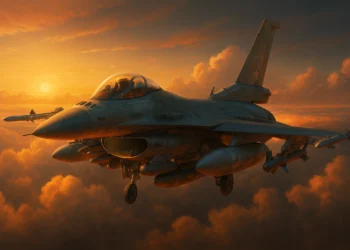


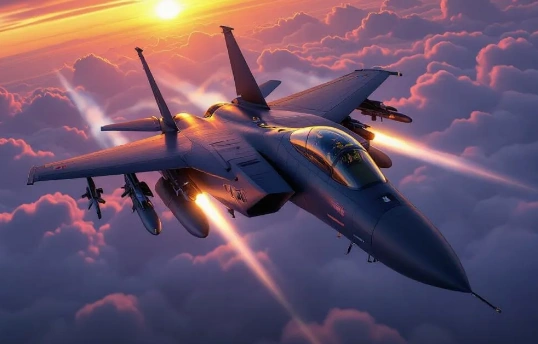
104 air-to-air victories. Zero confirmed losses.
That single statistic has turned the F-15 Eagle into something more than a fighter jet—it is an aviation outlier. No other modern combat aircraft has accumulated such a record across decades of real wars, against real opponents, flown by multiple air forces.
Yet the true paradox of the F-15 is not its past dominance, but its continued relevance.
In an era dominated by stealth aircraft, sensor fusion, and sixth-generation concepts, the United States is still buying brand-new Eagles in the form of the F-15EX Eagle II.1 This raises a legitimate strategic question:
Why does a fourth-generation design still have a future in modern air warfare?
The answer is not nostalgia. It is doctrine.
Key Takeaways
- The 104–0 record reflects not only aircraft performance but training, doctrine, and technological overmatch.2
- The F-15EX exists because stealth alone is insufficient for future high-intensity wars (payload limitations).
- The Eagle’s value today lies in payload, range, and networked firepower, not penetration.
- With a 20,000-hour airframe, the F-15EX could remain relevant into the 2060s.
What Is the F-15 Eagle? The Design Philosophy Behind Air Superiority
The F-15 was born from Cold War urgency. After sobering air combat lessons from Vietnam, the U.S. concluded that speed, climb rate, radar power, and missile capacity mattered more than cost or versatility when air dominance was on the line.
Developed by McDonnell Douglas, the F-15 was engineered around one non-negotiable requirement: it must always be able to out-climb, out-accelerate, and out-see its opponent.
This philosophy produced an aircraft with:
- A thrust-to-weight ratio greater than 1:1.
- Exceptional high-altitude performance.
- A large, powerful radar unmatched in its era.
Production and modernization are now handled by Boeing, ensuring the Eagle remains operationally relevant.3
F-15 Eagle Technical Specifications
| Specification | F-15 Eagle Details |
| Crew | 1 (2 in E / EX variants) |
| Length | 19.43 m |
| Wingspan | 13.05 m |
| Max Speed | Mach 2.5+ (~3,017 km/h) |
| Combat Radius | ~1,800 km |
| Service Ceiling | 65,000 ft |
| Engines | 2× Pratt & Whitney turbofans |
| Max Weapons Load | ~13,400 kg |
| Primary Role | Air Superiority |
The 104–0 Record — Context, Not Mythology
The F-15’s perfect air-to-air record is real, but it deserves precision rather than mythology.
Most kills were achieved by the Israeli Air Force (IAF) during the 1980s and 1990s, primarily against Syrian and other Arab air forces. These engagements were often asymmetric—not only technologically, but doctrinally.
Israeli pilots leveraged:
- Superior training and flight hours.
- Advanced situational awareness.
- Beyond-visual-range (BVR) missiles.
- Integrated command-and-control.
The United States Air Force added to the tally during the 1991 Gulf War, where Iraqi aircraft were overwhelmingly outmatched. Saudi F-15s also contributed during regional conflicts.
The critical takeaway: The 104–0 record reflects system dominance, not just airframe excellence. The F-15 enabled victory—but training, doctrine, and integration won it.
F-15 Variants Explained: From Cold War to Digital Age
F-15C — The Pure Air Superiority Fighter
Designed exclusively for air-to-air combat. Lightweight, brutally fast, and optimized for fighter sweeps over large areas.
F-15E Strike Eagle — Dual-Role Evolution
Added terrain-following radar, precision strike capability, and a second crew member—without sacrificing air combat performance.
F-15EX Eagle II — Digital Transformation
The F-15EX is not an “upgrade.” It is a networked weapons platform featuring:
- AESA Radar: Unmatched detection range.
- Fly-by-wire controls: Improved handling and stability.
- Glass Cockpit: Full digital displays.
- Open Architecture: Allows for rapid software upgrades (OMS).4
- Beast Mode: Capable of carrying up to 22 air-to-air missiles.
Why the F-15EX Exists in the Age of Stealth
The F-15EX was chosen not despite stealth—but because stealth alone is insufficient.
Key reasons the USAF selected it over additional F-35s:
- Cost: Lower cost per flight hour compared to 5th-gen fighters.
- Payload: Massive capacity for long-range weapons (hypersonic missiles).
- Logistics: Faster production using existing infrastructure.
Doctrinally, the F-15EX fits a distributed warfare model:
Stealth fighters (F-35, F-22) penetrate and sense targets. The F-15EX delivers volume firepower from standoff range.5 It acts as a “missile truck,” command node, and force multiplier.
Survivability: The Real Limitation
The F-15EX is not stealthy. Against advanced systems like the S-400, S-500, or PL-15 missiles, it cannot operate alone inside denied airspace. Its survivability depends on Electronic Warfare (EPAWSS), standoff weapons, and cooperative tactics.
F-15 vs F-16: Operational Reality
The F-16 Fighting Falcon is often compared to the F-15, but they were never designed for the same mission.6
- F-15 Strengths: Twin-engine safety, longer range, larger radar, offensive air dominance.
- F-16 Strengths: Cheaper, more numerous, superior low-altitude agility (dogfight), multi-role flexibility.
Operationally: The F-15 clears the sky; the F-16 exploits it.
The Satellite Kill — Fact, Not Legend
In 1985, a specially modified F-15A launched an ASM-135 ASAT missile, destroying a satellite in low Earth orbit.7 This was not a routine capability—but it demonstrated the F-15’s exceptional altitude, speed, and adaptability as a weapons test platform.
Legendary Durability: The One-Wing Landing
In 1983, an Israeli F-15D lost nearly its entire right wing in a mid-air collision—and still landed safely.8
The reason: The fuselage itself generates lift. This incident became legendary proof of the Eagle’s over-engineered robustness.
The Future: How Long Can the Eagle Fly?
- Airframe Life: 20,000 hours
- Service Horizon: Potentially into the 2060s
- Upgrade Path: AI, sensors, weapons via open architecture
The F-15EX may be the last great manned non-stealth fighter, bridging Cold War physics and future networked warfare.
Final Assessment
The F-15’s story is not about invincibility. It is about adaptation. From analog dogfights to digital battlespaces, the Eagle has evolved without abandoning the fundamentals of air combat: speed, altitude, payload, and pilot judgment.
As long as wars require massed firepower and human decision-making, the Eagle will remain relevant.
1. What is the top speed of the F-15 Eagle?
The F-15 Eagle is one of the fastest fighter jets ever built, capable of reaching speeds over Mach 2.5 (approx. 1,875 mph or 3,017 km/h) at high altitudes. Its high thrust-to-weight ratio allows it to accelerate vertically while climbing.
2. Has an F-15 ever been shot down in air-to-air combat?
No. The F-15 Eagle holds a legendary combat record of 104 victories to 0 losses in air-to-air engagements. While F-15s have been lost to ground fire (surface-to-air missiles) and accidents, none have been confirmed shot down by an enemy aircraft.
3. What is the main difference between the F-15 and the F-16?
The primary difference is their role and design. The F-15 is a large, twin-engine heavy fighter designed for air superiority and long-range missions. The F-16 is a smaller, single-engine, multi-role fighter designed to be lighter, cheaper, and more agile for close-range combat and ground support.
4. Why is the USAF buying the F-15EX instead of more F-35s?
The USAF is acquiring the F-15EX to complement the F-35, not replace it. The F-15EX offers lower operating costs, a longer lifespan, and a much larger weapons payload (it can carry heavy hypersonic missiles that don’t fit inside the F-35). It acts as a “missile truck” behind the stealthy F-35s.
5. How much does an F-15EX cost?
The estimated fly-away cost for a new Boeing F-15EX Eagle II is approximately $90 million to $97 million. While this is comparable to the F-35A, the F-15EX is cheaper to fly and maintain over its lifecycle (approx. $29,000 per flight hour vs. $42,000+ for the F-35).
6. Is the F-15 Eagle a stealth fighter?
No, the F-15 is not a stealth aircraft. It has a large radar cross-section. However, the modern F-15EX is equipped with the advanced EPAWSS (Eagle Passive/Active Warning Survivability System), a powerful electronic warfare suite that jams enemy radars to protect the aircraft.
7. Did an F-15 really land with one wing?
Yes. In 1983, an Israeli Air Force F-15D collided with an A-4 Skyhawk during a training exercise and lost almost its entire right wing. The pilot, Zivi Nedivi, managed to land the plane safely because the F-15’s wide fuselage generates significant lift and the engines provided enough thrust to keep it stable at high speed.
8. Which countries operate the F-15 Eagle?
Aside from the United States (USAF), the F-15 is operated by Israel (IAF), Japan (JASDF), Saudi Arabia (RSAF), South Korea (ROKAF), Singapore (RSAF), and Qatar (QEAF). It is a key asset for US allies globally.
9. Can the F-15EX beat the F-22 Raptor?
In a close-range dogfight, an F-15EX with a helmet-mounted queuing system and AIM-9X missiles is a formidable opponent. However, in Beyond Visual Range (BVR) combat, the F-22 Raptor would likely win due to its stealth capabilities, allowing it to see and lock onto the F-15EX before the Eagle even knows the F-22 is there.
What is the “Beast Mode” on the F-15EX?
“Beast Mode” refers to the F-15EX’s ability to utilize its new AMBER missile racks to carry an unprecedented amount of firepower. It can carry up to 12 air-to-air missiles in a standard loadout, or up to 22 missiles in a maximum density configuration, far exceeding any other US fighter.