

Have you ever wondered why a Sergeant often takes charge in movies, even when a Lieutenant is present? Or why a “Captain” in the Army is vastly different from a “Captain” in the Navy?
In the US Army, ranks are not just titles—they are a precise language of authority, experience, and responsibility. Misunderstanding these ranks leads to confusion, whether you are watching a military film, playing Call of Duty, or researching a military career.
This guide provides a complete breakdown of the US Army structure for 2025, explaining the difference between Enlisted soldiers, Warrant Officers, and Commissioned Officers, along with their insignia and pay grades.
Understanding the Military Classification System
Before diving into specific titles, it is crucial to understand the three main categories that define the US Army structure:
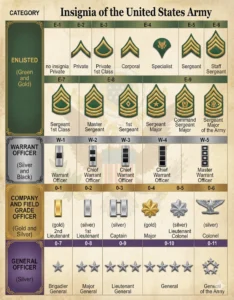
Enlisted (E-1 to E-9): The backbone of the Army. These soldiers perform specific jobs, ranging from infantrymen to technical specialists. Senior Enlisted personnel (NCOs) act as leaders and mentors.
Warrant Officers (W-1 to W-5): The technical experts. These are highly specialized officers who focus on a single domain, such as aviation (helicopter pilots) or intelligence, rather than general command.
Commissioned Officers (O-1 to O-10): The command authority. They are responsible for planning missions, issuing orders, and managing overall unit operations.
Note on Pay Grades: You will often see codes like “E-5” or “O-3.” These are Pay Grades. They determine a soldier’s salary band, regardless of their specific job title.
Enlisted Ranks: The Backbone (E-1 to E-9)
Enlisted soldiers make up the vast majority of the Army. They are the ones who execute missions on the ground.
Junior Enlisted (E-1 to E-4)
Private (PVT / E-1): Recruits in Basic Training. No insignia.
Private Second Class (PV2 / E-2): The first promotion, usually after 6 months.
Private First Class (PFC / E-3): Soldiers who have gained some experience and tactical competence.
Specialist (SPC / E-4):
Key Insight: This is the most common rank in the US Army. A Specialist focuses on technical proficiency in their job (MOS) rather than leadership.
Non-Commissioned Officers (NCOs)
This is where leadership begins. NCOs are often called “The Backbone of the Army.”
Corporal (CPL / E-4):
The Distinction: A Corporal shares the same pay grade (E-4) as a Specialist but is considered a Junior NCO. They have formal command authority over soldiers.
Sergeant (SGT / E-5): Typically commands a “Team” (4-5 soldiers). They are the first line of direct leadership.
Staff Sergeant (SSG / E-6): Typically commands a “Squad” (8-10 soldiers). They are responsible for the tactical development of their soldiers.
Senior NCOs (E-7 to E-9)
Sergeant First Class (SFC / E-7): Platoon Sergeant. The primary advisor to the Platoon Leader (Lieutenant).
Master Sergeant (MSG) & First Sergeant (1SG) (E-8): While paid the same, a First Sergeant is the senior NCO of a Company (100+ soldiers), handling discipline and administration.
Sergeant Major (SGM) & Command Sergeant Major (CSM) (E-9): The highest enlisted advisors to Battalion and Brigade commanders.
Warrant Officers: The Technical Experts (W-1 to W-5)
Unlike Commissioned Officers who are “generalists,” Warrant Officers are “specialists.”
Warrant Officer 1 (WO1): Appointed by warrant from the Secretary of the Army.
Chief Warrant Officers (CW2 to CW5): Commissioned by the President.
Role: You will frequently find them in the cockpit of Apache and Black Hawk helicopters, or managing advanced cyber defense systems.
Commissioned Officers: The Leadership Core (O-1 to O-10)
Officers hold their commission from the President of the United States. Their training focuses on leadership, management, and strategy.
Company Grade Officers (O-1 to O-3)
Second Lieutenant (2LT / O-1): A “Butterbar” (due to the gold bar insignia). Typically a Platoon Leader straight out of college/ROTC.
First Lieutenant (1LT / O-2): A more experienced Platoon Leader or Executive Officer (XO).
Captain (CPT / O-3):
Role: Commands a Company (approx. 100-150 soldiers). This is a pivotal command role in an officer’s career.
Field Grade Officers (O-4 to O-6)
Major (MAJ / O-4): Primary Staff Officer (Operations, Intelligence) for Battalions.
Lieutenant Colonel (LTC / O-5): Battalion Commander (commands 800-1,000 soldiers).
Colonel (COL / O-6): Brigade Commander (commands 3,000+ soldiers).
General Officers (O-7 to O-10)
The “Stars” of the Army.
Brigadier General (1 Star)
Major General (2 Stars)
Lieutenant General (3 Stars)
General (4 Stars)
Note: The 5-Star rank (General of the Army) is reserved only for wartime (e.g., WWII).
Common Confusion: Army Captain vs. Navy Captain
One of the biggest misconceptions in military hierarchy involves the rank of “Captain.”
US Army Captain (O-3): A mid-level officer commanding a Company.
US Navy Captain (O-6): A senior officer commanding a massive Warship or Air Wing.
The Verdict: A Navy Captain is equivalent to an Army Colonel, making them significantly higher in rank than an Army Captain.
Army Pay Grades & Salary Overview (2025 Estimates)
Rank determines authority, but Pay Grade determines the paycheck. Below is an overview of base pay estimates for key ranks.
(Note: These figures exclude housing allowances (BAH), BAS, and hazard pay, which can significantly increase total compensation.)
| Rank Title | Pay Grade | Est. Annual Base Pay* | Responsibility Level |
|---|---|---|---|
| Specialist | E-4 | $30,000 – $36,000 | Technical Expert |
| Sergeant | E-5 | $37,000 – $52,000 | Team Leader (4-5 Soldiers) |
| Sergeant First Class | E-7 | $45,000 – $65,000 | Platoon Sergeant |
| Captain | O-3 | $60,000 – $100,000 | Company Commander |
| Colonel | O-6 | $90,000 – $160,000+ | Brigade Commander |
| *Figures are approximate estimates based on 2025 scales excluding housing (BAH) and allowances. | |||
Career Progression: How Long Does it Take?
Moving up the ranks requires time, education, and performance. Here is a typical timeline for the Enlisted path:
Private to Specialist: 2 – 3 Years
Specialist to Sergeant: 4 – 5 Years (Requires passing a promotion board)
Sergeant to Sergeant First Class: 7 – 10 Years
To Sergeant Major: 18 – 20+ Years
Conclusion
The US Army rank system is engineered for discipline and clarity in the chaos of combat. Whether you are looking at the stripes on a sleeve or the stars on a shoulder, each insignia tells a story of time in service, professional education, and leadership capability.
Understanding these distinctions allows you to appreciate the nuance of military life, far beyond what is portrayed in Hollywood.
1. What is the highest rank in the US Army?
The highest active rank in the US Army is a four-star General (O-10). During times of major war, a five-star rank known as General of the Army (e.g., Dwight D. Eisenhower) can be authorized, but no one has held this rank since 1981.
2. What is the difference between a Corporal and a Specialist?
Both ranks share the pay grade of E-4, but their roles are different. A Specialist focuses on technical proficiency in their job, while a Corporal is a Junior Non-Commissioned Officer (NCO) with formal leadership authority over other soldiers.
3. Do you salute a Sergeant in the US Army?
No. In the US Army, you generally do not salute Non-Commissioned Officers (Sergeants). Salutes are reserved for Commissioned Officers and Warrant Officers. However, soldiers must stand at “Parade Rest” when addressing an NCO.
4. Is a Navy Captain higher than an Army Captain?
Yes. A Navy Captain is an O-6 (equivalent to an Army Colonel), while an Army Captain is an O-3. Therefore, a Navy Captain outranks an Army Captain significantly.
5. How long does it take to become a Sergeant?
On average, it takes about 4 to 5 years of service to reach the rank of Sergeant (E-5). However, this timeline can vary based on the soldier’s performance, promotion points, and the Army’s needs in their specific job field (MOS).
6. Can an Enlisted soldier become a Commissioned Officer?
Yes. Enlisted soldiers can become officers through programs like Green to Gold (ROTC), Officer Candidate School (OCS), or by receiving a direct battlefield commission (extremely rare). Soldiers who make this switch are often nicknamed “Mustangs.”
7. What is a “Butterbar” in the Army?
“Butterbar” is a common slang term for a Second Lieutenant (2LT). It refers to their rank insignia, which is a single gold bar that resembles a stick of butter. It is often used jokingly to imply inexperience.
8. What does a Warrant Officer do?
Warrant Officers are technical experts who specialize in a specific field, such as aviation (pilots), intelligence, or maintenance. Unlike Commissioned Officers who are generalist commanders, Warrant Officers stay within their technical specialty throughout their careers.
9. Which rank commands a Company? A Captain (O-3)
Typically commands a Company, which consists of approximately 100 to 150 soldiers. They are assisted by a First Sergeant (E-8), who acts as the senior NCO.
10. Do Army ranks determine salary?
Yes. A soldier’s base salary is determined by their Pay Grade (e.g., E-1, O-3), not just their specific job title. However, total compensation also includes housing allowances (BAH), food allowances (BAS), and special pays (e.g., hazard pay, jump pay), which vary by location and duty.