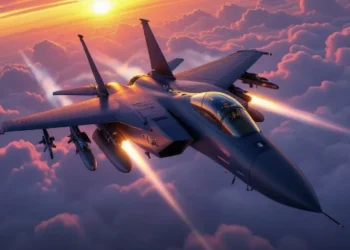


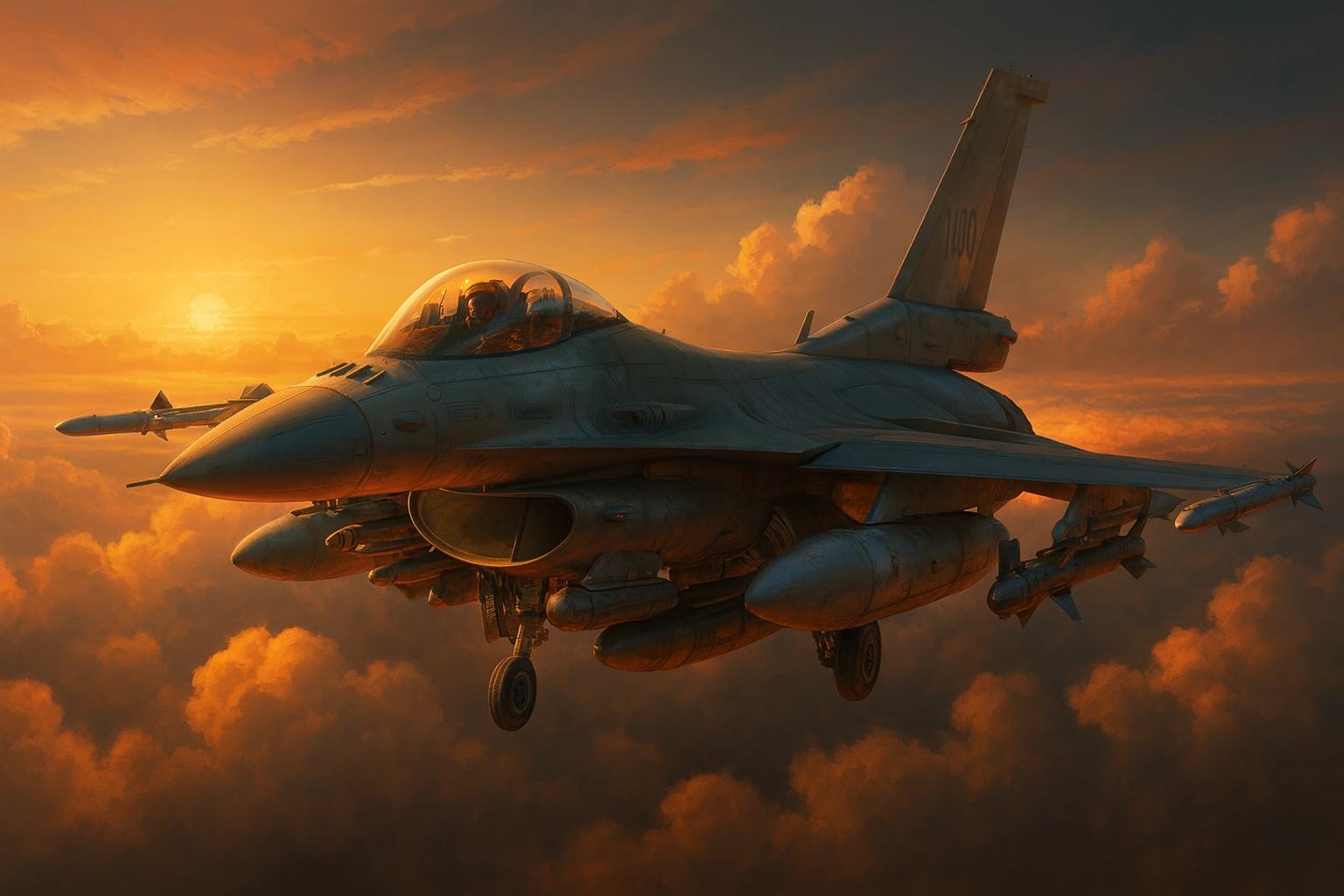
It first flew in 1974. Over 4,600 units have been built. By all logic, the F-16 Fighting Falcon should be a museum piece by now. Instead, it is experiencing the most sophisticated technological transformation in its 50-year history.
Introducing the F-16 Block 70/72 “Viper”—the most advanced variant ever produced by Lockheed Martin. With an international backlog spanning Taiwan, Slovakia, Bahrain, Jordan, and potentially Turkey, the Viper proves an unmistakable truth:
“You don’t always need stealth to dominate modern air combat—sometimes, you just need smart engineering.”
What Makes the Block 70 “Viper” Special?
The Block 70/72 appears similar to legacy F-16s on the outside, but internally it resembles a mini-F-35. It’s classified as a 4.5-Generation Fighter for one simple reason: It blends proven aerodynamics with fifth-generation avionics and sensors previously found only in stealth aircraft.
The top three upgrades are:
- AN/APG-83 AESA Radar: A near-F-35 level sensor.
- 12,000-Hour Service Life: A structural rebuild for the next four decades.
- Auto GCAS: A lifesaving autonomy system that literally prevents pilot death.
1. The AN/APG-83 AESA Radar — Why It Changes Everything
The Block 70’s most transformative component is the Northrop Grumman AN/APG-83 SABR, an Active Electronically Scanned Array radar.
Why is AESA so important?
Because AESA isn’t “just a better radar.” It fundamentally alters how the F-16 fights, survives, and kills. Instead of a single rotating antenna, AESA uses hundreds of tiny transmit/receive modules to steer radar beams electronically, allowing:
- Multi-target tracking
- Instantaneous beam steering
- Ultra-high resolution synthetic aperture mapping (SAR)
- Resistance to electronic jamming
This radar is built on core technologies derived from the F-22’s APG-77 and the F-35’s APG-81—meaning the F-16 just inherited two decades of classified sensor development.
Related Analysis:
Curious how these radar systems compare in a head-to-head matchup?
👉 Read our breakdown: F-22 Raptor vs. F-35 Lightning II
2. A 12,000-Hour Airframe — Rebuilding a Classic
Legacy F-16s were built for around 8,000 flight hours. The Block 70 boosts that to 12,000 hours, thanks to reinforced bulkheads and new composite materials.
A Viper purchased today could still be flying in 2060. This makes it the perfect workhorse to patrol airspace and conduct strikes without burning through the expensive flight hours of 5th-gen fleets.
3. Auto GCAS — The System That Saves Lives
The Automatic Ground Collision Avoidance System (Auto GCAS) is one of the most important safety breakthroughs in aviation history.
If the system detects pilot disorientation or G-LOC (loss of consciousness) leading to a crash, it takes control of the aircraft, rolls wings level, and pulls the jet out of a deadly descent. This system is now standard on all new Block 70/72 Vipers.
Why Are Countries Still Buying F-16s in the Stealth Era?
If the world has the F-35, why do nations still buy the F-16 Block 70? Here are the real reasons:
1. Cost Efficiency
The F-16’s Cost Per Flight Hour (CPFH) is less than half that of the F-35. With budget constraints rising, the Viper remains the most affordable high-performance jet on Earth.
2. Export Restrictions
Not all countries are cleared for F-35 acquisition due to political sensitivities or security concerns. The F-16 serves as the perfect “bridge fighter.”
3. “Beast Mode” Payload
Stealth aircraft must hide weapons internally. The Viper has no such limitation. Capable of carrying AIM-120D, JASSM, and Harpoon missiles externally, it can haul 7+ tons of ordnance. In large conflicts, quantity often beats stealth.
How the Viper Fits Into Future Warfare (2030s)
The F-16 Block 70 remains vital because it integrates smoothly with USAF networks and can fly alongside the F-22, F-35, and future platforms like the NGAD (6th Gen Fighter).
While the F-35 handles stealth penetration, the F-16 handles volume, persistence, and rapid availability.
Conclusion: The Legend Evolves
The F-16 Block 70/72 isn’t a nostalgia project. It is a strategic calculation: Combine proven aerodynamics with cutting-edge avionics, boost durability, and add lifesaving autonomy.
Stealth aircraft may define the future, but the Viper still rules the present—and it will continue to do so well into the 2050s.