

Executive Summary: The Zumwalt (DDG-1000) is a high-risk innovation testbed optimized for stealth and power margin. The Type 055 (Renhai-class) is a fleet workhorse optimized for missile volume and mass production. The strategic lesson is not “which ship is better,” but which acquisition model reliably produces combat power.
Estimated reading time: 12 minutes
1. Introduction: Context and Methodology
The post-Cold War naval environment has shifted from classic blue-water fleet engagements toward long-range precision strike and anti-access/area-denial (A2/AD) scenarios. Two warships epitomize divergent doctrinal approaches: the U.S. Navy’s DDG-1000 Zumwalt and China’s Type 055 (Renhai-class) destroyer.
This analysis synthesizes open-source technical data, DoD program documentation, and naval architecture commentary to provide a comparative assessment of these two surface combatants.
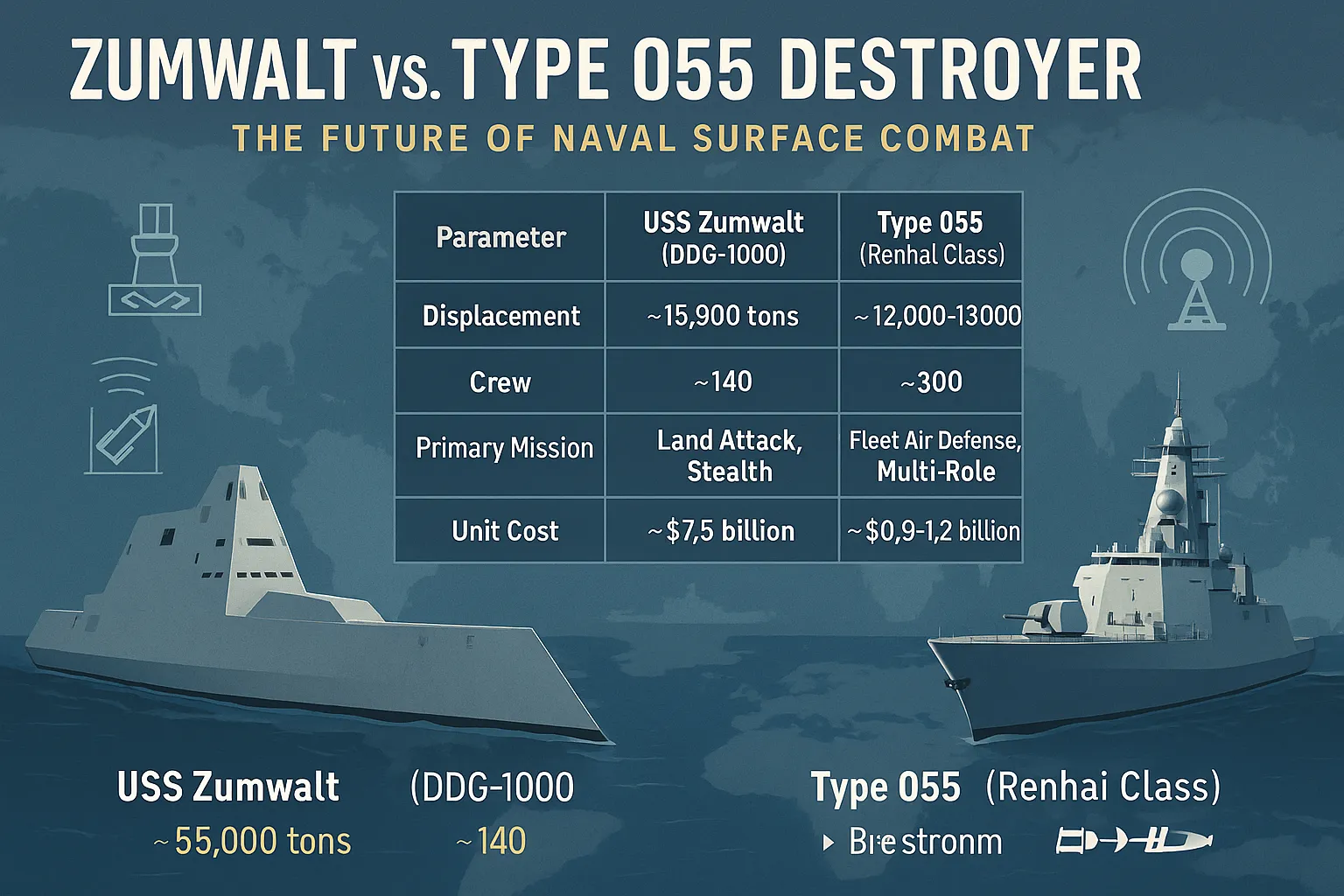
2. Technical Specifications Comparison
| Parameter | USS Zumwalt (DDG-1000) 🇺🇸 | Type 055 (Renhai-class) 🇨🇳 |
|---|---|---|
| Displacement | ~16,000 tons | ~13,000 tons |
| Length | 186 m | ~180 m |
| VLS Cells | 80 (Mk 57 PVLS) | 112 (Universal VLS) |
| Propulsion | Integrated Electric (~78 MW) | COGAG Gas Turbines |
| Primary Role | Hypersonic Strike / Surface Fire | Fleet Air Defense / Multi-Role |
| Unit Cost | ~$4.0 Billion+ | ~$1.0–$1.2 Billion (Est.) |
Key Design Philosophy Differences
- Zumwalt: Revolutionary technology demonstrator. Optimized for signature management (Stealth), automation, and electrical power margin.
- Type 055: Evolutionary scaling. Optimized for missile volume, carrier-group integration, and scalable production.
3. Stealth and Signature Management
Zumwalt’s Ghost Profile
The Zumwalt achieves a “ghost-like” radar signature through its Tumblehome hull, enclosed deckhouse, and Peripheral VLS (PVLS). While exact RCS values are classified, open sources frequently compare its return to that of a small fishing boat, despite being 186 meters long.
Type 055’s Balanced Approach
The Type 055 incorporates stealth features like an enclosed integrated mast and angled superstructure, but prioritizes weapons capacity over absolute invisibility. It is “low observable,” but not a true “stealth ship” in the Zumwalt sense.
Verdict: Zumwalt wins on pure stealth. Type 055 wins on balancing stealth with utility.
4. Combat Systems and Firepower
Sensors: SPY-3 vs Type 346B
- Zumwalt: Features the AN/SPY-3 Multi-Function Radar (X-band). Originally designed for horizon search and volume fire support, its role has shifted towards supporting precision strikes.
- Type 055: Utilizes the massive Type 346B AESA Radar (S/C-band). Its larger aperture is optimized for long-range volume search and tracking ballistic missiles, similar to the US Aegis system.
The Missile Gap: 80 vs 112 Cells
The most critical disparity lies in volume.
- Zumwalt (80 Cells): Uses the Mk 57 PVLS. While fewer in number, these cells are wider and deeper, designed to house massive future missiles.
- Type 055 (112 Cells): Uses a “Universal VLS” capable of hot and cold launch. The sheer number of cells allows for a deeper magazine of air-defense interceptors (HHQ-9) and anti-ship missiles (YJ-18, YJ-21).
5. Propulsion: The Electric Advantage
The Zumwalt is built around an Integrated Electric Propulsion (IEP) system generating ~78 MW of power. This massive power margin is its “ace in the hole,” theoretically allowing it to host future Directed Energy Weapons (Lasers) that conventional ships like the Type 055 (Gas Turbine) cannot support without major refits.
6. Cost-Effectiveness: The Scale Problem
| Metric | Zumwalt Class | Type 055 Class |
|---|---|---|
| Fleet Size | 3 Ships (Capped) | 8+ Ships (Growing) |
| Cost Per VLS Cell | ~$50 Million | ~$9 Million (Est.) |
| Production Status | Program Ended | Active Mass Production |
The Lesson: Revolutionary tech stacks (Zumwalt) compound risk. If scale collapses, per-unit cost skyrockets. Evolutionary tech stacks (Type 055) allow for affordable mass production.
7. Conclusion: Divergent Paths
Neither approach is “wrong”—they reflect different strategic needs.
- The Zumwalt is a specialized sniper—a stealthy, high-tech platform now evolving into a hypersonic carrier.
- The Type 055 is a line linebacker—a heavy hitter designed to protect carriers and project power in numbers.
The optimal future warship likely lies in the middle: blending Zumwalt’s power generation with Type 055’s production scalability.
❓ FAQ: Zumwalt vs Type 055
Q: Which ship is more powerful?
A: In a one-on-one duel, Zumwalt’s stealth gives it the first-shot advantage. However, in a fleet battle, Type 055’s superior missile capacity (112 vs 80 cells) and radar coverage make it a more impactful strategic asset.
Q: Is the Type 055 a cruiser or a destroyer?
A: While China calls it a destroyer (Type 055), the US Navy classifies it as a Cruiser (CG) due to its size (13,000 tons) and command capabilities.
Q: Does Zumwalt carry hypersonic missiles?
A: Not yet, but integration is underway. The US Navy is removing the 155mm gun turrets to install launchers for the Conventional Prompt Strike (CPS) hypersonic missile, expected by the late 2020s.