
• Login
UltiDefense: Military Tech Comparisons & Modern Warfare Analysis
  • Defense Systems
    • Air Platforms
      • Fighter Jets
      • Drones
      • Attack Helicopters
      • Strategic Bombers
    • Land Systems
      • Main Battle Tanks
      • Artillery & Firepower
      • Infantry Fighting Vehicles
      • Military Logistics and Support Vehicles
      • Soldier Systems & Robotics: UGV, Exoskeleton, and Modern Infantry Integration
    • Integrated Defense Systems
      • Ballistic Missile Defense
      • Air Defense Systems
    • Missiles & Munitions
      • Air-to-Air & Anti-Ship Missiles
      • Cruise Missiles
      • Strategic & Hypersonic Weapons
    • Naval
      • Aircraft Carriers
      • Submarines
      • Surface Combatants
      • Unmanned Maritime Systems
    • Future Tech & Innovations
      • Sensors and Avionics
  • Comparisons
  • Space Warfare
    • Counter-Space & ASAT
    • Spaceplanes & Launch Vehicles
    • Military Satellites & ISR
  • Defense News
  • Military Life
  • Policy, Budget and Geopolitics
  • Cyber Security & Electronic Warfare
No Result
View All Result
Defense News
No Result
View All Result

Home - Cyber Security & Electronic Warfare - S-400 Missile System: How Its ECM Suite Compares to Western Countermeasures

S-400 Missile System: How Its ECM Suite Compares to Western Countermeasures

George Schouten by George Schouten
December 21, 2025
in Cyber Security & Electronic Warfare, Air Defense Systems
0
S-400 Missile System: How Its ECM Suite Compares to Western Countermeasures
160
SHARES
2k
VIEWS
Share on Twitter

Scenario: An Israeli F-35 crosses into Syrian airspace. Somewhere below, a Russian S-400 battery commander faces an impossible choice:

  • Option A: Turn on radar → Track the jet → Expose position → Get targeted in minutes.
  • Option B: Stay silent → Survive → Let the enemy through.

This highlights the critical weakness in S-400 Electronic Warfare defense. It has nothing to do with missile range.

Executive Summary: The S-400 Triumf isn’t defeated by better missiles—it is paralyzed by a doctrine older than radar itself: “To emit is to die.” This definitive analysis of S-400 Electronic Warfare explains how modern NATO jamming and SEAD kill-chains force Russia’s most advanced air defense into a lose-lose dilemma.

Estimated reading time: 14 minutes


1. Introduction: The Missile Trap

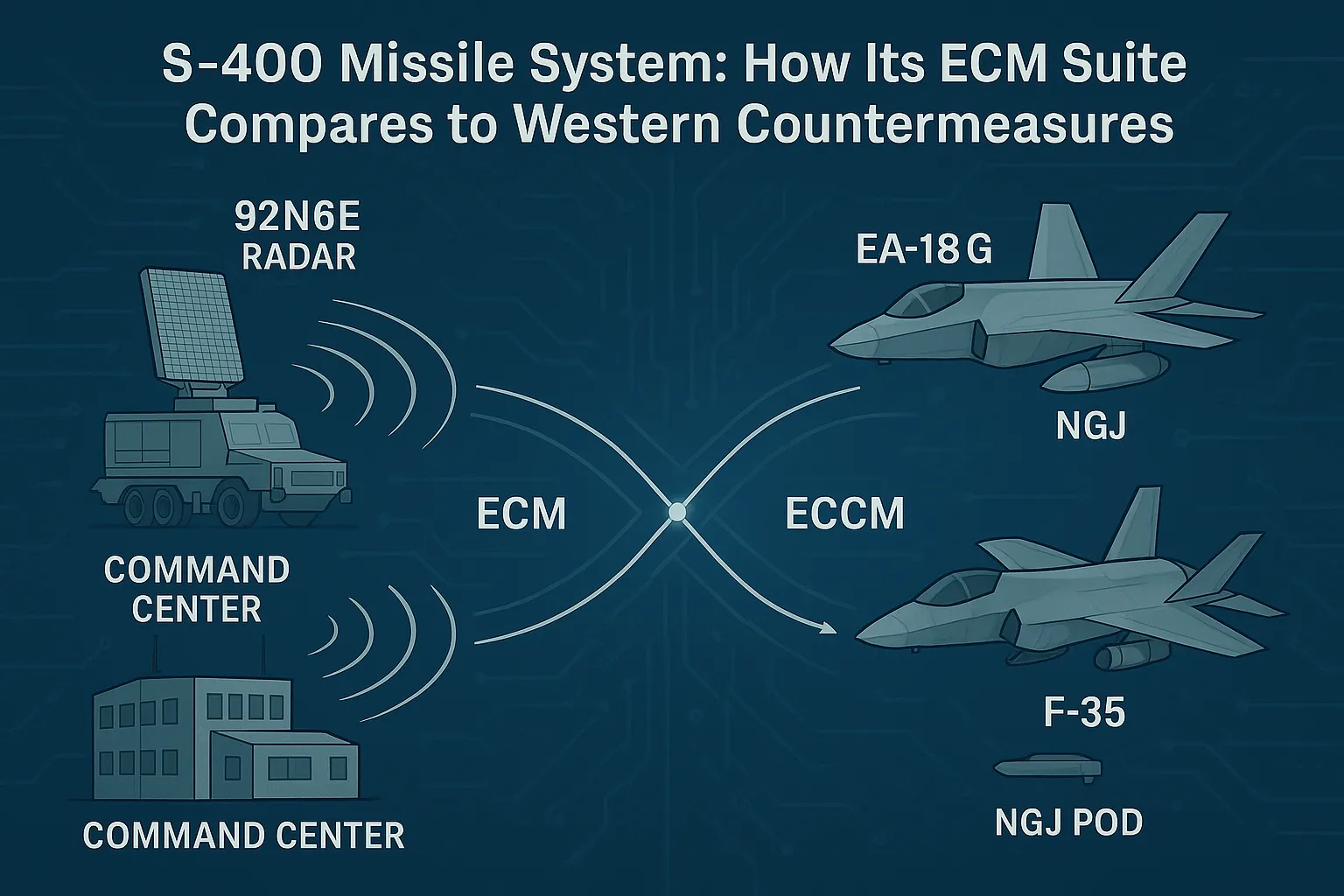
Most analysts fixate on the “400 km range” of the S-400’s 40N6E missile. That is a trap. The system’s true combat value is defined by its integrated network: the 92N6E “Grave Stone” fire-control radar and the 55K6E command post. Russian doctrine treats this grid as survivable—but modern S-400 Electronic Warfare capabilities are struggling to keep up with the pace of NATO’s digital dominance.

2. Operational Context: Syria & Ukraine

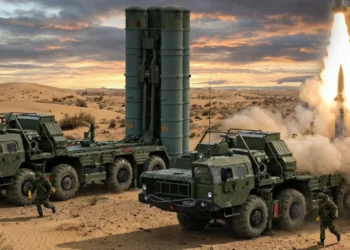
Syria (The Silent Standoff): Since 2017, the Israeli Air Force has struck targets in Syria repeatedly, often near S-400 batteries. Why didn’t the S-400 shoot? It wasn’t a technical failure; it was EMCON (Emission Control). Operators kept radars silent to avoid giving away their electronic signature to ELINT aircraft like the RC-135 Rivet Joint. In the game of S-400 Electronic Warfare, silence is the only armor.

⚡ The S-400 Death Spiral

📡

Step 1: Radar ON

92N6E searches for target

📍

Step 2: ELINT Lock

Enemy geolocates signal

💥

Step 3: Targeted

HARM / Strike inbound

This is why the S-400 often prefers silence over certainty.

Ukraine (The Stress Test): In Ukraine, Russia’s air defense nodes have been systematically hunted. The conflict has exposed the fragility of the S-400 Electronic Warfare architecture when faced with AGM-88 HARM missiles and Storm Shadow cruise missiles. The lesson? A networked defense has a single point of failure: The Radar. Kill the radar, and the battery is useless.

3. Comparative Analysis: S-400 vs NATO EW

ParameterS-400 Electronic Warfare 🇷🇺NATO EW (Offensive) 🇺🇸
Detection LogicActive Radar (Must Emit)Passive Sensors (Silent)
SurvivabilityLow when activeHigh (Standoff)
CountermeasureFreq. Hopping / LPIAESA Jamming (NGJ)
AdvantagePower (Ground Based)Stealth & Networking
WinnerNATO (Due to Distributed EW Architecture)

💡 Key Insight: “The S-400 doesn’t lose because its missiles are bad. It loses because modern warfare punishes radar emissions faster than any missile can fly.”

4. The “Wild Weasel” Trap: Advanced SEAD Tactics

Modern SEAD (Suppression of Enemy Air Defenses) tactics have evolved far beyond the Vietnam-era “fly and shoot.” Today, the primary threat to S-400 Electronic Warfare units is the ADM-160 MALD (Miniature Air-Launched Decoy).

The MALD is a small, programmable cruise missile that does not carry a warhead. Instead, it carries an electronic signature generator. It can mimic the radar cross-section (RCS) of a B-52 bomber, an F-16 fighter, or even a stealth aircraft. This creates a “saturation attack” on the S-400’s scope.

“Decoys don’t destroy the S-400. They force it to commit suicide.”

Once the S-400 operator is flooded with 50+ incoming targets, they are forced to turn on their fire-control radar to discriminate between real jets and decoys. The moment they emit high-power tracking beams, they are geolocated by circling F-35s or RC-135s. Seconds later, an AGM-88E AARGM or a GPS-guided HIMARS rocket is inbound to those coordinates.

5. Conclusion: The Emission Dilemma

The S-400 remains formidable—when it can afford to turn on its radar. But in contested airspace, that is a luxury. The iron law of modern air defense is simple:

  • ❌ Emit → Get Targeted → Die
  • ❌ Stay Silent → Survive → Lose the Mission

Until Russia solves the problem of “seeing without being seen” (through Passive Radar or IRST networks), the greatest enemy of S-400 Electronic Warfare units will not be a missile, but their own radar beam.

📬 Get Deep-Dive Defense Analysis

Subscribe for geopolitical breakdowns the mainstream media won’t touch.

❓ FAQ: S-400 Electronic Warfare

Q: Can the F-35 jam the S-400?
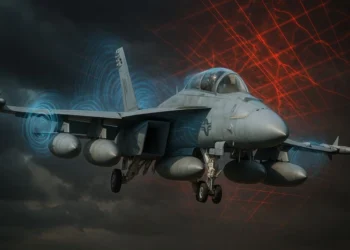
A: Yes. The F-35 can detect and geolocate the S-400’s radar emissions using its AN/ASQ-239 suite. While it doesn’t “blind” it with raw power like a Growler, it dismantles the S-400 Electronic Warfare kill chain by locating the nodes for destruction.

Q: Has the S-400 been destroyed in combat?
A: Yes. Multiple S-400 components (radars and launchers) have been confirmed destroyed in the Ukraine conflict via HARM missiles, Storm Shadow cruise missiles, and precision strikes.
Tags: 92N6E Grave StoneAnti-Access Area DenialbestCognitive EWECCMElectronic WarfareF-35 EW SuiteNext Generation JammerRussian IADSS-400 TriumfSEAD TacticsUkraine Air DefenseUltiDefense

Related Posts

A Russian S-500 Prometheus air defense system conducting a missile test launch in a desert environment during sunset.
Air Defense Systems

S-500 Prometheus: The Ultimate Shield Against Hypersonic Threats?

December 19, 2025
US Navy EA-18G Growler electronic warfare aircraft emitting jamming signals to blind enemy radar systems.
Cyber Security & Electronic Warfare

EA-18G Growler: The Electronic Assassin That Makes Stealth Untouchable

December 13, 2025
Cognitive Radar and Low Probability of Intercept Technologies: Evolution of Modern Detection Systems
Cyber Security & Electronic Warfare

Cognitive Radar and Low Probability of Intercept Technologies: Evolution of Modern Detection Systems

November 10, 2025
Map illustration showing Russia's GPS jamming and spoofing zones in Ukraine and the Black Sea. Icons represent defensive technologies like CRPA antennas and Inertial Navigation Systems countering the electronic warfare threats.
Cyber Security & Electronic Warfare

Auto Russia’s GPS War in Ukraine: Spoofing Attacks and Defense Technologies

December 14, 2025
F-35 and Su-57 aircraft comparison
Cyber Security & Electronic Warfare

The True Cost of Cyber Resilience: F-35 vs. Su-57 Network Defense and Integration

December 14, 2025
Next Post
Cognitive Radar and Low Probability of Intercept Technologies: Evolution of Modern Detection Systems

Cognitive Radar and Low Probability of Intercept Technologies: Evolution of Modern Detection Systems

Leave a Reply Cancel reply

Your email address will not be published. Required fields are marked *

About

Ultidefense is a digital platform focused on modern defense, military technology, and strategic innovation.
We explore how advancements in aerospace, AI, cybersecurity, and autonomous systems are transforming the global defense landscape.
Our mission is to connect technical insight with strategic awareness, helping readers understand the technologies shaping modern security and warfare.
At Ultidefense, we believe knowledge is strength — and our goal is to deliver clear, factual, and forward-looking analysis on the systems, science, and strategies defining the future of defense.

Categories

  • Comparisons
  • Cyber Security & Electronic Warfare
  • Defense News
  • Defense Systems
    • Air Platforms
      • Attack Helicopters
      • Fighter Jets
      • Global Military Drones: UAV Systems, Autonomy, and Unmanned Warfare
      • Strategic Bombers
    • Future Tech & Innovations
      • Sensors and Avionics
    • Land Systems
      • Artillery & Firepower: Self-Propelled Guns, Rocket Systems, and Barrage Analysis
      • Main Battle Tanks: Armor, Firepower, and Modern MBT Comparisons
    • Missiles & Munitions
      • Strategic & Hypersonic Weapons
    • Space Warfare
      • Military Satellites & ISR
      • Spaceplanes & Launch Vehicles
  • Integrated Defense Systems
    • Air Defense Systems
  • Military Life
  • Naval Systems: Warships, Carriers, and Maritime Defense Technology
    • Aircraft Carriers
    • Submarines
  • Policy, Budget and Geopolitics
  • Unmanned Maritime Systems

Recent Posts

  • Which Military Boot Camp is the Hardest? All 6 US Branches Ranked
  • The SFAS Fallout: What Happens After You Fail Special Forces Selection
  • The Algorithm of War:The Anatomy of Conflict in 2050
  • Russia’s Avangard HGV: Breaking the Shield of Global Missile Defense

Newsletter

Pages

  • About Us
  • Home
  • Contact Us
  • Privacy Policies
  • Terms of Service
  • Disclaimer

© 2025 Defense Systems

Welcome Back!

Login to your account below

Forgotten Password?

Retrieve your password

Please enter your username or email address to reset your password.

Log In
No Result
View All Result
  • Defense Systems
    • Air Platforms
      • Fighter Jets
      • Drones
      • Attack Helicopters
      • Strategic Bombers
    • Land Systems
      • Main Battle Tanks
      • Artillery & Firepower
      • Infantry Fighting Vehicles
      • Military Logistics and Support Vehicles
      • Soldier Systems & Robotics: UGV, Exoskeleton, and Modern Infantry Integration
    • Integrated Defense Systems
      • Ballistic Missile Defense
      • Air Defense Systems
    • Missiles & Munitions
      • Air-to-Air & Anti-Ship Missiles
      • Cruise Missiles
      • Strategic & Hypersonic Weapons
    • Naval
      • Aircraft Carriers
      • Submarines
      • Surface Combatants
      • Unmanned Maritime Systems
    • Future Tech & Innovations
      • Sensors and Avionics
  • Comparisons
  • Space Warfare
    • Counter-Space & ASAT
    • Spaceplanes & Launch Vehicles
    • Military Satellites & ISR
  • Defense News
  • Military Life
  • Policy, Budget and Geopolitics
  • Cyber Security & Electronic Warfare

© 2025 Defense Systems