

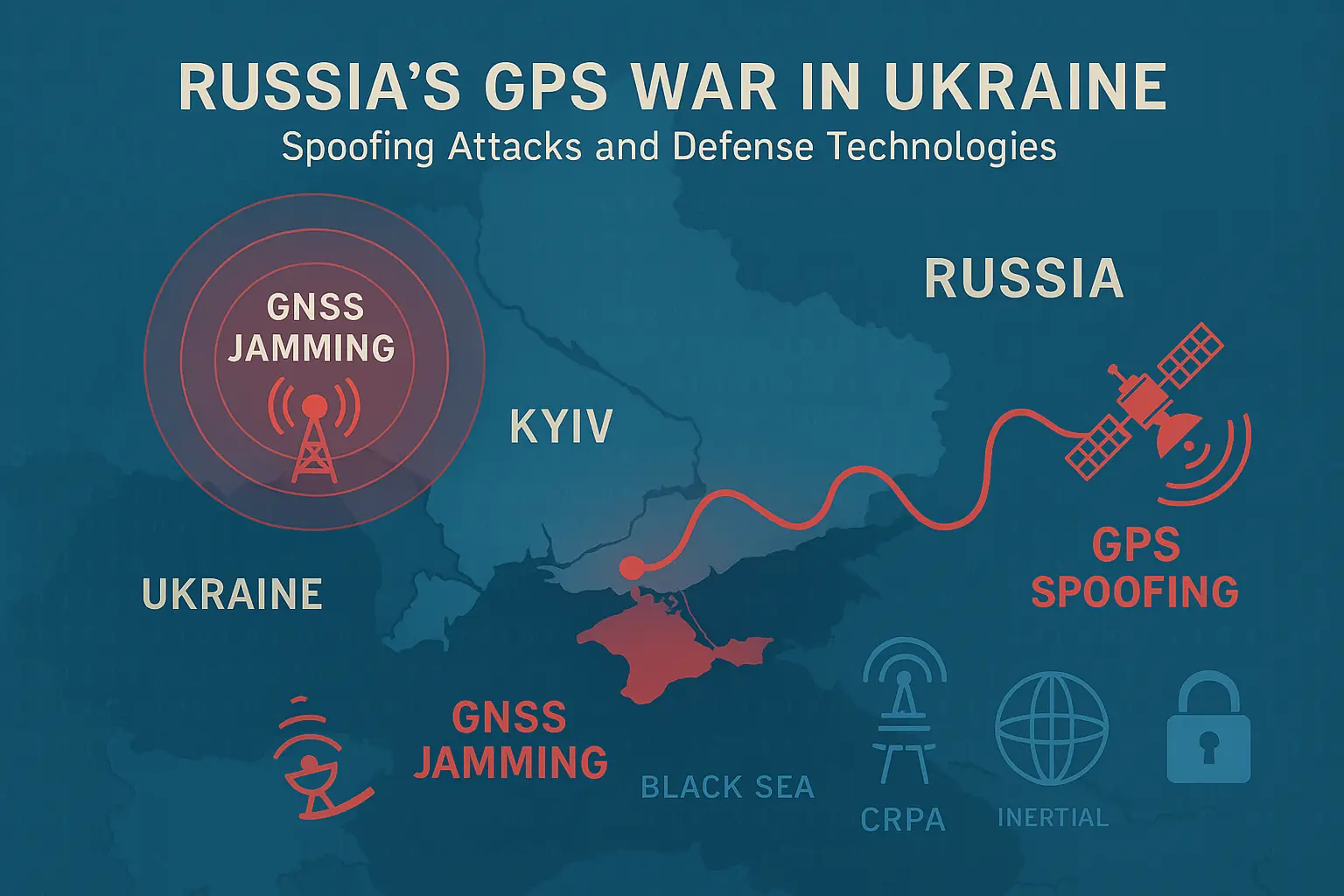
In modern warfare, the backbone of every precision strike, autonomous weapon, and coordinated maneuver is the
Positioning, Navigation, and Timing (PNT) ecosystem. Global Navigation Satellite Systems (GNSS) — led by GPS — form the
invisible scaffolding of missile guidance, drone operations, artillery correction, and battlefield communications.
The war in Ukraine has revealed how this digital foundation can be weaponized. Through a sophisticated mix of
jamming and spoofing, Russia has executed a multi-layered electronic warfare (EW) campaign designed to degrade enemy
situational awareness while causing unintended risks to civilian air and maritime traffic across Europe.
From Fixed Platforms to Mobile Units: Russia’s Tactical Architecture
Open-source intelligence and battlefield reporting reveal clear patterns in how Russia structures its GNSS interference operations.
1. Maritime Platforms and Strategic Persistence
Russia has mounted GNSS spoofing equipment on offshore drilling platforms, gas rigs, and coastal EW facilities, creating persistent
electronic bubbles over strategic maritime corridors. These elevated, unobstructed sites provide wide-area coverage — but also
become high-value, easily targetable assets.
Tactical Note: Ukrainian forces have successfully struck at least one such offshore installation reportedly connected to
spoofing operations, exposing the physical vulnerability of fixed EW infrastructure.
2. Regional Jamming Networks (The “Baltic Shield”)
Since late 2023, massive GNSS interference events have plagued the Baltic Sea region, affecting thousands of civilian flights from Poland to Finland. Analysts attribute this to the Russian “Tobol” EW system based in Kaliningrad. Unlike tactical jamming, this is strategic-level area denial, effectively creating a permanent “electronic shield” over NATO’s eastern flank.
3. Hybrid and Adaptive Tactics
Russian EW units employ a blended doctrine: high-power area jammers (like the R-330Zh Zhitel and Krasukha-4) combined with
precision spoofing modules. This hybrid approach allows simultaneous denial and deception, creating an “electronic fog” that
complicates Ukrainian targeting cycles, drone routing, and artillery fire adjustment.
Technical Capability Assessment: How Advanced Is Russia?
Russia’s EW inventory is a mix of mature Soviet-era designs, modernized digital emitters, and improvised field solutions. Two
strategic objectives dominate its PNT interference strategy:
- Wide-Area Jamming: Large emitter arrays saturating GNSS frequency bands to deny coverage.
- Targeted Spoofing: Precision signal injection that manipulates a receiver’s calculated position and time.
Jamming is conceptually simple but requires significant power. Spoofing, however, demands fine timing synchronization, phase
alignment, and precise waveform generation. Evidence suggests Russia has integrated spoofing capabilities into airborne, naval,
and ground platforms — although effectiveness remains constrained by line-of-sight geometry and terrain masking.
The most visible symbol of this electronic arms race is the Russian Kometa-M CRPA antenna found on Shahed-136 drones. Despite Western sanctions, this small, distinct square antenna has allowed cheap suicide drones to penetrate advanced jamming fields, proving that antenna-level hardening is often more decisive than the sophistication of the drone itself.
across different domains, create overlapping interference zones that are difficult to counter.
Layered Architecture of Defense: The Western Anti-Spoofing Response
No single system can fully protect PNT. Effective defense requires a layered, multi-constellation, multi-sensor architecture.
1. Multi-Constellation GNSS Receivers
Systems that simultaneously use GPS, GLONASS, Galileo, and BeiDou are inherently more resilient. Jamming or spoofing four
frequency bands is exponentially harder than attacking only GPS L1.
2. Inertial Navigation System (INS) Fusion
Fusing GNSS readings with inertial data allows platforms to maintain accurate trajectories during temporary GNSS outages.
Sensor-fusion algorithms smooth out corrupted satellite data, reducing vulnerability to spoofing.
3. Antenna-Level Hardening (CRPA)
Controlled Reception Pattern Antennas (CRPA) employ adaptive null-steering to block interfering ground-based signals while
maintaining connectivity with satellites overhead. This represents the most effective hardware-level defense against broad-area
jamming.
Strategic Evaluation: Gains and Trade-Offs
Russia’s EW doctrine balances scalable jamming (for area denial) and precision spoofing (for tactical disruption). However, each
approach carries inherent trade-offs.
- Fixed Emitters: Offer persistent, theater-wide influence but become highly vulnerable to long-range strike systems.
- Mobile Emitters: Harder to target but provide only localized coverage.
While Russia has demonstrated the ability to degrade PNT across broad regions, sustaining dominance requires constant adaptation
against evolving Western anti-jamming technologies.
Weakness Analysis: Limitations of Russia’s GNSS Interference Strategy
| Weakness | Description |
|---|---|
| Line-of-Sight Constraints | GNSS spoofing requires direct signal access, limiting strategic depth. |
| Targetability of Fixed Emitters | Offshore and coastal jamming stations are vulnerable to missile strikes. |
| Collateral Civilian Impact | Air and maritime navigation hazards risk international backlash. |
| Countermeasures Are Scaling | CRPA, INS fusion, and multi-constellation receivers are reducing vulnerability. |
FAQ
How does GNSS spoofing differ from jamming?
Jamming denies satellite signals by overpowering them with noise. Spoofing replaces them with fake signals, tricking receivers into miscalculating location and time.
What is the “Tobol” system?
Tobol is a strategic Russian Electronic Warfare system, with units reportedly in Kaliningrad, designed to protect satellites but also capable of massive area-denial jamming, as seen in the Baltic region.
Has Russia used spoofing effectively in Ukraine?
Yes, but mostly in localized tactical applications. Wide-area spoofing remains difficult to perform continuously due to physics constraints.
What is the best defense against GNSS denial?
A layered approach: multi-constellation receivers, INS fusion, CRPA antennas (like the Kometa-M equivalent), and real-time anomaly detection algorithms.
Conclusion: Resilience Is Systemic
The war in Ukraine has proven that PNT denial and deception can have strategic impact — shaping targeting cycles, disrupting
drone operations, and complicating command-and-control networks. The key lesson is that PNT resilience cannot rely on a single
system. It must be built into the entire navigation ecosystem.
In the electromagnetic battlespace, victory will not favor the side with the most powerful jammer, but the side with the
most adaptive, multi-layered, and self-healing PNT architecture.