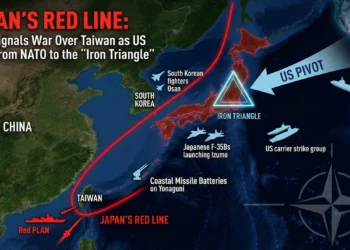


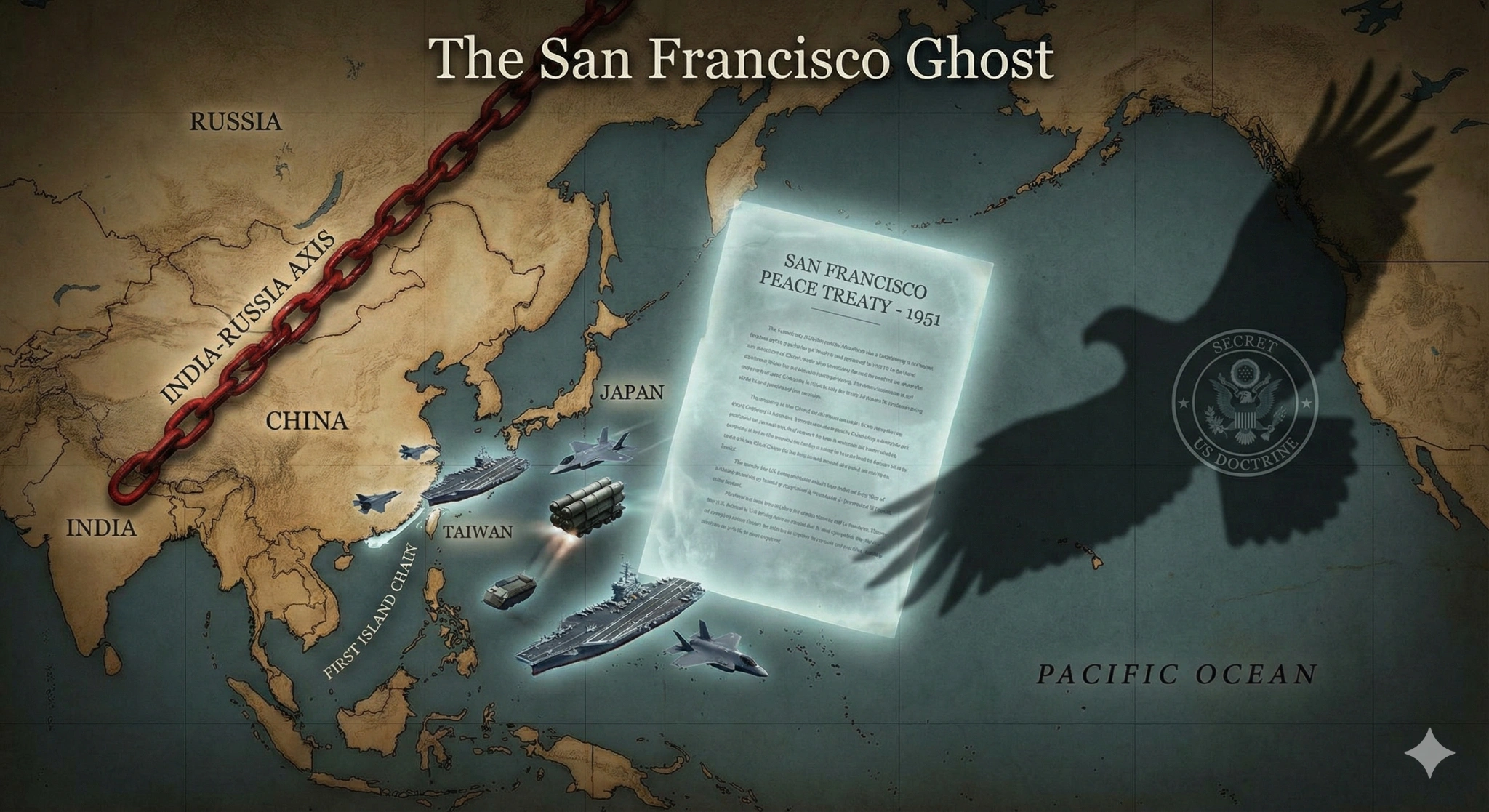
One sentence from Tokyo was enough to pierce the strategic ambiguity of East Asia. When Japanese leadership recently referenced the San Francisco Peace Treaty to define its stance on Taiwan—stating Japan “has no position to determine Taiwan’s legal status”—it wasn’t just a history lesson. It was a diplomatic declaration of war.
To the Chinese Communist Party (CCP), this is not merely a legal dispute; it is an attack on the Post-WWII Order. But to understand why this 74-year-old document is suddenly radioactive, we must look beyond the text. We must look at the US Grand Strategy Asia, the fragility of the First Island Chain Strategy, and the wildcard that keeps Washington awake at night: the unexpected resilience of India-Russia defense ties.
Why is China Angry About San Francisco Treaty?
The core of the current crisis lies in what was omitted in 1951. The treaty forced Japan to renounce sovereignty over Taiwan and the Penghu Islands, but deliberately—and strategically—failed to specify the beneficiary.
1951 Treaty vs Cairo Declaration
The legal friction stems from a direct contradiction.
The Cairo Declaration (1943) and Potsdam Proclamation (1945) explicitly stated that Taiwan should be returned to “China.”
The San Francisco Peace Treaty (1951) left this blank.
Because the People’s Republic of China (PRC) was excluded from the 1951 conference, Beijing views the treaty as an illegitimate attempt to rewrite history. Whenever a politician like Sanae Takaichi highlights this treaty, Beijing hears a challenge to its sovereignty, fearing that Japan is laying the legal groundwork for an independent Taiwan.
The Legal Status of Taiwan & US Grand Strategy Asia
Why does the West cling to this ambiguity? The answer lies in the unstated US Grand Strategy Asia. Washington knows that a direct kinetic war with China is costly. Instead, the strategy appears to be one of “entrapment and attrition.”
Did Japan Renounce Sovereignty Over Taiwan?
Yes, but by not naming a successor state, the treaty created a “legal void.” This void allows the US to argue that the Legal Status of Taiwan remains “undetermined.” This is the foundation of Strategic Ambiguity.
The “Porcupine” Doctrine: By keeping the status ambiguous, the US justifies the continuous arming of the island, turning it into an indigestible “porcupine” for the PLA.
Attrition over Invasion: The goal is not necessarily to fight a war, but to force the PLA into a costly arms race that drains China’s economic resources, leveraging the Taiwan Strait Crisis as a permanent pressure point.
Okinawa Strategic Importance for US Navy
While diplomats argue over treaties, the real chessboard is the First Island Chain Strategy. This strategy aims to bottle up the Chinese Navy within the Yellow and South China Seas. The linchpin of this chain is not Taiwan—it is Okinawa.
Ryukyu Islands Reversion and the Secret Deal
History reveals a transactional tragedy. Chiang Kai-shek, desperate for US protection against Mao’s forces, tacitly traded away Chinese claims to the Ryukyu Islands (Okinawa) in exchange for American security guarantees.
Today, the Okinawa strategic importance for US Navy cannot be overstated. It hosts the largest concentration of US military power in the region. Without Okinawa, the US capacity to project power over Taiwan collapses. This explains why the “reversion” of Okinawa to Japan in 1972 never led to demilitarization; it simply legalized the island’s role as an unsinkable aircraft carrier.
India-Russia Defense Ties: The Eurasian Wildcard
While Washington focuses on the Pacific rim, a massive geopolitical failure is brewing in its rear-view mirror. The US Indo-Pacific strategy relies heavily on The Quad (US, Japan, Australia, India) to encircle China. However, India’s refusal to join anti-China alliance fully has shocked Western planners.
Breaking the Containment
Despite immense pressure, India-Russia defense ties have deepened.
Hardware Dependency: India continues to operate Russian S-400 systems and leases nuclear submarines.
Energy Realpolitik: By purchasing Russian oil, India has helped Moscow bypass Western sanctions.
This creates a nightmare scenario for the US: A “neutral” India that refuses to join a naval blockade against China. Furthermore, the International North-South Transport Corridor (INSTC) between India, Iran, and Russia provides a trade route that is immune to US naval power, effectively neutralizing the US offshore balancing doctrine explained by many strategists as the ultimate weapon against Eurasian powers.
Conclusion: Geopolitical Fault Lines in 2025
The invocation of the San Francisco Peace Treaty is not an isolated incident. It is a signal flare. We are witnessing a convergence of timelines:
Legal: The weaponization of the San Francisco Peace Treaty Taiwan clauses.
Military: The race to harden defenses before PLA Modernization 2027 targets are met.
Geopolitical: The consolidation of an India-Russia axis that refuses to bow to the Post-WWII Order.
For defense analysts, the lesson is clear: The next war may start over a dusty treaty from 1951, but it will be fought on the Geopolitical Fault Lines of a multipolar world that no longer follows American rules.