

Introduction: Early Signals of a Strategic Shift
Over the past several days, various commentators and defense observers have suggested that France and Ukraine may be exploring a deeper level of bilateral defense cooperation. While official details remain limited and no comprehensive package has been formally disclosed, the emerging discussions seem to point toward an ambitious set of capabilities that could significantly influence Ukraine’s long-term security posture.
Although nothing should be considered final at this stage, the scope of what is being circulated among analysts appears to include, at least conceptually, advanced combat aircraft, next-generation air-defense technology, and integrated sensor systems. These possibilities raise important strategic questions worth examining.
Rafale Fighters: A New Air Superiority Option?
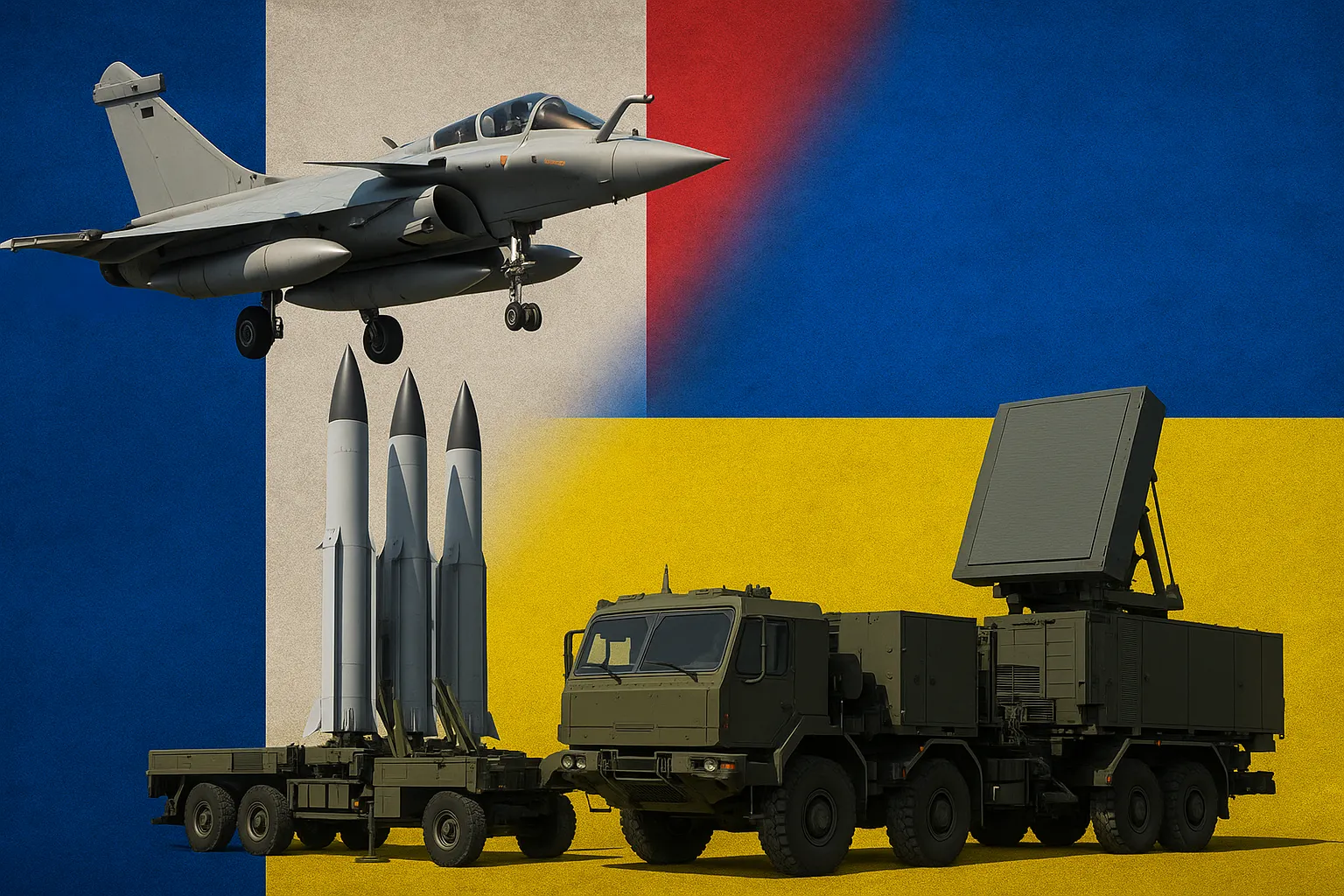
Some defense specialists have mentioned the prospect that Ukraine could be evaluating French Rafale multirole fighters as part of a wider modernization effort. If such conversations are indeed taking place, they would reflect Kyiv’s broader intent to diversify its future air fleet and align more closely with Western aerospace standards.
- The Capability: The Rafale, with its proven combat record and robust sensor-fusion architecture, would theoretically provide Ukraine with improved long-range strike, air-superiority, and deep interdiction capabilities.
- The Reality Check: At this point, however, discussions surrounding aircraft numbers, configurations, or delivery timelines remain speculative and should be interpreted only as conceptual exploration rather than concrete planning.
SAMP/T NG and Aster 30 B1 NT: Next-Gen Air Defense
There has also been increasing commentary on the possibility that the next-generation SAMP/T NG system, paired with Aster 30 B1 NT interceptors, might be considered within a future Franco-Ukrainian framework. This system, still in its modernization cycle, is designed to address a wider spectrum of airborne threats, including certain classes of tactical ballistic missiles.
Should Ukraine eventually gain access to such a capability, its layered air-defense network could undergo a meaningful transformation. The B1 NT interceptor — reportedly engineered to counter more demanding ballistic profiles — would, in theory, extend Ukraine’s ability to manage high-velocity, high-altitude threats that traditional medium-range SAM systems struggle to defeat.
Note: Again, it is essential to emphasize that these discussions appear to be preliminary and largely analytical, rather than the result of official confirmations.
GF300 Radars and Unmanned Ecosystem
In parallel, French industry observers have mentioned the potential relevance of long-range radars such as the GF300, alongside a variety of unmanned aerial systems. These platforms, if ever integrated, might contribute to a more comprehensive sensor-to-shooter chain, enhancing command-and-control efficiency and situational awareness.
Such systems, in a layered defense context, could theoretically strengthen Ukraine’s early-warning capabilities, particularly against complex missile trajectories or saturation drone attacks. Still, these notions stem from strategic speculation rather than formal procurement announcements.
Strategic Interpretation: What Is France Signaling?
Although the exact nature of any upcoming agreements is uncertain, the breadth of the systems being publicly discussed suggests that France may be positioning itself as a long-term defense partner for Kyiv. This would align with Paris’ broader strategic objective of reinforcing European defense autonomy while countering regional instability.
Rather than indicating a single momentous deal, the conversation might reflect a gradual convergence between French industrial capacity and Ukraine’s evolving operational requirements. The symbolism of such cooperation — even at the conceptual stage — underscores France’s potential willingness to play a prominent strategic role in Ukraine’s future air and missile-defense architecture.
Conclusion: Possibility, Not Confirmation
At this point, everything being circulated should be treated as possibility, not confirmation. What is emerging is not a finalized package but rather the outline of a potential trajectory: one in which high-end fighter aircraft, next-generation air-defense systems, and advanced sensor technologies could someday converge into a wider European effort to bolster Ukraine’s defense resilience.
As always in matters of international security, the distinction between discussion and decision is significant. Still, the very emergence of these ideas — however tentative — offers valuable insight into how future strategic partnerships in Europe might evolve.