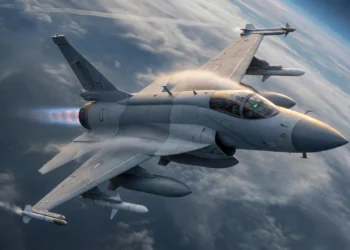


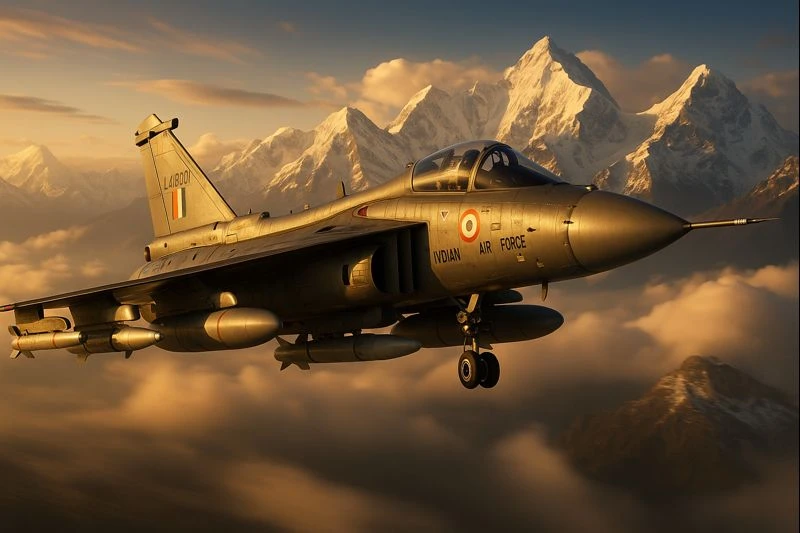
Executive Summary: The LCA Tejas Mk-1A is not just a replacement for the aging MiG-21; it is India’s statement of intent in the 4.5-generation arena. Featuring an AESA radar, advanced Electronic Warfare (EW) suite, and indigenous Astra missiles, it aims to close the gap with regional rivals. This analysis breaks down its technical architecture and pits it directly against the JF-17 Block III.
Estimated reading time: 12 minutes
Contents
- 1. Introduction: From “Flying Coffins” to Indigenization
- 2. Technical Deep Dive: The AESA & Avionics Revolution
- 3. Performance & Kinematics: The Delta Wing Advantage
- 4. The Arrow: Weaponry and BVR Capabilities
- 5. The Great Rivalry: Tejas Mk-1A vs. JF-17 Block III
- 6. Industrial Challenges: The Engine Bottleneck
- 7. Conclusion
- FAQ
1. Introduction: From “Flying Coffins” to Indigenization
For decades, the Indian Air Force (IAF) relied on the Soviet-era MiG-21, a legendary but increasingly obsolete interceptor notoriously dubbed the “Flying Coffin” due to its high accident rate. The Light Combat Aircraft (LCA) Tejas program was born from the necessity to retire these fleets and achieve strategic autonomy under the Atmanirbhar Bharat (Self-Reliant India) initiative.
The Mk-1A is not merely an incremental update; it is a structural overhaul of the original Tejas. It corrects the shortcomings of the initial operational clearance (IOC) models by integrating 40+ major improvements, primarily focusing on maintainability, sensor fusion, and electronic warfare survivability.
2. Technical Deep Dive: The AESA & Avionics Revolution
The heart of the Mk-1A’s lethality lies in its sensor suite. Unlike the mechanical radars of the past, the Mk-1A enters the digital age with Active Electronically Scanned Array technology.
📡 The Radar: Uttam AESA
While initial batches may use the Israeli ELM-2052, the primary goal is the indigenous Uttam AESA radar. Capable of tracking 50+ targets and engaging 4 simultaneously, it features Liquid Cooling and Gallium Arsenide (GaAs) TR modules, providing high resistance to jamming.
🛡️ Electronic Warfare
The Mk-1A features an integrated Self-Protection Jammer (SPJ) and a podded ELL-8222WB jammer option. This allows the aircraft to operate inside contested airspace without relying on dedicated escort jammers.
The Digital Cockpit: The avionics suite is built around a “Glass Cockpit” concept with Multi-Function Displays (MFD) and a DASH IV Helmet Mounted Display System (HMDS), allowing the pilot to target enemy aircraft simply by looking at them (High Off-Boresight capability).
3. Performance & Kinematics: The “Delta Wing” Advantage
The Tejas Mk-1A is not designed to be a brute-force interceptor like the Su-30MKI; it is a Light Combat Aircraft (LCA) optimized for agility. Built around a Compound Delta Wing configuration with relaxed static stability, the aircraft sacrifices some sustained turn rate for exceptional Instantaneous Turn Rate (ITR) and high-Alpha (Angle of Attack) handling.
Strategic Note: Unlike the base model, the Mk-1A features an In-Flight Refueling (IFR) probe, effectively nullifying the traditional “short legs” criticism of light fighters and extending its ferry range significantly.
| Metric | Specification (Mk-1A) | Operational Context |
|---|---|---|
| Maximum Speed | Mach 1.6 – 1.8 | High-altitude clean configuration. Optimized for Transonic combat. |
| Service Ceiling | 50,000+ ft (16,000 m) | Sufficient for high-energy BVR missile launches. |
| Combat Radius | ~500 – 739 km | Varies heavily by profile. Optimized for battlefield interdiction. |
| Engine | GE F404-IN20 | 84 kN Wet Thrust. Proven reliability, though currently facing supply delays. |
| G-Limits | +8G / -3.5G | Enabled by advanced Digital Fly-by-Wire (FBW). |
4. The Arrow: Weaponry and BVR Capabilities
A fighter is only as good as its spear. The Tejas Mk-1A has moved away from Russian R-73/R-77 dependency toward a Western and Indigenous mix.
- Astra Mk1: The indigenous Beyond Visual Range (BVR) missile with a range of ~110km. It is the primary stick for the Tejas.
- I-Derby ER: Israeli BVR missile with advanced datalink capabilities.
- ASRAAM: The MBDA Advanced Short Range Air-to-Air Missile for Within Visual Range (WVR) dominance.
Future Potential: Integration of the Astra Mk2 (160km+) and potentially the BrahMos-NG (miniaturized supersonic cruise missile) will transform the Mk-1A into a tactical strike platform.
5. The Great Rivalry: Tejas Mk-1A vs. JF-17 Block III
This is the comparison that defines South Asian air power. While the JF-17 (Pakistan/China) focuses on cost-effective mass, the Tejas (India) focuses on technological density.
| Feature | 🇮🇳 LCA Tejas Mk-1A | 🇵🇰/🇨🇳 JF-17 Thunder Block III |
|---|---|---|
| Radar Technology | AESA (Uttam / ELM-2052) | AESA (KLJ-7A) |
| Engine & Reliability | GE F404-IN20 (Proven, High TBO) | RD-93MA / WS-13 (Smoke issues, lower TBO) |
| Primary BVR Missile | Astra Mk1 (110km) / I-Derby ER | PL-15E (145km+ claimed) |
| Airframe Life | High Composite usage (Lighter, Stronger) | Traditional Aluminum/Metal mix |
| Fly-By-Wire | Quadruplex Digital FBW (Full envelope) | Hybrid FBW (Pitch axis only on older blocks) |
| Cost Strategy | Higher Tech / Higher Cost | “Good Enough” / Mass Production |
Verdict: The Tejas Mk-1A is aerodynamically superior and features a more reliable engine and composite structure. However, the JF-17 Block III holds a dangerous card with the long-range PL-15 missile. The winner depends on whether the Tejas can close the distance utilizing its EW suite and AESA jamming.
6. Industrial Challenges: The Engine Bottleneck
Despite the technological success, the program faces a critical hurdle: Production Rate. HAL (Hindustan Aeronautics Limited) aims to produce 16-24 aircraft per year, but supply chain issues with General Electric (GE) regarding the delivery of F404 engines have caused delays.
India is currently negotiating the domestic manufacturing of the more powerful GE F414 engine for the future Tejas Mk2, but for the Mk-1A, the timely arrival of F404 turbines remains the single biggest risk to fleet induction timelines.
7. Conclusion
The LCA Tejas Mk-1A is a coming-of-age story for Indian aerospace. It is a capable, agile, and smart 4.5-generation fighter that successfully sheds the “underdog” label. While it may face stiff competition from the JF-17 in the export market due to cost, for the IAF, it represents a massive leap in network-centric capability over the MiG-21 Bison.
❓ FAQ: Tejas Mk-1A
Technologically, yes. The Tejas features a superior composite airframe, a more reliable American engine, and a full Quadruplex Fly-by-Wire system. However, the JF-17 Block III is a formidable rival due to its integration of the long-range PL-15 missile and lower unit cost.
The Mk-1A utilizes AESA (Active Electronically Scanned Array) technology. Early units may use the Israeli ELTA ELM-2052, while the majority will feature the indigenous Indian “Uttam” AESA radar.
Currently, no. Due to integration costs and refusal from the OEM to integrate it on Israeli/Indian radars, the Tejas uses the indigenous Astra and Israeli I-Derby missiles instead of the MBDA Meteor.
The flyaway cost is estimated around $40-45 Million USD. While more expensive than the JF-17, it offers lower lifecycle costs due to the reliability of its Western engine and composite airframe.