

For years, Western analysts dismissed it. They called it a copycat. They said the canards would ruin its stealth. They mocked its underpowered Russian engines.
But in 2025, the laughter has stopped.
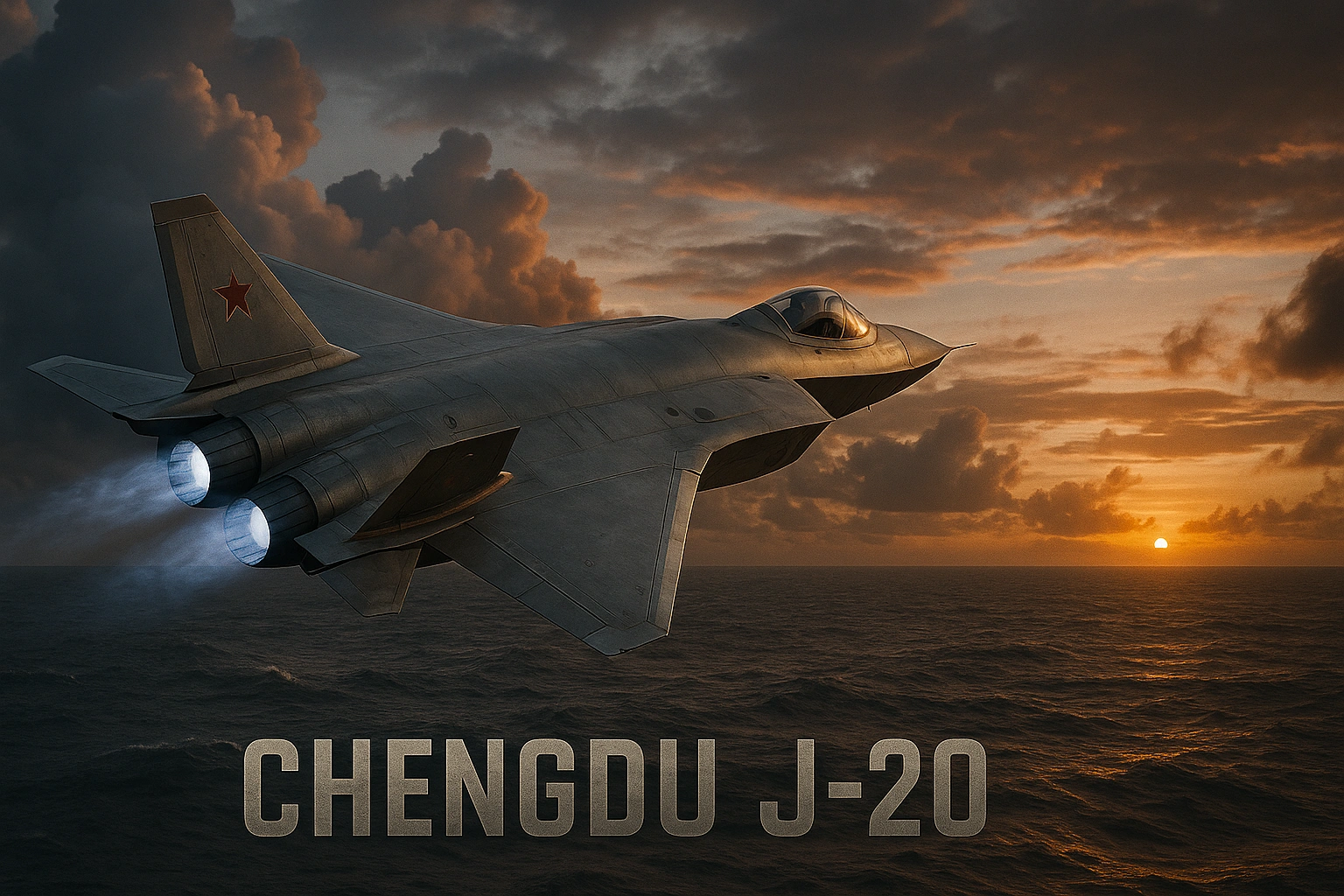
The Chengdu J-20 “Mighty Dragon” (Weilong) is now flying in significant numbers, powered by domestic WS-15 engines, and patrolling the South China Sea. It is the world’s third operational 5th-Generation stealth fighter, and arguably the most misunderstood aircraft in modern history.
Is it a match for the F-22 Raptor? Or is it a specialized assassin designed for a completely different mission? In this UltiDefense Deep Dive, we strip away the propaganda and analyze the metal.
Technical Specifications: The Dragon’s Stats
The J-20 is huge. It is significantly larger than the F-22 and F-35. This size is not an accident; it is a strategic choice.
| Feature | Chengdu J-20A / J-20B (2025 Standard) |
| Role | Air Superiority / Deep Strike Interceptor |
| Crew | 1 (Single Seat) or 2 (J-20S Variant) |
| Length | ~21.2 meters (Massive airframe) |
| Engine | 2x Shenyang WS-15 “Emei” (Target Thrust: 40,000+ lbf) |
| Max Speed | Mach 2.0 – 2.5 (Estimated with WS-15) |
| Combat Radius | >2,000 km (Designed for Long Range) |
| Weaponry | PL-15 (Long Range) + PL-10 (Short Range) |
| Stealth | Frontal VLO (Very Low Observable) |
| Radar | Type 1475 AESA (Active Electronically Scanned Array) |
| Unique Feature | Side Weapon Bays (Closed-hatch firing capability) |
1. The Engine Saga: From AL-31 to WS-15
The Achilles’ heel of the J-20 was always its heart. For a decade, it flew with underpowered Russian AL-31 engines or interim Chinese WS-10s. It was like putting a sedan engine in a Ferrari.
The 2025 Update: The integration of the WS-15 “Emei” engine has changed the game.
Thrust: The WS-15 brings the J-20 close to the kinematic performance of the F-22.
Supercruise: Reports suggest the J-20 can now supercruise (fly supersonic without afterburners), a critical requirement for a true 5th-gen fighter.
Vectoring: Newer variants are testing Thrust Vectoring Control (TVC) nozzles, granting it the agility to fight close-range if forced to.
2. Design Philosophy: The “AWACS Hunter”
This is where most comparisons fail. The J-20 is not designed to dogfight an F-16.
The UltiDefense Insight:
The J-20 is a Sniper. Its massive fuel tanks and long-range design suggest its primary mission is to slip past the enemy fighter screen and kill the High-Value Targets in the back:
Tanker Aircraft (KC-135/KC-46)
AWACS / E-3 Sentry (Early Warning Radar Planes)
Maritime Patrol (P-8 Poseidon)
If the J-20 kills the tankers, the F-35s and F-22s run out of fuel and fall into the ocean. It attacks the logistics, not just the fighters.
3. The Claws: PL-15 and The “Side Bay” Trick
The J-20 carries one of the most dangerous missiles in the world: the PL-15.
Range: With a reported range of over 200-300km, the PL-15 outranges the standard Western AMRAAM (AIM-120C/D). It uses a dual-pulse motor to maintain energy at extreme distances.
The Magic Trick: The J-20 has a unique mechanism for its side weapon bays. The PL-10 dogfight missile can be extended outside the bay while the doors close behind it. This allows the missile to “see” the target while maintaining stealth—a feature neither the F-22 nor F-35 has.
4. The Controversy: Canards and Stealth
Critics argue that the Canards (the small wings near the cockpit) ruin stealth because they reflect radar waves.
The Reality: While canards do increase Radar Cross Section (RCS) slightly from certain angles, computer modeling suggests the J-20 compensates with advanced radar-absorbent materials (RAM) and fuselage shaping.
Frontal vs. Rear: The J-20 is likely extremely stealthy from the front (where it matters for interception), but perhaps less stealthy from the rear/side compared to the F-22.
5. J-20 vs. F-22 Raptor: Who Wins?
This is the trillion-dollar question.
Kinematics: The F-22 is still the King. It has better thrust-to-weight ratio and proven maneuverability. In a merge (close combat), the Raptor likely wins.
Avionics: The J-20 is newer. Its cockpit, helmet-mounted displays, and sensor fusion are closer to the F-35 level than the older F-22 architecture.
Range: The J-20 wins. It has longer legs to operate over the vast Pacific Ocean.
The Verdict: The F-22 is the better boxer. The J-20 is the better marathon runner with a sniper rifle.
Conclusion: A Threat Reimagined
The Chengdu J-20 is no longer a cheap copy. It is a mature, mass-produced platform that perfectly fits China’s Anti-Access/Area Denial (A2/AD) strategy.
It doesn’t need to be “better” than the F-22 in every metric. It just needs to be good enough to keep US carriers and support aircraft far away from the coastline. And with the WS-15 engines, it is certainly “good enough.”
The Dragon is awake. The question is no longer “Does it fly?”, but “How do we stop it?”
❓ FAQ: Chengdu J-20
Q: Is the J-20 a copy of the F-22?
A: It likely incorporates stolen data (espionage), specifically regarding the F-35’s DSI intakes and EOTS sensors. However, the aerodynamic design (Canard-Delta) is uniquely Chinese and distinct from US designs.
Q: How many J-20s does China have?
A: As of late 2025, estimates suggest over 250-300 operational airframes, surpassing the total number of F-22s ever built (195).
Q: Can it land on aircraft carriers?
A: No. The J-20 is too large and heavy for current carrier ops. China is developing the J-35 (a smaller stealth fighter) for its Fujian-class carriers.
💬 Join the Discussion
Is the J-20 a true peer competitor to the US Air Force, or is it hyped up?
Drop a comment: Do you fear the Dragon? 🐉