

Introduction
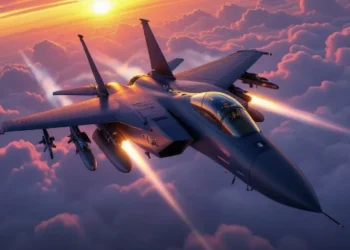
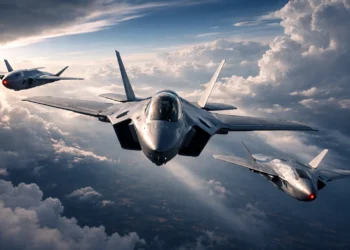
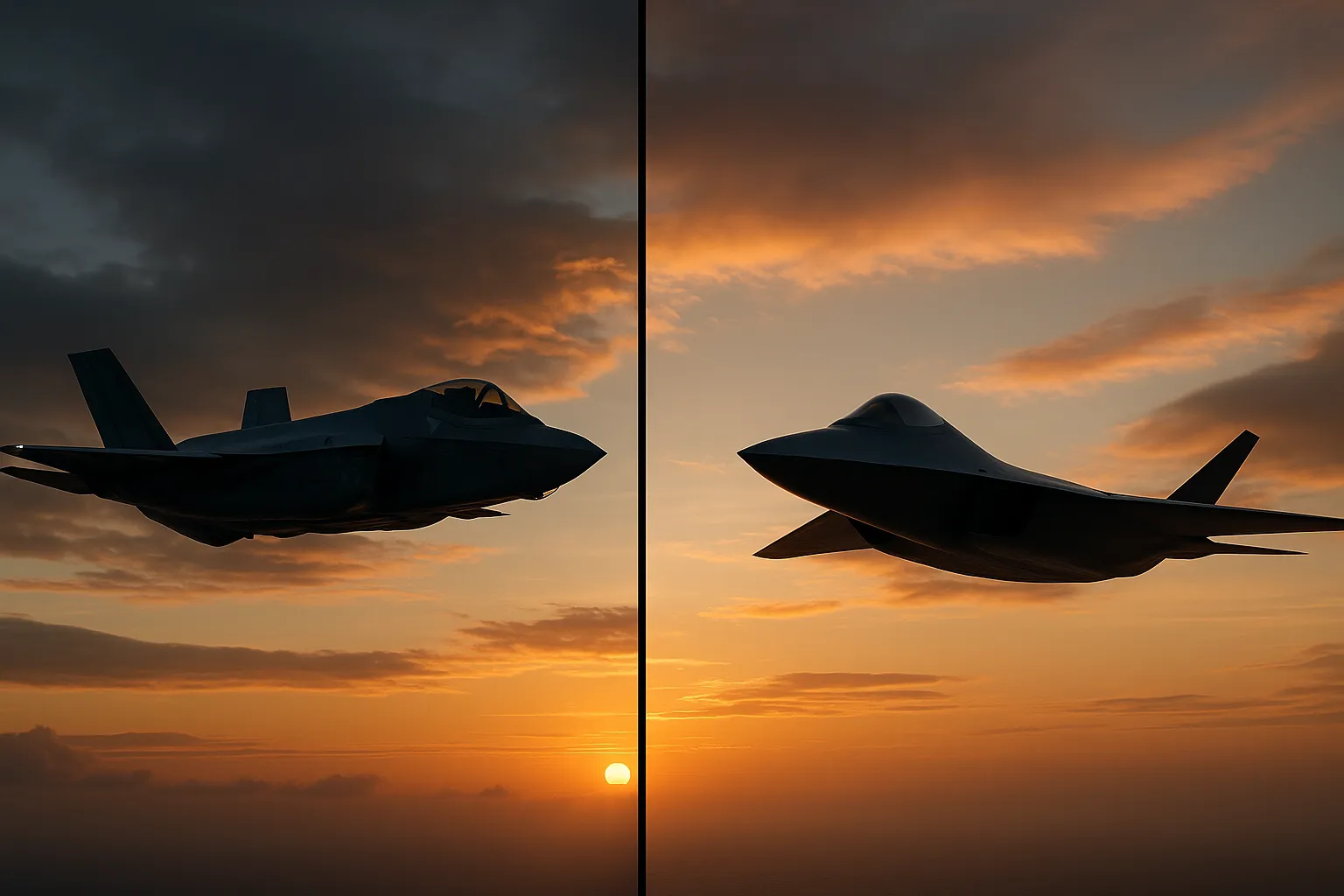
When examining 5th Gen vs. 6th Gen Fighter Jets, it becomes clear that the standard of air superiority established by the F-22 Raptor and F-35 Lightning II has remained unrivaled for years.
However, a new paradigm is approaching: NGAD (Next Generation Air Dominance), Tempest (GCAP), FCAS, and China’s J-XX 6th generation platform.
Today, most people ask:
“Will the 6th generation be faster?”
No.
In modern aerial combat, speed is no longer the primary determinant.
The real revolution lies in:
- ➡️ AI-driven mission management
- ➡️ Network-native architecture (not just network-centric)
- ➡️ Manned-Unmanned Teaming (MUM-T / CCA / Loyal Wingmen)
- ➡️ Megawatt-class power management for directed energy weapons
- ➡️ Adaptive cycle engine technology
- ➡️ Broadband VLO (Very-Low Observable) skin morphing
What Defines a 5th Generation Fighter?
The 5th generation is defined by two critical platforms: the F-22 Raptor and the F-35 Lightning II.
In engineering literature, these aircraft are defined by three core characteristics:
1. Stealth Geometry + Low Observable (LO) Coatings
- Radar Cross Section (RCS): 0.001–0.005 m² (Size of a marble).
- Surface Coating: RAM (Radar Absorbent Material) + serrated panel joints.
- Benefit: Drastically reduces detection range by enemy radar → First detection advantage.
2. Sensor Fusion
The F-35’s sensor layer consists of:
- AN/APG-81 AESA Radar
- DAS (AN/AAQ-37)
- EOTS (Electro-Optical Targeting System)
- ESM/ELINT
- MADL & Link-16 data fusion
The pilot receives this as a single “God’s Eye” view.
The critical difference: Raw sensor data is synthesized into a unified tactical reality → Decision time is reduced to milliseconds.
3. Supercruise (F-22) + High Agility
- F-22’s capability to sustain Mach 1.82 without afterburners.
- Thrust-vectoring nozzles for high Angle of Attack (AOA) maneuvers.
The Leap to 6th Generation: It’s Not Just a Plane
A 6th-generation fighter is no longer just an aircraft: It is the central command computer of the battlefield.
This architecture is defined as “System-of-Systems Warfare (SOSW).”
Technical Breakpoints of the 6th Gen Revolution:
1. AI Co-Pilot / Autonomous Mission Manager
- AI Role: Threat classification, sensor optimization, target resolution, and ECM/ECCM management.
2. Loyal Wingman Drones (CCA – Collaborative Combat Aircraft)
Unmanned jets accompanying the manned fighter for:
- SEAD/DEAD missions (Suppression of Enemy Air Defenses)
- Stand-in jamming
- Stand-off strikes
- Sensor extension layer
3. Optional-Manned Flight Architecture
The aircraft can fly with or without a pilot, minimizing risk based on the mission profile.
4. Distributed Aperture & Multi-Static Radar
All platforms around the aircraft act as a shared radar network, effectively seeing through stealth.
5. Adaptive Cycle Engine (AETP)
A revolutionary 3-mode engine:
- Mode 1: High-thrust mode for combat.
- Mode 2: Fuel-efficiency mode for loitering.
- Mode 3: High-cooling/GPU generation mode (Critical for lasers).
Direct Comparison: 5th Gen vs. 6th Gen
| Feature | 5th Gen (F-35) | 6th Gen (NGAD / Tempest) |
| Speed | Mach 1.6 | Mach 1.8+ (Multi-regime optimization) |
| Stealth Level | VLO (0.005 m² RCS) | Broadband Stealth + Morphing Skin + IR Suppression |
| Engine Type | PW F135 (Single engine) | Adaptive Cycle Engine (AETP) – 3 Modes |
| Power Generation | ~80 kW | 300–450 kW (Sufficient for DEW) |
| Weapon Systems | AIM-120D, JSM, SDB-II | Laser Weapons (150–300 kW), Hypersonic Strike |
| Combat Concept | Network-centric warfare | Network-native + AI-driven swarm operations |
Future Weapons: Lasers and Hypersonics
The most critical engineering challenge for 6th-generation fighters is power generation.
Power Required for Laser Weapons:
- Requirement: 150–300 kW continuous laser output.
- Challenge: This requires a megawatt-class thermal management system on the aircraft. The fuel itself will be used as a “heat sink” to cool the systems.
Hypersonic Weapons:
- Speed: Mach 5–10+ range.
- Range: Stand-off distance of 1,000 km+.
- Role: The aircraft is no longer just a platform, but a launch node for hypersonic systems.
Conclusion
For the 5th generation, the revolution was stealth + sensor fusion.
For the 6th generation, the revolution is now:
“Connectivity + AI + Directed Energy + Autonomous Swarms.”
We are no longer talking about a fighter jet, but an aerial combat ecosystem.
👉 What do you think? Will the F-35 retire earlier than expected with the arrival of NGAD? Let us know in the comments!
FAQ (Frequently Asked Questions)
Is the F-22 a 6th generation fighter?
No. The F-22 Raptor is the world’s first 5th-generation fighter, designed for air superiority with VLO, supercruise, and thrust-vectoring capabilities.
Will 6th gen jets replace 5th gen platforms?
Gradually, YES. 5th-generation aircraft will shift from being “spearhead assets” to “supporting node” roles.
Which countries are developing 6th gen fighters?
- USA: NGAD + CCA
- UK-Japan-Italy: Tempest (GCAP)
- France-Germany-Spain: FCAS
- China: J-XX Program
- Russia: PAK DP (Early stage concept)
What is an Adaptive Cycle Engine (AETP)?
It is an innovative engine that switches between high thrust, high efficiency, and high cooling modes in flight, providing the infrastructure needed for Directed Energy Weapons (DEW) and hypersonics.
Will 6th gen fighters be optionally manned?
Yes. Depending on the mission risk analysis, they will be capable of flying fully autonomously or with a pilot.
What are Loyal Wingman drones?
Low-cost unmanned combat jets (CCA) linked to the main manned fighter. They perform high-risk tasks like jamming, decoying, and striking targets.