

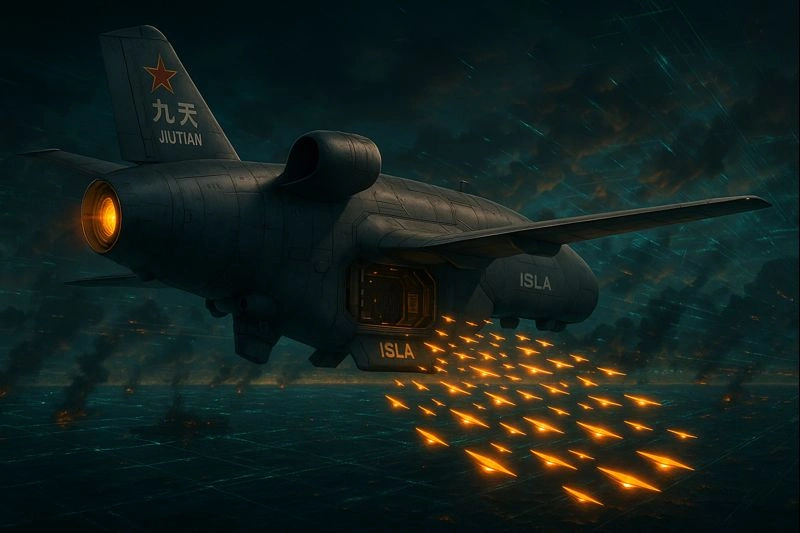
In the history of aerial warfare, the concept of an “Aerial Aircraft Carrier” has always been science fiction. Until now.
At the recent Zhuhai Airshow, China unveiled a monster: the Jiutian UAV (meaning “High Sky”). Powered by a jet engine and weighing in at over 10 tons, this is not just another surveillance drone. It is a “Drone Mothership”—a massive, rapidly deployable platform designed to carry and launch swarms of smaller attack drones directly into combat.
While the US experiments with launching drones from C-130 cargo planes, China has built a dedicated robot for the job. In this UltiDefense Analysis, we decode the “Isla” mission module and what the arrival of the Jiutian UAV means for the balance of power in the Pacific.
1. What Is the Jiutian UAV? The “Heavy Hauler”
The Jiutian is classified as a SS-UAV (Special Mission Unmanned Aerial Vehicle). Visually, it looks like a futuristic, unmanned version of the American A-10 Warthog or OV-10 Bronco, but significantly larger.
It represents a shift in Chinese drone philosophy: moving from “Light & Long Endurance” (like the Wing Loong series) to “Heavy, Fast, & Modular.”
Key Design Features:
Jet Propulsion: Unlike the propeller-driven Reaper or TB2, the Jiutian uses a turbofan engine aimed at high-subsonic speeds to keep up with strike packages.
Massive Payload: With a Maximum Take-Off Weight (MTOW) estimated between 10 to 16 tons, it is nearly three times heavier than a US MQ-9 Reaper.
Robust Landing Gear: Heavy-duty wheels suggest it can operate from rough, forward-deployed airstrips.
2. The “Hive” Module: A Game Changer
The defining feature of the Jiutian is the massive, interchangeable mission pod located in the center of its fuselage, labeled “Isla” (Island).
This isn’t just a bomb bay; it’s a Swarm Launcher.
The Concept: The module functions like a honeycomb. It can carry dozens of smaller loitering munitions (suicide drones) or ISR swarm bots.
The Tactic: The Jiutian flies to the edge of the battlefield and releases the swarm. These small drones confuse enemy air defenses (like Patriot or Aegis radars) by creating hundreds of targets, paving the way for heavy missiles to hit the real target.
Modularity: If the mission changes, the “Swarm Hive” can be swapped out in minutes for a Cargo Pod, an Electronic Warfare suite, or a Precision Bombing module.
3. Technical Specifications (Estimated)
Since this is a new platform, specs are based on OSINT analysis and exhibition data.
| Feature | Jiutian (High Sky) SS-UAV |
| Type | Jet-Powered Heavy Multi-Role UAV |
| Propulsion | 1x Turbofan Engine (Dorsal Intake) |
| MTOW | ~10,000 – 16,000 kg (Heavy Class) |
| Payload Capacity | ~6,000 kg (External + Internal) |
| Primary Weapon | “Isla” Modular Swarm Launcher |
| Hardpoints | 8x Underwing Pylons (for missiles/pods) |
| Role | Aerial Carrier, Swarm Launch, Heavy Strike |
| Speed | High Subsonic (Est. 600-800 km/h) |
4. Strategic Role: Why Build a Mothership?
Why not just launch the small drones from the ground? Range and Speed.
Small swarm drones have tiny batteries; they can only fly for 15-30 minutes. By carrying them on a jet-powered mothership like the Jiutian, the PLA (People’s Liberation Army) can:
Transport the Swarm: Carry the “Hive” 1,000 km away from the base.
Release at Altitude: Dropping drones from 30,000 ft gives them kinetic energy and extended range.
Overwhelm Defenses: A single Jiutian could release 50+ decoys. A flight of four Jiutians could saturate an entire carrier strike group’s radar with 200+ targets instantly.
This is the nightmare scenario for Air Defense operators: Saturation Attacks.
5. Global Comparison: Jiutian vs. The West
USA: The US Military is testing similar concepts like the X-61 Gremlins (launched from C-130s) or the Rapid Dragon pallet system. However, these rely on converting existing cargo planes.
China: The Jiutian is a dedicated platform. It is cheaper than risking a manned cargo plane and more agile. It suggests China is aggressively operationalizing “Swarm Warfare” faster than anticipated.
Conclusion: The Era of the Carrier Drone
The Jiutian SS-UAV proves that the future of air combat isn’t just about stealth; it’s about Volume.
It transforms the drone from a “Sniper” (like the Reaper) into a “Shotgun.” By fielding a robotic mothership capable of deploying its own air force, China has added a dangerous new layer to the Anti-Access/Area Denial (A2/AD) puzzle in the Pacific.
UltiDefense Verdict: The Jiutian is not a concept toy; it is a heavy-lift truck designed to break air defense networks through sheer numbers.
❓ FAQ: Jiutian UAV
Q: What is the “Isla” module?
A: It is a rapidly interchangeable central mission bay on the Jiutian. It is primarily depicted as a “Swarm Launcher” for deploying dozens of smaller drones, but can also carry cargo or electronic warfare equipment.
Q: Is the Jiutian stealth?
A: No. Its design prioritizes payload and modularity over radar invisibility. It relies on stand-off distance and the chaos caused by its drone swarms to survive.
Q: How big is the Jiutian?
A: While exact dimensions are classified, its 10-16 ton take-off weight places it in the “Heavy UAV” class, significantly larger and heavier than the MQ-9 Reaper