

• Login
UltiDefense: Military Tech Comparisons & Modern Warfare Analysis
  • Defense Systems
    • Air Platforms
      • Fighter Jets
      • Drones
      • Attack Helicopters
      • Strategic Bombers
    • Land Systems
      • Main Battle Tanks
      • Artillery & Firepower
      • Infantry Fighting Vehicles
      • Military Logistics and Support Vehicles
      • Soldier Systems & Robotics: UGV, Exoskeleton, and Modern Infantry Integration
    • Integrated Defense Systems
      • Ballistic Missile Defense
      • Air Defense Systems
    • Missiles & Munitions
      • Air-to-Air & Anti-Ship Missiles
      • Cruise Missiles
      • Strategic & Hypersonic Weapons
    • Naval
      • Aircraft Carriers
      • Submarines
      • Surface Combatants
      • Unmanned Maritime Systems
    • Future Tech & Innovations
      • Sensors and Avionics
  • Comparisons
  • Space Warfare
    • Counter-Space & ASAT
    • Spaceplanes & Launch Vehicles
    • Military Satellites & ISR
  • Defense News
  • Military Life
  • Policy, Budget and Geopolitics
  • Cyber Security & Electronic Warfare
No Result
View All Result
Defense News
No Result
View All Result

Home - Missiles & Munitions - AIM-120D AMRAAM: The US Air Force’s Long-Range Sniper

AIM-120D AMRAAM: The US Air Force’s Long-Range Sniper

George Schouten by George Schouten
December 22, 2025
in Missiles & Munitions
0
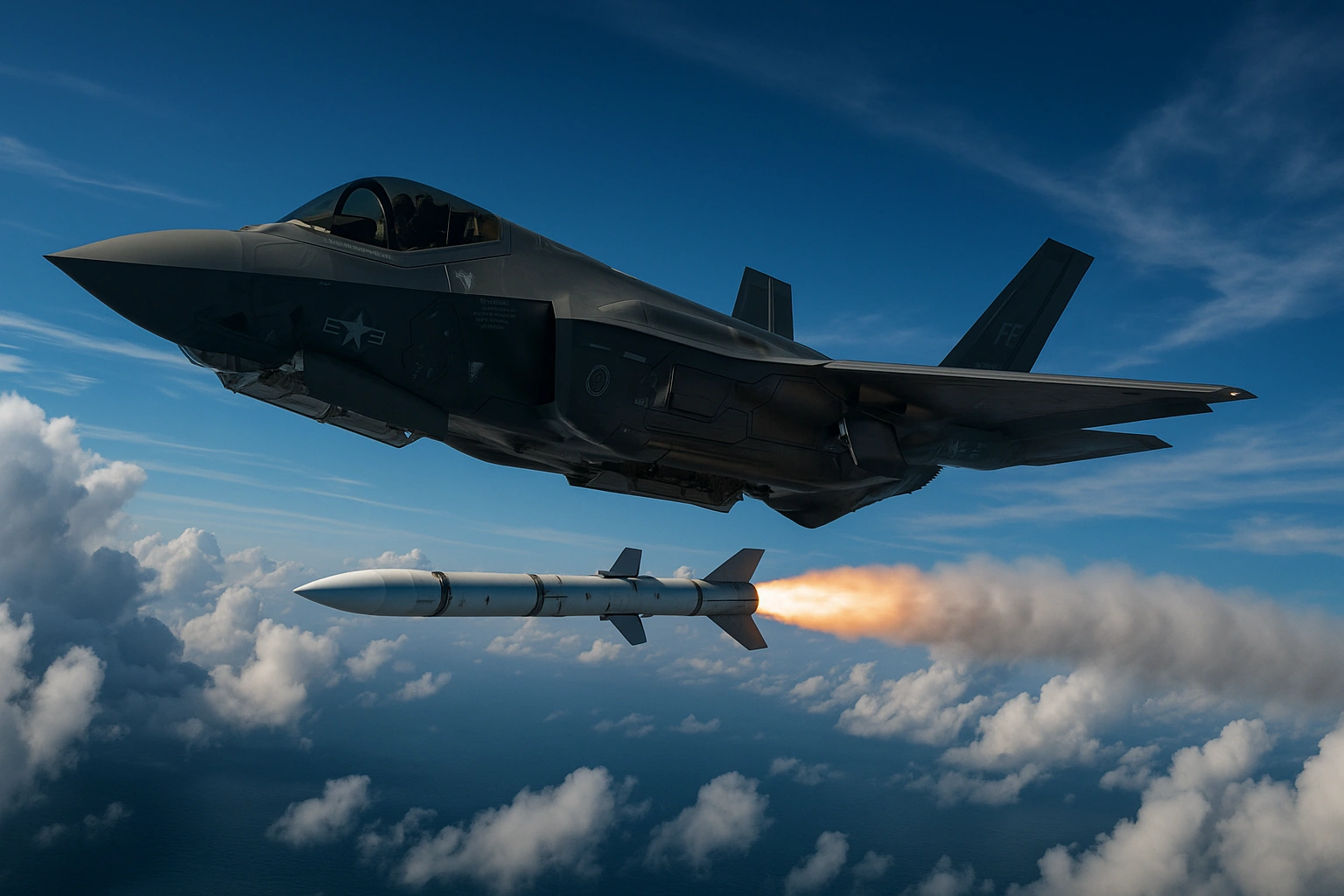
US Air Force F-35 stealth fighter firing a Raytheon AIM-120D AMRAAM missile from its internal weapons bay during aerial combat.

The AIM-120D allows stealth aircraft like the F-35 to engage targets without compromising their radar cross-section until the moment of launch.

169
SHARES
2.1k
VIEWS
Share on Twitter

In Beyond Visual Range (BVR) warfare, the pilot who shoots first almost always wins. But to shoot first, you need a missile that can reach farther, react faster, and think smarter than anything your adversary is carrying. For the U.S. Air Force and Navy, that missile is the AIM-120D AMRAAM.

Built by Raytheon, the “Delta” variant is the most advanced evolution of the AMRAAM family—designed specifically to counter long-range Chinese threats like the PL-15 and to maintain U.S. dominance in the next decade of aerial engagements.

READ ALSO

Russia’s Avangard HGV: Breaking the Shield of Global Missile Defense

How to Kill a Hypersonic Missile: The Rise of Glide Phase Interceptors (GPI)

When paired with advanced AESA radars like the AN/APG-83 SABR, the AIM-120D transforms 4th and 5th-generation fighters into long-range snipers capable of killing before being detected.


What Makes the AIM-120D Special?

The older AIM-120C series was reaching its kinematic limits against modern threats. Adversaries were deploying long-range missiles (like the PL-15 and R-37M) and high-powered jammers.

The U.S. needed a missile that could:

  • Reach farther (50% range increase).
  • Resist sophisticated Electronic Warfare (EW).
  • Maneuver aggressively at long distances.
  • Receive mid-course updates from multiple sources.

Inside the “Delta”: Engineering Breakdown

The AIM-120D is not just a “longer-range C-7.” Its internals were completely redesigned to survive the new high-tech battlefield.

1. Extended-Range Rocket Motor

Though classified, engineers have hinted at optimizations in grain efficiency and burn profiles. The result is a massive 50% increase in range, often estimated to be well above 160 km (100+ miles).

Why this matters: Longer range creates “no-fly corridors,” protecting high-value assets like Tankers and AWACS from enemy fighters.

2. The Brain: GPS-Aided Guidance

The missile uses a GPS-aided Inertial Measurement Unit (IMU) for precise long-range navigation. It constantly recalculates its energy state, loft trajectory, and terminal dive angle. This ensures the missile arrives at the target with enough kinetic energy to maneuver.

3. Two-Way Datalink (The Game Changer)

Older missiles only received updates. The AIM-120D sends information back to the launching aircraft.

  • Target Confirmation: Tells the pilot “I have lock.”
  • Real-Time Retasking: Can be redirected mid-flight.
  • Networked Lethality: Compatible with F-35 sensor fusion and JADC2 networks.

Understanding the “No-Escape Zone” (NEZ)

The NEZ is the holy grail of missile engineering. It is the distance where a target aircraft cannot run, cannot turn, and cannot survive—no matter what the pilot does.

“An enemy fighter might defeat range on paper, but it cannot defeat physics inside the NEZ.”

The AIM-120D’s larger NEZ forces enemies into defensive dives and energy-draining maneuvers long before they can threaten U.S. forces.


How It Hunts: The Silent Kill Chain

From a pilot’s perspective, the AIM-120D is terrifying because it operates in silence until the final seconds. Here is a typical engagement profile from an F-35 Lightning II:

  1. Detection: Passive sensors detect the enemy without emitting radar.
  2. Launch: The missile fires on a predictive intercept point using GPS.
  3. Silent Cruise: It flies towards the target without radiating energy.
  4. Terminal Phase: Only in the last few seconds does the active radar seeker turn on.

By the time the enemy’s Radar Warning Receiver (RWR) screams “Missile Launch,” impact is imminent.


Platform Compatibility

The AIM-120D is integrated across the entire U.S. and Allied fleet:

  • Stealth: F-22 Raptor & F-35 (Internal Carriage).
  • Workhorses: F-16 Block 70/72 and F/A-18 Super Hornet.
  • Missile Trucks: The F-15EX Eagle II can carry up to 12 AMRAAMs, providing massive firepower volume.

The Rivalry: AIM-120D vs. China’s PL-15

China’s PL-15 is often cited as having a longer maximum range due to its dual-pulse motor. So how does the AIM-120D compete?

The answer is the Kill Chain. U.S. fighters possess superior AESA radars, sensor fusion, and networking. Range is irrelevant if you cannot see the target or maintain a track. The U.S. doctrine relies on superior situational awareness to ensure the AIM-120D hits its mark.

Conclusion: The Sky’s True Sniper

The AIM-120D AMRAAM is not just another missile—it is the backbone of Western air dominance. It brings long range, jam-proof guidance, and stealth synergy to the fight.

Until the next-generation AIM-260 JATM arrives, the AIM-120D remains the “first shot, first kill” sniper of the skies.
Frequently Asked Questions (FAQ) about AIM-120D

What is the maximum range of the AIM-120D AMRAAM?

While the exact range is classified, the AIM-120D is estimated to have an effective range exceeding 160 km (100+ miles). This is roughly a 50% increase over the previous AIM-120C-7 variant, achieved through a larger “no-escape zone” and optimized flight profiles.

How is the AIM-120D different from the AIM-120C?

The “Delta” variant features significant upgrades over the “Charlie” model, including 50% greater range, a two-way datalink for better pilot control, GPS-aided navigation for precise targeting, and improved High-Angle Off-Boresight (HOBS) capabilities.

Is the AIM-120D better than China’s PL-15 missile?

China’s PL-15 may have a longer raw kinematic range due to its dual-pulse motor. However, the AIM-120D relies on the superior US “kill chain”—better radars (AESA), sensor fusion, and networking—to ensure higher probability of kill (Pk) despite potential range disadvantages.

How much does a single AIM-120D missile cost?

As of recent fiscal year procurement reports, the unit cost for an AIM-120D is approximately $1.1 million to $1.3 million USD, depending on the lot number and contract volume.

Can the F-35 carry the AIM-120D internally?

Yes. The F-35A and F-35C can currently carry four AIM-120D missiles internally in their weapons bays to maintain stealth. Future “Sidekick” upgrades may allow the F-35A/C to carry up to six internal AMRAAMs.

How fast is the AIM-120D?

The AIM-120D is a supersonic missile capable of reaching speeds of Mach 4 (approximately 3,000 mph), allowing it to close the distance on maneuvering targets rapidly.

What does AMRAAM stand for?

AMRAAM stands for Advanced Medium-Range Air-to-Air Missile. It is the world’s most popular beyond-visual-range missile.

Does the AIM-120D use GPS guidance?

Yes. Unlike older versions, the AIM-120D integrates a GPS-aided Inertial Measurement Unit (IMU). This allows for more precise navigation to the target’s predicted location, especially in heavy electronic warfare environments.

Is the AIM-120D better than the MBDA Meteor?

The Meteor uses a ramjet engine, giving it more sustained energy at long ranges compared to the AIM-120D’s solid rocket motor. However, the AIM-120D is lighter, cheaper, and more widely integrated into US stealth fighters like the F-22 and F-35.

What will replace the AIM-120D?

The US Air Force and Navy are currently developing the AIM-260 JATM (Joint Advanced Tactical Missile). It is designed to significantly outrange the AIM-120D and directly counter next-generation threats like the PL-15.
Tags: Air-to-AirbestBVR MissileF-35 WeaponsMilitary TechNo Escape ZonePL-15 vs AIM-120DRaytheon

Related Posts

Russia’s Avangard HGV: Breaking the Shield of Global Missile Defense
Strategic & Hypersonic Weapons

Russia’s Avangard HGV: Breaking the Shield of Global Missile Defense

April 4, 2026
igh-technical military infographic comparing a Hypersonic Glide Vehicle (HGV) non-ballistic flight profile with a traditional ballistic missile trajectory. The visual highlights the "Glide Phase" in the upper atmosphere and depicts a Glide Phase Interceptor (GPI) maneuvering for engagement.
Strategic & Hypersonic Weapons

How to Kill a Hypersonic Missile: The Rise of Glide Phase Interceptors (GPI)

March 30, 2026
Next Post
A USAF F-22 Raptor fighter jet flying alongside an autonomous MQ-20 Avenger drone during a Manned-Unmanned Teaming test.

Historic First: F-22 Raptor Pilot Controls MQ-20 Avenger Drone from Cockpit

Leave a Reply Cancel reply

Your email address will not be published. Required fields are marked *

About

Ultidefense is a digital platform focused on modern defense, military technology, and strategic innovation.
We explore how advancements in aerospace, AI, cybersecurity, and autonomous systems are transforming the global defense landscape.
Our mission is to connect technical insight with strategic awareness, helping readers understand the technologies shaping modern security and warfare.
At Ultidefense, we believe knowledge is strength — and our goal is to deliver clear, factual, and forward-looking analysis on the systems, science, and strategies defining the future of defense.

Categories

  • Comparisons
  • Cyber Security & Electronic Warfare
  • Defense News
  • Defense Systems
    • Air Platforms
      • Attack Helicopters
      • Fighter Jets
      • Global Military Drones: UAV Systems, Autonomy, and Unmanned Warfare
      • Strategic Bombers
    • Future Tech & Innovations
      • Sensors and Avionics
    • Land Systems
      • Artillery & Firepower: Self-Propelled Guns, Rocket Systems, and Barrage Analysis
      • Main Battle Tanks: Armor, Firepower, and Modern MBT Comparisons
    • Missiles & Munitions
      • Strategic & Hypersonic Weapons
    • Space Warfare
      • Military Satellites & ISR
      • Spaceplanes & Launch Vehicles
  • Integrated Defense Systems
    • Air Defense Systems
  • Military Life
  • Naval Systems: Warships, Carriers, and Maritime Defense Technology
    • Aircraft Carriers
    • Submarines
  • Policy, Budget and Geopolitics
  • Unmanned Maritime Systems

Recent Posts

  • Which Military Boot Camp is the Hardest? All 6 US Branches Ranked
  • The SFAS Fallout: What Happens After You Fail Special Forces Selection
  • The Algorithm of War:The Anatomy of Conflict in 2050
  • Russia’s Avangard HGV: Breaking the Shield of Global Missile Defense

Newsletter

Pages

  • About Us
  • Home
  • Contact Us
  • Privacy Policies
  • Terms of Service
  • Disclaimer

© 2025 Defense Systems

Welcome Back!

Login to your account below

Forgotten Password?

Retrieve your password

Please enter your username or email address to reset your password.

Log In
No Result
View All Result
  • Defense Systems
    • Air Platforms
      • Fighter Jets
      • Drones
      • Attack Helicopters
      • Strategic Bombers
    • Land Systems
      • Main Battle Tanks
      • Artillery & Firepower
      • Infantry Fighting Vehicles
      • Military Logistics and Support Vehicles
      • Soldier Systems & Robotics: UGV, Exoskeleton, and Modern Infantry Integration
    • Integrated Defense Systems
      • Ballistic Missile Defense
      • Air Defense Systems
    • Missiles & Munitions
      • Air-to-Air & Anti-Ship Missiles
      • Cruise Missiles
      • Strategic & Hypersonic Weapons
    • Naval
      • Aircraft Carriers
      • Submarines
      • Surface Combatants
      • Unmanned Maritime Systems
    • Future Tech & Innovations
      • Sensors and Avionics
  • Comparisons
  • Space Warfare
    • Counter-Space & ASAT
    • Spaceplanes & Launch Vehicles
    • Military Satellites & ISR
  • Defense News
  • Military Life
  • Policy, Budget and Geopolitics
  • Cyber Security & Electronic Warfare

© 2025 Defense Systems