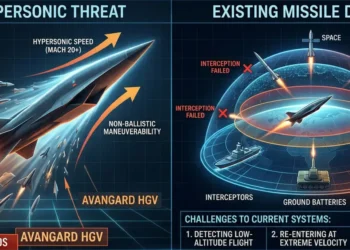


1. Introduction: The Unstoppable Threat?
Over the past decade, hypersonic weapons have evolved from a niche R&D concept into a central challenge to modern air and missile defense architectures. In particular, Hypersonic Glide Vehicles (HGVs) are redefining the engagement problem by operating outside the assumptions that shaped legacy missile defense systems. The debate inside the U.S. defense community is no longer whether hypersonic weapons are viable—it is how and where they can be intercepted within the kill chain.
At the core of this challenge lies what defense analysts increasingly refer to as the “hypersonic gap.” This gap is not simply about speed. While hypersonic systems operate at velocities exceeding Mach 5, their true advantage comes from the combination of high speed, atmospheric maneuverability, variable flight paths, and compressed decision timelines. These characteristics disrupt the predictive tracking models that underpin traditional Ballistic Missile Defense (BMD) systems.
Legacy systems such as Aegis Combat System, Patriot Missile System, and THAAD were engineered primarily to counter ballistic trajectories or conventional cruise missiles. Ballistic threats follow largely predictable parabolic paths, enabling early tracking, midcourse discrimination, and terminal interception. Hypersonic glide vehicles, by contrast, do not follow a fixed trajectory. After separation from their booster, they operate within the upper atmosphere, continuously adjusting their path. This creates a dynamic targeting problem where interception solutions degrade in real time.
As a result, the issue is not merely detection—it is fire control quality tracking. A defense system may detect a hypersonic object, but if it cannot maintain a continuous, high-fidelity track suitable for weapons engagement, the target remains effectively unengageable. This distinction has become central in U.S. Missile Defense Agency (MDA) doctrine and budget justification language.
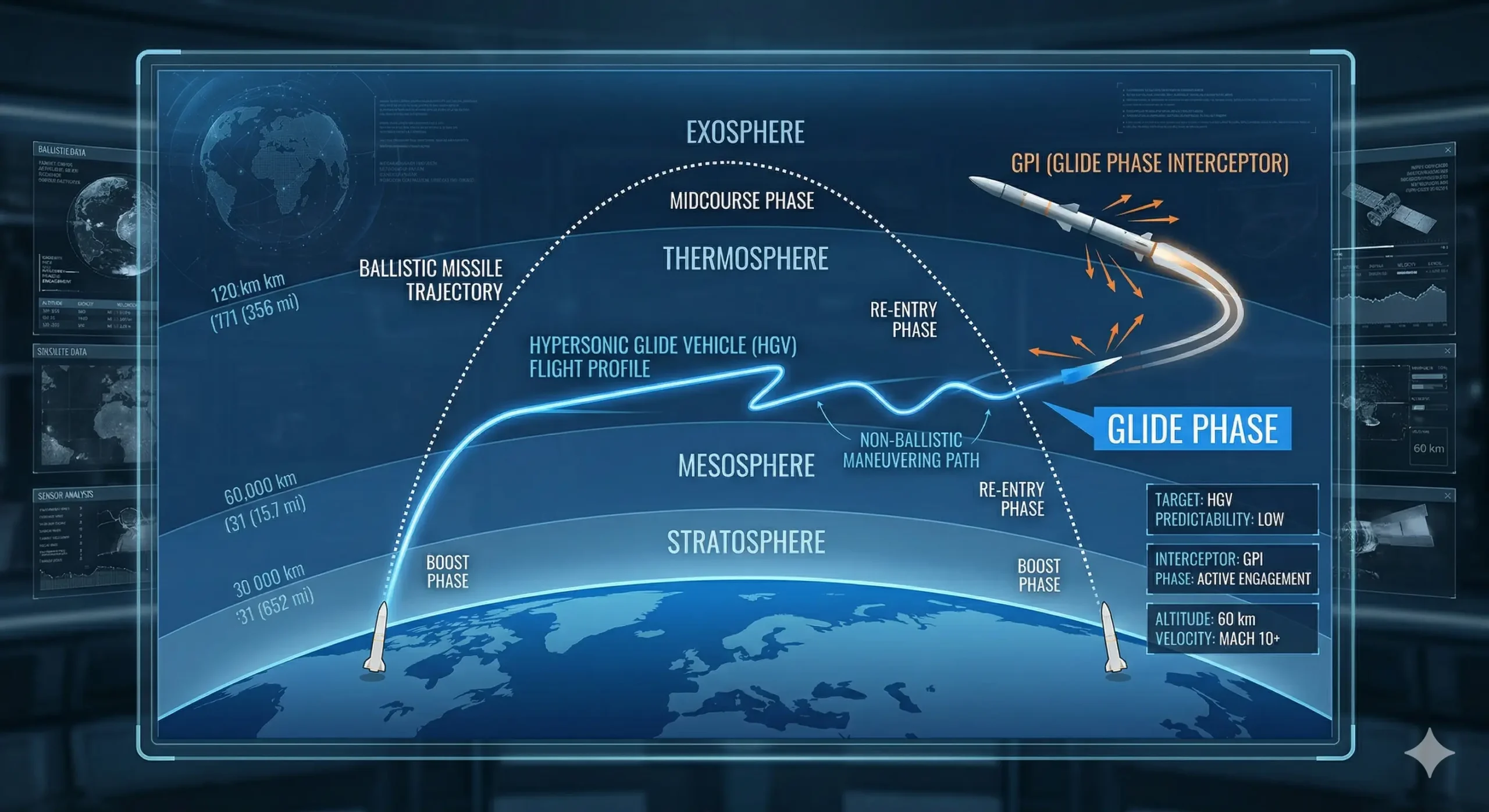
The limitations of traditional BMD architectures against HGVs have forced a strategic shift. Instead of attempting interception during the terminal phase—where timelines are extremely compressed—or relying on boost-phase interception—where opportunities are limited and geographically constrained—the focus has moved to an intermediate window: the glide phase.
The glide phase begins after the booster burnout, when the HGV separates and enters sustained atmospheric flight at hypersonic speeds. This phase presents a paradox. On one hand, the target remains highly maneuverable and difficult to predict. On the other, it is continuously trackable over a longer duration compared to the boost phase and occurs early enough to avoid the severe time compression of terminal defense.
This makes the glide phase the only viable operational engagement window for countering advanced hypersonic threats at scale.
The U.S. response to this challenge is the development of the Glide Phase Interceptor (GPI)—a next-generation interceptor designed specifically to engage maneuvering hypersonic targets in the upper atmosphere. Unlike legacy interceptors, GPI is not a standalone solution. It is conceived as part of an integrated architecture that includes space-based tracking, real-time data fusion, advanced fire control, and high-performance interceptors.
Programs under the Missile Defense Agency emphasize that defeating hypersonic threats requires closing the entire kill chain, from persistent global tracking to terminal guidance. This includes new sensor layers such as space-based tracking constellations, improved command-and-control systems, and interceptors capable of operating in extreme thermal and kinematic environments.
Ultimately, the question is not whether hypersonic missiles are “unstoppable,” but whether current defense architectures are optimized for the wrong phase of the fight. The emerging consensus within the U.S. defense establishment is clear: the future of missile defense lies in shifting the engagement battlespace upward—into the glide phase—where interception is still possible, but only with fundamentally new tools.
2. Understanding the Hypersonic Flight Profile
To effectively counter hypersonic threats, it is essential to understand how these systems actually fly. Unlike traditional ballistic missiles or cruise missiles, hypersonic weapons—particularly Hypersonic Glide Vehicles (HGVs)—operate across a hybrid flight regime that combines elements of both. This hybridization is what makes them uniquely difficult to track, predict, and intercept.
The Three Phases: Boost, Glide, and Terminal
Hypersonic weapon systems generally follow a three-phase flight profile:
1. Boost Phase
This phase begins at launch and continues until the rocket booster burns out. In this stage, the system behaves similarly to a ballistic missile. The booster accelerates the payload—typically an HGV—to hypersonic speeds and lofts it to the edge of the atmosphere.
From a defense perspective, this is the most detectable phase, due to the intense infrared (IR) signature of the rocket plume. However, it is also the shortest and most geographically constrained window for interception. Boost-phase intercept requires assets to be positioned relatively close to the launch site—an operational constraint that limits scalability.
2. Glide Phase
After booster separation, the HGV enters the glide phase—the defining characteristic of hypersonic weapons. Instead of following a ballistic arc, the vehicle re-enters the upper atmosphere and begins sustained, aerodynamic flight at altitudes typically between 30–80 km.
During this phase, the vehicle can:
- Execute lateral maneuvers (cross-range capability)
- Adjust altitude dynamically
- Alter its trajectory mid-course
This phase is significantly longer than the boost phase and occurs before terminal descent, making it the primary focus of modern interception strategies—particularly for the Glide Phase Interceptor (GPI) concept.
3. Terminal Phase
In the final stage, the HGV descends toward its target, often executing high-G evasive maneuvers to complicate last-line defenses. At this point, reaction times are extremely compressed—often measured in seconds to a few minutes.
Traditional systems like Patriot Missile System are optimized for this phase, but against hypersonic threats, the terminal window is often too late for reliable interception, especially against maneuvering targets.
The Maneuverability Factor: Breaking Legacy Algorithms
The defining feature of hypersonic glide vehicles is not just speed—it is maneuverability under hypersonic conditions.
Traditional missile defense systems rely heavily on predictive tracking algorithms. These algorithms assume that once a missile’s trajectory is established, future positions can be estimated with high confidence. This assumption holds true for ballistic missiles, whose motion is governed largely by gravity and initial launch parameters.
HGVs invalidate this assumption.
By performing continuous course corrections during the glide phase, hypersonic vehicles introduce uncertainty into the tracking solution. Even small deviations at hypersonic speeds can translate into massive positional errors over time. This forces defensive systems to constantly update targeting data, placing enormous strain on:
- Sensor fusion systems
- Fire control solutions
- Interceptor guidance logic
Systems like Aegis Combat System were not originally designed to handle targets with non-ballistic, continuously evolving trajectories, which explains the growing emphasis on next-generation tracking and interception architectures.
The Heat Signature: Mask and Target
Hypersonic flight introduces another critical variable: extreme thermal effects.
As an HGV travels through the atmosphere at Mach 5+, it generates intense aerodynamic heating, forming a plasma sheath around the vehicle. This has two contradictory implications:
1. The Masking Effect
The plasma cloud can degrade or distort certain sensor frequencies, particularly radar, making precise tracking more difficult. This phenomenon contributes to the perception of hypersonic weapons as “hard to see” or “ghost-like” targets.
2. The Targeting Opportunity
At the same time, the extreme heat produces a strong infrared signature, which can be detected by advanced IR sensors—especially from space-based platforms. In fact, this thermal signature is a cornerstone of emerging tracking architectures.
This duality—masking in some domains, visibility in others—is why modern missile defense is shifting toward multi-sensor fusion, combining infrared, radar, and potentially other modalities to maintain a continuous track.
Operational Implication: A Moving, Heated, and Unpredictable Target
When these factors are combined, the hypersonic engagement problem becomes clear:
- A target moving at extreme speed
- Continuously maneuvering
- Operating within the atmosphere (not exo-atmospheric)
- Generating both sensor interference and detection signals
This is fundamentally different from any threat class that legacy missile defense systems were built to defeat.
The implication is decisive: intercepting a hypersonic vehicle is not just a speed problem—it is a tracking, prediction, and data fusion problem under extreme physical conditions.
This realization directly informs the design philosophy behind the next generation of interceptors, particularly the Glide Phase Interceptor (GPI), which is engineered specifically to operate within this complex engagement environment.
3. What is a Glide Phase Interceptor (GPI)?
The Glide Phase Interceptor (GPI) represents a fundamental shift in U.S. missile defense strategy—from reacting to threats in their final moments to engaging them earlier, in a more controllable battlespace. Rather than attempting to defeat hypersonic weapons at the point of impact, GPI is designed to intercept maneuvering Hypersonic Glide Vehicles (HGVs) during their most operationally viable engagement window: the glide phase.
The Pentagon’s Strategic Shift: Moving the Kill Chain Upward
For decades, U.S. missile defense doctrine focused heavily on midcourse (exo-atmospheric) and terminal (endo-atmospheric) interception. Systems such as THAAD and Patriot Missile System were optimized to defeat threats late in their flight path, where the defended asset is directly at risk.
Hypersonic weapons break this model.
By the time an HGV enters the terminal phase, its speed, maneuverability, and reduced warning time make reliable interception extremely difficult. Conversely, boost-phase interception—while theoretically attractive—is constrained by geography, timing, and the need for forward-deployed assets.
GPI addresses this gap by shifting the engagement battlespace upward and earlier—into the upper atmosphere during the glide phase. This is a deliberate attempt to:
- Extend the engagement timeline
- Improve fire-control quality tracking
- Enable multiple shot opportunities (shoot-look-shoot doctrine)
In essence, GPI is not just a new interceptor—it is a repositioning of the entire kill chain.
Program Leadership: MDA and Industry Competition
The development of GPI is being led by the Missile Defense Agency, which has prioritized hypersonic defense as a top-tier modernization effort.
In its early phases, the program featured competitive prototyping between major U.S. defense contractors, most notably:
- Northrop Grumman
- Raytheon Technologies
These firms were tasked with developing interceptor concepts capable of operating in one of the most demanding environments in modern warfare: high-speed, high-temperature, maneuvering target engagement within the upper atmosphere.
The competitive phase is critical, as it drives innovation in propulsion, guidance, and thermal protection—areas where traditional interceptor designs are insufficient.
Key Technical Requirements: Engineering for the Hypersonic Fight
Designing an interceptor capable of defeating hypersonic targets requires a significant leap beyond legacy systems. GPI must meet several non-negotiable technical requirements:
1. High-Altitude Maneuverability
Unlike exo-atmospheric interceptors, GPI must operate within the upper atmosphere, where aerodynamic forces are still significant. This requires:
- Advanced control surfaces or divert systems
- High agility under extreme dynamic pressure
- Stability across variable flight regimes
2. Dual-Stage (or Advanced) Propulsion
To match and overtake hypersonic targets, the interceptor must sustain high energy throughout the engagement. This often implies:
- Multi-stage propulsion architectures
- High-thrust boost followed by sustained maneuver capability
- Efficient energy management for endgame guidance
3. Thermal Resilience
Operating at hypersonic speeds within the atmosphere exposes the interceptor to intense aerodynamic heating. GPI must incorporate:
- Advanced thermal protection systems (TPS)
- Materials capable of withstanding plasma-level temperatures
- Sensor shielding without degrading performance
4. Precision Guidance and Control
At Mach 5+, even microsecond delays or minor guidance errors can result in a miss. GPI requires:
- Ultra-fast onboard processing
- Real-time trajectory updates
- High-precision divert and attitude control systems
Integration with the Aegis Weapon System
One of the defining features of GPI is its planned integration with the Aegis Weapon System, the backbone of U.S. naval air and missile defense.
This integration is strategically significant for several reasons:
- Forward deployment: Aegis-equipped destroyers can operate close to threat regions
- Scalability: Naval platforms provide flexible, distributed launch capability
- Sensor integration: Aegis can fuse data from multiple sources, including space-based sensors
By embedding GPI within Aegis, the U.S. is effectively transforming its surface fleet into a mobile hypersonic defense layer, capable of projecting defensive coverage across key theaters such as the Indo-Pacific.
Conceptual Shift: From Interceptor to System-of-Systems
Perhaps the most important aspect of GPI is that it is not a standalone weapon. Its effectiveness depends entirely on the broader architecture in which it operates.
GPI is part of a system-of-systems, including:
- Space-based tracking sensors
- Advanced command and control (C2) networks
- Real-time data fusion systems
- Forward-deployed launch platforms
Without this integrated architecture, even the most advanced interceptor would fail to achieve consistent intercepts against hypersonic threats.
The Glide Phase Interceptor is the U.S. answer to a simple but urgent question:
How do you intercept a target that is fast, maneuverable, and unpredictable—before it is too late?
The answer is not just better missiles, but better timing, better tracking, and a fundamentally restructured engagement strategy.
4. The Eyes in the Sky: Tracking the Ghost
If the Glide Phase Interceptor (GPI) is the “shooter,” then space-based sensing is the eyes of the entire kill chain. Without persistent, high-fidelity tracking, even the most advanced interceptor is effectively blind. In the hypersonic era, the central challenge is no longer just intercepting the target—it is maintaining continuous custody of a maneuvering object moving at extreme speed through a complex thermal environment.
This is where the U.S. defense architecture is undergoing one of its most significant transformations: the shift toward space-based tracking as the backbone of hypersonic defense.
HBTSS: The Backbone of Hypersonic Tracking
At the center of this transformation is the Hypersonic and Ballistic Tracking Space Sensor (HBTSS) program, developed under the Missile Defense Agency.
HBTSS is designed to operate as a Low Earth Orbit (LEO) satellite constellation capable of tracking both ballistic and hypersonic threats from space. Unlike legacy early-warning satellites—which primarily detect launches based on infrared signatures—HBTSS is engineered for persistent, precision tracking throughout the entire flight path, including the glide phase.
Key capabilities include:
- Wide-area coverage with multiple satellites for global persistence
- High-resolution infrared sensing to track dim, maneuvering targets
- Real-time data relay to fire control systems
The critical innovation here is not just detection—it is fire-control quality tracking from space, something that legacy systems were not designed to provide.
Closing the Fire Control Loop
Tracking alone is not sufficient. The real challenge is closing what defense planners call the “fire control loop”—the seamless chain from detection to engagement.
For hypersonic threats, this loop involves multiple steps:
- Initial detection (typically via space-based IR sensors)
- Continuous tracking and trajectory updates
- Data fusion across multiple sensors
- Transmission of targeting data to the interceptor platform
- Launch and midcourse guidance updates
The difficulty lies in the handoff between systems. A target detected by a satellite must be translated into a weapons-grade track that an interceptor can use in real time. Any latency, data degradation, or misalignment in this chain can break the engagement.
This is why modern missile defense architecture emphasizes:
- Low-latency communication networks
- Cross-domain data fusion (space, sea, land)
- Advanced command-and-control (C2) systems
Programs aligned with the U.S. Space Force are increasingly focused on ensuring that sensor data is not فقط collected, but actionable within seconds.
Why Terrestrial Radar Is Not Enough
Traditional missile defense relies heavily on ground-based and sea-based radar systems, including those integrated into platforms like the Aegis Weapon System.
However, hypersonic threats expose critical limitations in these systems:
1. Line-of-Sight Constraints
Radar systems are fundamentally limited by the curvature of the Earth. Hypersonic glide vehicles flying at lower altitudes can remain below the radar horizon for significant portions of their trajectory.
2. Tracking Instability
Because HGVs maneuver unpredictably, maintaining a continuous radar track is difficult—especially when the target frequently changes direction and altitude.
3. Late Detection
By the time a ground-based radar acquires a hypersonic target, the available engagement window may already be severely compressed.
Over-the-Horizon (OTH) Radar: Partial Solution, Not a Fix
To address line-of-sight limitations, the U.S. has explored Over-the-Horizon (OTH) radar systems, which use ionospheric reflection to detect targets beyond the curvature of the Earth.
While OTH radar extends detection range, it has significant drawbacks in the hypersonic context:
- Lower resolution compared to direct line-of-sight radar
- Limited ability to provide fire-control quality tracking
- Sensitivity to atmospheric conditions and signal distortion
In practical terms, OTH radar can contribute to early warning, but it cannot replace the precision tracking required for interception.
The Shift to a Space-Centric Architecture
The conclusion drawn by U.S. defense planners is clear: only space-based sensors can provide the persistence, coverage, and tracking fidelity required for hypersonic defense.
This has led to a broader architectural shift toward:
- Proliferated LEO constellations
- Layered sensing (wide-field + tracking satellites)
- Integration with terrestrial and naval systems
The goal is to ensure that a hypersonic target is never lost once detected—a concept often referred to as maintaining “custody of the track.”
Operational Reality: Tracking a “Ghost”
Hypersonic targets are often described as “ghosts” because they:
- Move extremely fast
- Maneuver unpredictably
- Generate complex thermal and plasma effects
Tracking such a target requires not a single sensor, but a networked sensing ecosystem that can compensate for individual limitations.
In this model:
- Space sensors provide persistence
- Radar provides precision updates
- Data fusion systems reconcile discrepancies
- Interceptors receive continuous guidance
Only when all these elements function seamlessly can the system achieve a successful intercept.
In the hypersonic era, tracking is the battle.
Without persistent, high-quality tracking data, interception is impossible—regardless of interceptor performance. The development of systems like HBTSS reflects a strategic recognition that the future of missile defense begins in space.
5. How the Kill Happens: “Hit-to-Kill” Technology
Intercepting a hypersonic glide vehicle is not simply a matter of getting “close enough.” At velocities exceeding Mach 5, traditional blast-fragmentation approaches lose effectiveness due to extremely short engagement windows, reduced dwell time, and the difficulty of predicting proximity detonation timing. As a result, modern hypersonic defense concepts—especially those underpinning the Glide Phase Interceptor (GPI)—are built around a single principle: hit-to-kill (kinetic intercept).
This is not an incremental improvement. It is a requirement imposed by physics.
Kinetic vs. Blast-Fragmentation: Why Precision Wins
Legacy air defense systems often rely on proximity-fused warheads, which detonate near a target and destroy it using fragmentation. This approach works well against aircraft and even some missile threats, where engagement geometries are more forgiving.
Against hypersonic targets, however, this model breaks down.
At hypersonic speeds:
- The closing velocity between interceptor and target can exceed several kilometers per second
- The engagement window may last only milliseconds
- The target may maneuver during the final seconds, invalidating predicted intercept points
Under these conditions, fragmentation patterns become unreliable. Even slight miscalculations in detonation timing can result in a complete miss.
By contrast, hit-to-kill relies on direct collision—transferring the interceptor’s kinetic energy into the target with devastating effect. The equation is simple:
velocity × mass = destructive energy.
Systems like SM-3 Missile and elements of THAAD already employ kinetic interceptors, but GPI pushes this concept into a far more complex regime: endo-atmospheric, maneuvering, hypersonic engagements.
The Challenge of “The Handshake”
One of the most critical—and least visible—steps in the kill chain is what engineers often refer to as “the handshake.”
This is the moment when:
- Tracking responsibility transitions from external sensors (e.g., space-based systems like HBTSS)
- To the interceptor’s onboard seeker and guidance system
This handoff must occur seamlessly and at precisely the right time.
If the handoff occurs too early:
- The onboard seeker may not yet have sufficient resolution
- The target may still be outside its acquisition envelope
If it occurs too late:
- The interceptor may not have enough time to adjust its trajectory
This creates a narrow and unforgiving window where:
- Data latency must be minimal
- Track accuracy must be extremely high
- Sensor alignment must be near-perfect
Failure at this stage results in loss of track—and mission failure.
Advanced Seekers: Seeing Through Heat and Plasma
The onboard seeker is the interceptor’s “final set of eyes,” and in hypersonic engagements, it must operate in one of the harshest sensing environments imaginable.
Hypersonic targets generate:
- Extreme thermal signatures (due to aerodynamic heating)
- Plasma sheaths, which can interfere with electromagnetic signals
- Rapidly changing aspect angles due to maneuvering
To overcome these challenges, next-generation interceptors are expected to use multi-mode seekers, combining different sensing modalities:
1. Infrared (IR) Sensors
Infrared seekers exploit the intense heat generated by hypersonic flight. These sensors are particularly effective in:
- Detecting thermal contrast
- Maintaining lock in high-speed environments
However, they must be hardened against background clutter and thermal noise.
2. Multi-Mode (IR + RF) Systems
To improve reliability, advanced designs integrate:
- Infrared tracking
- Radio frequency (RF) or radar-based sensing
This redundancy allows the system to cross-validate target data and maintain tracking even if one sensing mode is degraded.
Guidance and Control: The Final Milliseconds
Once the seeker acquires the target, the interceptor enters the terminal homing phase, where success or failure is determined in fractions of a second.
At this stage, the interceptor must:
- Continuously update its trajectory
- Compensate for last-second target maneuvers
- Execute precise divert and attitude control adjustments
This requires:
- Ultra-fast onboard computation
- High-thrust, responsive control systems
- Minimal latency between sensor input and control output
Even a microsecond-scale delay or minor trajectory error can result in a miss measured in meters—which, at hypersonic speeds, is equivalent to total failure.
Environmental Complexity: Fighting Inside the Atmosphere
Unlike exo-atmospheric intercepts, GPI operates within the upper atmosphere, introducing additional complications:
- Aerodynamic drag
- Turbulence and variable air density
- Thermal stress on sensors and control surfaces
This means the interceptor must not only “see” and “think” correctly—it must also fly precisely in a highly dynamic physical environment.
At hypersonic speeds, there is no margin for approximation.
The shift to hit-to-kill reflects a hard reality:
only direct, high-precision collision can reliably defeat a maneuvering hypersonic target.
But achieving that collision requires more than speed—it demands:
- Perfectly synchronized sensor networks
- Seamless data handoffs
- Advanced multi-mode seekers
- Ultra-fast guidance and control systems
In this context, the “kill” is not a single moment—it is the successful execution of an entire, tightly coupled system-of-systems under extreme conditions.
6. Global Competitors: Who is Leading the Race?
The race to counter hypersonic threats is not confined to the United States. Major defense actors—including Israel and European consortia—are actively developing or adapting systems that could play a role in hypersonic defense. However, the approaches differ significantly in architecture, doctrine, and technological maturity.
United States: Layered Defense and Aegis Integration
The United States currently leads in system-level integration, particularly in combining space-based tracking, naval platforms, and advanced interceptors into a unified architecture.
At the center of this approach is the Aegis Weapon System, which serves as the backbone of U.S. naval missile defense. Aegis-enabled destroyers provide:
- Forward-deployed interception capability
- Scalable launch platforms
- Integration with joint and allied sensor networks
While the Glide Phase Interceptor (GPI) is still in development, the U.S. is leveraging existing systems such as the SM-6 Missile in interim roles. The SM-6, originally designed for air and missile defense, has demonstrated limited hypersonic tracking and engagement potential, particularly in terminal or near-glide scenarios.
The U.S. advantage lies not in a single system, but in its integrated architecture:
- Space-based tracking (e.g., HBTSS)
- Networked command and control
- Distributed naval and ground-based interceptors
This “system-of-systems” approach positions the U.S. as the most advanced player in end-to-end hypersonic defense, even if no fully operational GPI capability exists yet.
Israel: Proven Interceptors with Emerging Adaptability
Israel brings a different strength to the table: combat-proven missile defense systems and rapid iteration cycles.
The Arrow 3 is one of the most advanced interceptors currently in service, designed to engage ballistic threats in space. Complementing this is the David’s Sling, which fills the gap between short-range and long-range interception.
While these systems were not originally designed for hypersonic glide vehicles, Israel’s layered defense architecture offers potential pathways for adaptation:
- High-speed interceptors with proven guidance systems
- Advanced radar and sensor integration
- Real-world operational validation under combat conditions
Israel’s key advantage is operational maturity—its systems are deployed, tested, and continuously refined. However, its limitation lies in scale and space-based tracking infrastructure, which are critical for full-spectrum hypersonic defense.
Europe: The TWISTER Program and Collaborative Defense
Europe’s primary initiative in hypersonic defense is the TWISTER program (Timely Warning and Interception with Space-based TheatER surveillance), developed under the framework of European defense cooperation.
TWISTER aims to create a multi-layered defense system that includes:
- Space-based early warning and tracking
- Advanced interceptor development
- Integration across multiple European nations
Unlike the U.S., which builds around existing global infrastructure, Europe is effectively attempting to build a hypersonic defense ecosystem from the ground up.
Key characteristics of the European approach:
- Emphasis on multinational interoperability
- Gradual development of space-based sensing capabilities
- Focus on regional defense rather than global coverage
While promising, TWISTER remains in earlier stages compared to U.S. efforts, particularly in terms of deployment timelines and operational readiness.
Comparative Assessment: Who Is Ahead?
From a strictly technical and architectural perspective:
- United States
Leads in integration, space-based tracking, and interceptor development (GPI). The only nation pursuing a fully realized glide-phase interception capability at scale. - Israel
Leads in operational experience and proven interceptor performance, but lacks a dedicated hypersonic-specific architecture. - Europe
Strong in collaborative defense frameworks, but still maturing technologically and operationally in the hypersonic domain.
The Real Competition: Architecture, Not Just Interceptors
The key takeaway is that this is not a race to build the “best missile.”
It is a race to build the most effective kill chain architecture, integrating:
- Persistent tracking
- Real-time data fusion
- High-performance interceptors
- Distributed launch platforms
In this context, the U.S. currently holds the lead—not because it has already solved the hypersonic problem, but because it is addressing the problem at the system level.
Hypersonic defense is becoming a defining feature of next-generation military capability. While multiple nations are advancing in this المجال, only a few are approaching the problem holistically.
The outcome of this race will not be determined by a single breakthrough, but by who can most effectively integrate sensing, decision-making, and interception into a seamless operational system.
7. Strategic Implications for the 2030 Battlefield
The emergence of hypersonic defense—especially glide-phase interception—has implications far beyond missile engineering. By the early 2030s, systems such as the Glide Phase Interceptor (GPI), if fielded as planned, would not merely add another layer to missile defense; they would reshape deterrence, force design, and the economics of missile warfare. The Missile Defense Agency’s FY2026 budget materials continue to frame GPI as a regional, sea-based capability integrated with Aegis, underscoring that Washington sees hypersonic defense as an operational requirement for future theaters rather than a niche technology demonstrator.
Does GPI Restore Nuclear Stability—or Accelerate the Arms Race?
There are two competing strategic interpretations.
The first is the stability argument: if a state can credibly defend high-value assets against maneuvering hypersonic weapons, then an adversary’s confidence in a coercive first strike declines. In that sense, glide-phase interception could restore part of the deterrent balance that hypersonic systems were designed to undermine. NATO’s 2025 Integrated Air and Missile Defence policy reflects the broader allied view that air and missile defense is now central to territorial defense and resilience against increasingly diverse missile threats.
The second is the arms-race argument: once one side fields better hypersonic defenses, the other side is incentivized to respond with more missiles, more decoys, more complex attack packages, lower-altitude trajectories, and coordinated salvos intended to saturate the defense. That logic is already visible in the broader shift toward integrated offensive strike packages combining ballistic missiles, cruise missiles, and unmanned systems to overload defensive architectures. CSIS, summarizing MDA’s own framing, highlighted how recent attacks have illustrated the rise of “integrated air and missile offense,” not just isolated missile launches.
In practice, both interpretations can be true at once. A credible GPI architecture may improve deterrence at the margin, but it is also likely to trigger counter-adaptation, not strategic closure. The more accurate conclusion is that GPI probably does not end the hypersonic competition; it changes the terms of that competition.
The Cost-per-Kill Problem
This is where the strategic debate becomes brutally practical.
Missile defense has always faced an unfavorable cost-exchange ratio: attackers can often add offensive missiles faster and more cheaply than defenders can build exquisite interceptors, sensor layers, and command networks. That concern becomes even sharper with hypersonic defense, because the architecture is not just interceptor-centric. It requires persistent space tracking, low-latency communications, advanced fire control, and highly specialized interceptors operating in an extreme flight regime. CBO has noted that hypersonic systems themselves are already costly relative to some alternatives, while outside analysis continues to warn that U.S. missile defense economics can become highly unfavorable in large-scale salvo scenarios.
That creates a central question for the 2030 battlefield: Can the United States afford to defend against swarm or mixed-volley hypersonic attacks at scale?
The answer is likely: not through interceptors alone.
A sustainable architecture will have to combine:
- left-of-launch disruption,
- distributed sensing,
- layered interceptors,
- electronic warfare and deception,
- and selective defense of only the most critical nodes.
In other words, GPI may become a premium defensive tool reserved for the most consequential threats, not a universal answer for every inbound missile.
From Carrier Strike Groups to Distributed Defense
One of the most important operational consequences of hypersonic weapons is the pressure they place on large, concentrated platforms. Carrier strike groups, fixed air bases, and major logistics hubs remain enormously valuable—but they are also increasingly exposed to long-range precision strike.
That does not make carriers obsolete. It does mean the U.S. force posture is likely to move further toward distributed defense, where survivability comes from dispersion, networking, and layered protection rather than from concentration alone. Because GPI is being designed for Aegis integration, its eventual deployment would support this transition by allowing naval forces to act not just as offensive platforms, but as mobile missile-defense nodes within a wider theater architecture. The MDA’s budget documents explicitly tie GPI to sea-based regional defense and Aegis integration, reinforcing that this is a fleet architecture issue as much as a missile issue.
This matters operationally in the Indo-Pacific in particular. A distributed force can complicate enemy targeting, preserve combat power after first contact, and reduce the vulnerability of any single platform or base. Hypersonic defense therefore supports a broader doctrinal shift: away from defending a few massive concentrations of force and toward protecting a networked battlespace.
The Real Strategic Shift: Defense Becomes More Architectural
The deepest implication of GPI is that air and missile defense in the 2030s will be judged less by the performance of individual weapons and more by the coherence of the full engagement architecture.
Success will depend on whether a military can:
- maintain continuous track custody from space to shooter,
- fuse multi-domain sensor data in real time,
- allocate interceptors intelligently under salvo conditions,
- and preserve enough resilience to keep fighting after the first wave.
That is why hypersonic defense is best understood not as a missile procurement story, but as a systems-integration competition. The side that builds the fastest learning architecture—not just the fastest interceptor—will hold the advantage.
By the 2030s, GPI and related systems could narrow the window of opportunity that hypersonic weapons currently enjoy. But they are unlikely to restore a simple offense-defense balance. More likely, they will produce a new strategic environment defined by:
- tighter warning timelines,
- more expensive defensive architectures,
- greater reliance on space-based sensing,
- and a continued duel between precision strike and distributed defense.
In that sense, the real significance of glide-phase interception is not that it makes hypersonic threats disappear. It is that it forces the battlefield of the 2030s to become more layered, more networked, and more contested than ever before.
8. Conclusion: The End of the Hypersonic Hegemony?
Hypersonic weapons entered the strategic conversation with a powerful narrative: speed plus maneuverability equals near-inevitability. For several years, that narrative held. Traditional air and missile defense systems—optimized for ballistic or cruise threats—struggled to adapt to a target that combined both profiles while compressing reaction time to the limit.
However, as of FY2026, the U.S. response has matured from conceptual concern to architectural redesign.
Programs led by the Missile Defense Agency—particularly the Glide Phase Interceptor (GPI) and space-based tracking initiatives—demonstrate a clear shift: hypersonic threats are no longer treated as an unsolvable problem, but as a systems integration challenge. Budget documentation and program milestones indicate that GPI remains in the prototyping and risk-reduction phase, with an anticipated operational timeline extending into the early-to-mid 2030s. This reflects both the technical difficulty and the strategic importance of getting the architecture right.
At the same time, enabling layers—especially space-based tracking such as Hypersonic and Ballistic Tracking Space Sensor (HBTSS)—are advancing in parallel. This reinforces a central lesson of the hypersonic problem: interception begins with persistent tracking. Without continuous custody of the target, no interceptor—no matter how advanced—can succeed.
From “Unstoppable” to “Conditional”
The most important shift is conceptual.
Hypersonic weapons are no longer viewed as inherently unstoppable. Instead, their effectiveness is now seen as conditional—dependent on whether the defender can:
- Detect early
- Track continuously
- Maintain fire-control quality data
- Engage within the correct phase of flight
The glide phase, once an uncontested domain, is now the focal point of this contest. With systems like GPI, the United States is attempting to turn the hypersonic advantage into a vulnerability—targeting the very phase that gives HGVs their flexibility.
The Future of Integrated Air and Missile Defense (IAMD)
Looking ahead, the evolution of Integrated Air and Missile Defense (IAMD) will be defined by several key trends:
1. Space as the Primary Sensing Layer
Missile defense is becoming space-centric, with proliferated LEO constellations providing persistent global coverage.
2. Multi-Domain Integration
Effective defense will require seamless coordination across:
- Space (tracking)
- Sea (Aegis platforms)
- Land (terminal defenses)
- Cyber and communications (data fusion and resilience)
3. Interceptors as Part of a Larger System
Future interceptors—including GPI—will not operate independently. Their effectiveness will depend entirely on:
- Sensor quality
- Network latency
- Data fusion accuracy
4. Selective and Layered Defense
Given cost and scalability constraints, defense architectures will prioritize:
- High-value assets
- Layered engagement opportunities
- Efficient allocation of interceptors
Strategic Reality: No Silver Bullet
Despite rapid progress, it is critical to maintain analytical clarity:
GPI does not “solve” hypersonic warfare.
Instead, it:
- Reduces the attacker’s confidence
- Expands defensive options
- Forces adversaries to adapt
The offense-defense competition will continue. Hypersonic systems will evolve with:
- Better maneuverability
- Lower flight profiles
- Decoys and countermeasures
And defense systems will respond in turn.
Final Assessment
The era of hypersonic dominance—if it ever truly existed—was always likely to be temporary.
What is emerging now is not the end of hypersonic weapons, but the beginning of a new equilibrium—one defined by:
- Persistent tracking from space
- Precision interception in the glide phase
- Highly integrated, networked defense architectures
In this environment, the decisive factor will not be who has the fastest missile, but who has the most coherent, resilient, and responsive system-of-systems.
The question posed at the beginning of this article—“How do you kill a hypersonic missile?”—now has a clearer answer:
You don’t defeat it with a single interceptor.
You defeat it by owning the entire kill chain—from orbit to impact—before it ever reaches the terminal phase.