

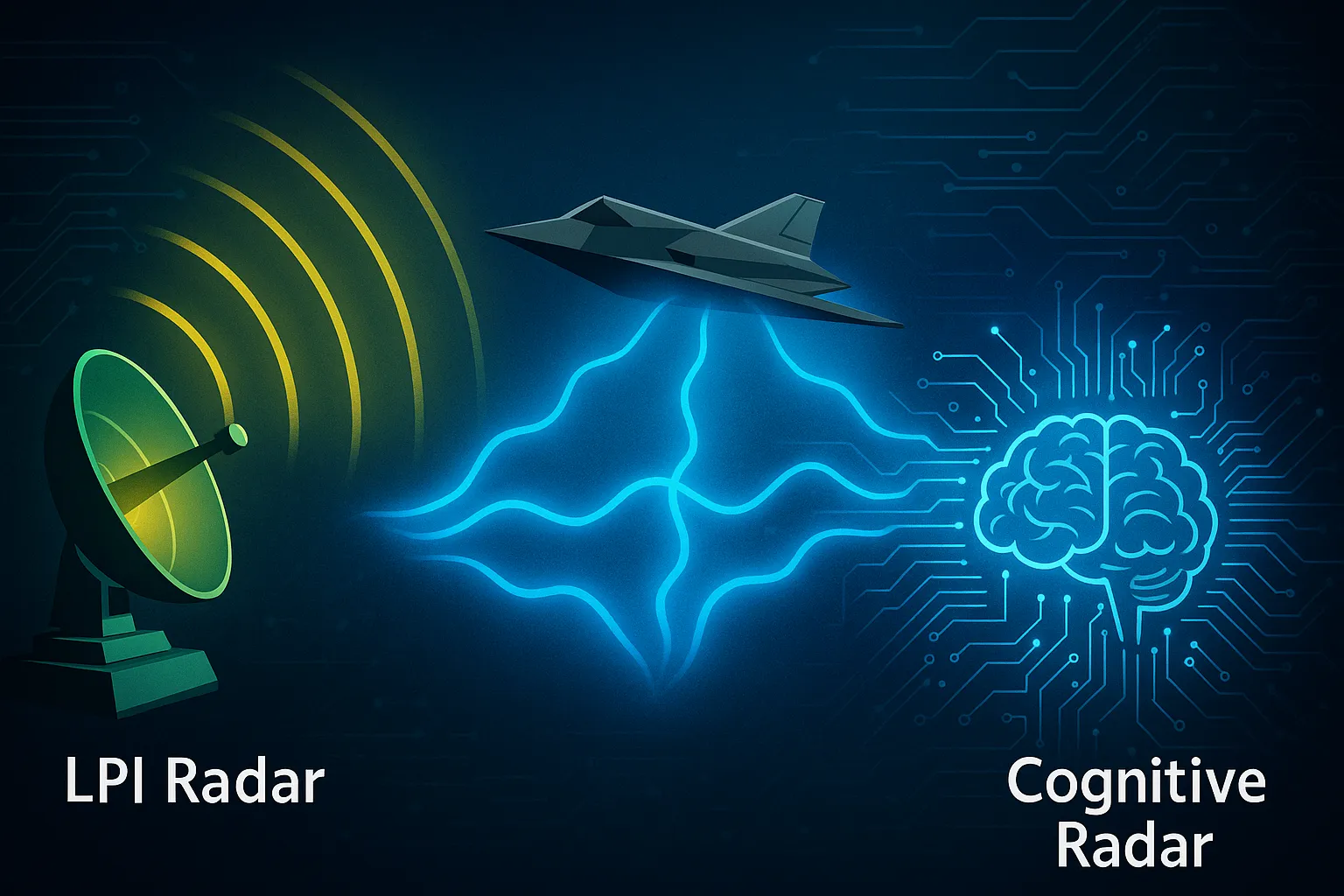
Abstract
The electromagnetic spectrum has become a contested domain where detection and evasion technologies evolve in continuous opposition. This article examines the technical foundations of Low Probability of Intercept (LPI) radar systems and the emergence of Cognitive Radar architectures leveraging adaptive waveform design and machine learning.
By drawing on operational systems and peer-reviewed research, we analyze how these technologies are reshaping detection capabilities against stealth platforms while recognizing the physical and operational constraints that govern their deployment.
Introduction: The Changing Nature of Radar Detection
Modern radar warfare has transitioned from a power-dominant paradigm to an information-centric one. Early stealth aircraft like the F-117 Nighthawk relied mainly on radar cross-section (RCS) reduction through shaping and radar-absorbent materials.
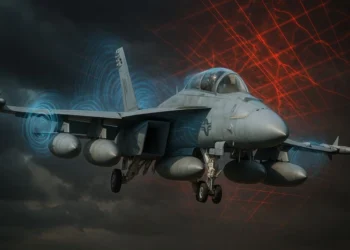
Contemporary low-observable platforms integrate electronic warfare (EW) functions that actively manipulate the electromagnetic environment.
Radar designers have responded with LPI and cognitive sensing architectures—systems that adapt waveforms and process information to see through deception and low observability.
Low Probability of Intercept Radar: Technical Foundations
Defining LPI Characteristics
Contrary to the common belief that LPI means “low power,” true LPI radar design minimizes detectability through intelligent energy management and signal structure.
LPI radars distribute signal energy over frequency and time—reducing spectral density and blending transmissions into background noise. Key techniques include:
- Temporal and Spectral Energy Distribution: Wideband, time-dispersed energy reduces peak detectability by ESM receivers.
- Signal Processing Gain: Coherent integration across pulses allows detection even when the signal is buried in noise.
- Waveform Complexity: Frequency hopping, pseudo-random modulation, and phase coding generate noise-like spectra resistant to classification.
Operational Examples
The AN/APG-81 AESA radar on the F-35 Lightning II employs agile frequency hopping and low autocorrelation waveforms.
Similarly, the U.S. Navy’s AN/SPY-6(V) radar combines digital beamforming with LPI techniques, transmitting multi-band waveforms that reduce anti-radiation vulnerability.
LPI Limitations
Physics imposes tradeoffs: LPI spreads power to remain covert, but this reduces range due to the radar range equation’s fourth-root dependency.
Moreover, advanced ESM systems using cyclostationary analysis or higher-order spectral detection can sometimes reveal hidden LPI emissions.
Cognitive Radar: Adaptive Sensing Architectures
Theoretical Framework
Coined by Simon Haykin, Cognitive Radar introduces the Sense–Think–Act Loop—a closed-loop process where the radar perceives its environment, reasons using AI, and acts by adjusting waveforms.
This transforms radar from a passive sensor into an intelligent agent in the electromagnetic battlespace.
- Perception: Collects echoes, clutter, and interference across multi-spectral sensors.
- Decision: Machine learning models optimize detection probability and interference rejection.
- Action: Waveform parameters (frequency, pulse width, PRF, modulation) are adapted in real time.
Implementation Approaches
Current R&D includes reinforcement learning for waveform selection (DARPA ARC Program), knowledge-aided signal processing (Raytheon Advanced Combat Radar), and multifunction architectures like the CEAFAR-2 radar, which dynamically reallocates resources among simultaneous missions.
Cognitive Radar versus AESA Technology
While AESA radars offer agile beam steering and frequency agility, their responses are predetermined. Cognitive Radar adds an AI-driven decision layer that learns from feedback and modifies waveform strategy dynamically.
This represents a shift from programmable to adaptive intelligence.
Comparative Table: Conventional, LPI AESA, and Cognitive Radar Architectures
| Metric | Conventional Pulse Radar | LPI AESA Radar (e.g., AN/APG-81) | Cognitive Radar (Next Generation) |
|---|---|---|---|
| Waveform | Fixed PRF/Pulse Width (Predictable Patterns) | Frequency Hopping / Spread Spectrum | Real-Time Adaptive / ML-Optimized |
| Detectability | High (Easily Classified by ESM) | Low (Requires Wideband ESM) | Very Low (Dynamic, Non-Repetitive) |
| Adaptivity | None (Fixed Modes) | Limited (Programmed Modes) | High (Self-Learning Sense–Think–Act Loop) |
| Operational Control | Operator-Defined | Software-Defined | AI-Driven / Autonomous Optimization |
| Threat Resilience | Vulnerable to Jamming | Resistant via Spread Spectrum | Predictive Counter-Adaptation |
Summary: Conventional radars emit predictable waveforms easily intercepted by ESM. LPI AESA radars mitigate this through waveform agility and signal processing gain, while Cognitive Radars evolve dynamically using AI to anticipate and counter stealth and jamming.
Electronic Support Measures in the LPI Era
Detecting LPI emissions challenges traditional ESM systems. Modern receivers require wideband instantaneous coverage, high sensitivity, and AI-based classification.
Advanced systems like the AN/ALR-94 on the F-22 use digital channelization and cyclostationary analysis to detect patterns hidden below the noise floor.
Operational Context and Constraints
LPI and Cognitive Radar effectiveness depends on context. In permissive environments, LPI offers limited advantage. In contested environments, cognitive adaptation ensures survivability.
Yet, real-world implementation faces SWaP-C constraints, algorithm validation challenges, and spectrum management issues.
Emerging Technologies and Research Directions
Quantum Sensing Concepts
Quantum illumination explores entangled photon detection to enhance sensitivity. While promising at optical scales, RF implementation remains experimental.
Stealth will not vanish overnight—quantum sensing improves SNR but does not alter the radar range equation’s fundamentals.
Metamaterials and Reconfigurable Apertures
Dynamic metamaterial antennas and frequency-selective surfaces may redefine radar aperture flexibility.
Prototypes like Kymeta’s Dynamic Metasurface Antenna demonstrate reconfigurable beam steering, but power handling and thermal limits constrain radar-grade use.
Conclusion: From Power to Intelligence
The shift from conventional to LPI to Cognitive Radar marks the evolution of radar from power-dominant to information-dominant architectures.
Systems like the AN/APG-81 and AN/SPY-6 show how intelligent energy management redefines detection and survivability.
Future radar supremacy will hinge not on raw power, but on algorithmic intelligence—systems that think, learn, and adapt faster than the threats they face.
References
- Haykin, S. (2006). “Cognitive Radar: A Way of the Future.” IEEE Signal Processing Magazine, 23(1), 30–40.
- Pace, P.E. (2009). “Detecting and Classifying Low Probability of Intercept Radar.” Artech House, 2nd Edition.
- Greco, M., Gini, F., & Farina, A. (2018). “Cognitive Radars: On the Road to Reality.” IEEE AES Magazine, 33(11), 28–44.
- Guerci, J.R. (2015). “Cognitive Radar: The Knowledge-Aided Fully Adaptive Approach.” Artech House.
- Lloyd, S. (2008). “Enhanced Sensitivity of Photodetection via Quantum Illumination.” Science, 321(5895), 1463–1465.
- Richards, M.A. (2014). “Fundamentals of Radar Signal Processing.” McGraw-Hill, 2nd Edition.
- DARPA (2019). “Adaptive Radar Countermeasures (ARC) Program Overview.”
- Schuerger, J., & Garmatyuk, D. (2008). “Performance of Random OFDM Radar Signals in Deception Jamming Scenarios.” IEEE Radar Conference, 1–6.