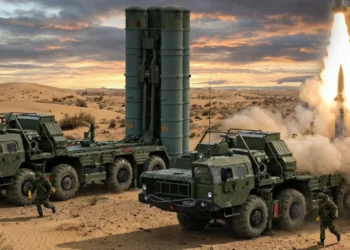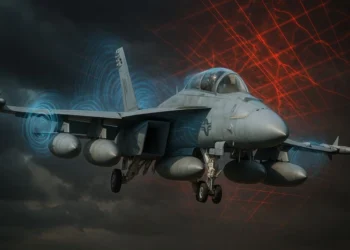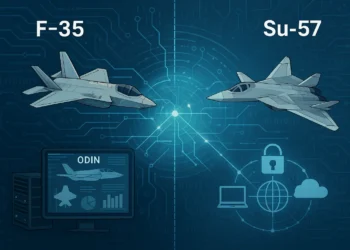


Scenario: An Israeli F-35 crosses into Syrian airspace. Somewhere below, a Russian S-400 battery commander faces an impossible choice:
- Option A: Turn on radar → Track the jet → Expose position → Get targeted in minutes.
- Option B: Stay silent → Survive → Let the enemy through.
This highlights the critical weakness in S-400 Electronic Warfare defense. It has nothing to do with missile range.
Executive Summary: The S-400 Triumf isn’t defeated by better missiles—it is paralyzed by a doctrine older than radar itself: “To emit is to die.” This definitive analysis of S-400 Electronic Warfare explains how modern NATO jamming and SEAD kill-chains force Russia’s most advanced air defense into a lose-lose dilemma.
Estimated reading time: 14 minutes
1. Introduction: The Missile Trap
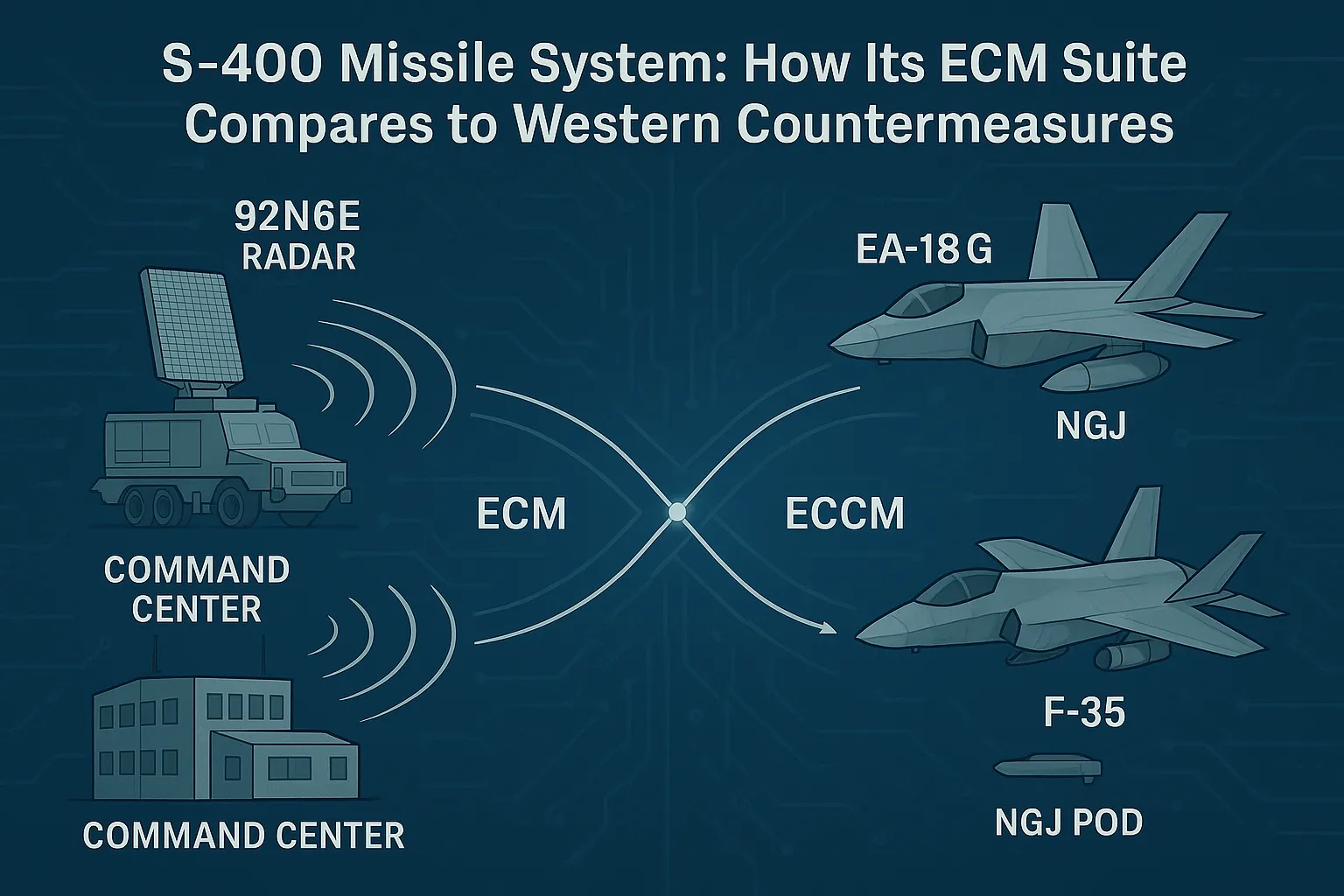
Most analysts fixate on the “400 km range” of the S-400’s 40N6E missile. That is a trap. The system’s true combat value is defined by its integrated network: the 92N6E “Grave Stone” fire-control radar and the 55K6E command post. Russian doctrine treats this grid as survivable—but modern S-400 Electronic Warfare capabilities are struggling to keep up with the pace of NATO’s digital dominance.
2. Operational Context: Syria & Ukraine
Syria (The Silent Standoff): Since 2017, the Israeli Air Force has struck targets in Syria repeatedly, often near S-400 batteries. Why didn’t the S-400 shoot? It wasn’t a technical failure; it was EMCON (Emission Control). Operators kept radars silent to avoid giving away their electronic signature to ELINT aircraft like the RC-135 Rivet Joint. In the game of S-400 Electronic Warfare, silence is the only armor.
⚡ The S-400 Death Spiral
Step 1: Radar ON
92N6E searches for target
Step 2: ELINT Lock
Enemy geolocates signal
Step 3: Targeted
HARM / Strike inbound
This is why the S-400 often prefers silence over certainty.
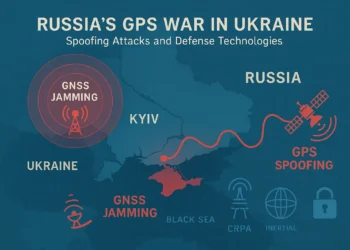
Ukraine (The Stress Test): In Ukraine, Russia’s air defense nodes have been systematically hunted. The conflict has exposed the fragility of the S-400 Electronic Warfare architecture when faced with AGM-88 HARM missiles and Storm Shadow cruise missiles. The lesson? A networked defense has a single point of failure: The Radar. Kill the radar, and the battery is useless.
3. Comparative Analysis: S-400 vs NATO EW
| Parameter | S-400 Electronic Warfare 🇷🇺 | NATO EW (Offensive) 🇺🇸 |
|---|---|---|
| Detection Logic | Active Radar (Must Emit) | Passive Sensors (Silent) |
| Survivability | Low when active | High (Standoff) |
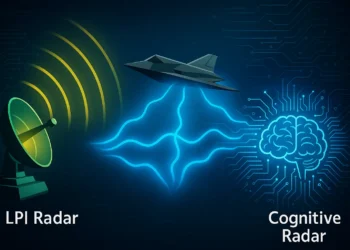
| Countermeasure | Freq. Hopping / LPI | AESA Jamming (NGJ) |
| Advantage | Power (Ground Based) | Stealth & Networking |
| Winner | NATO (Due to Distributed EW Architecture) | |
💡 Key Insight: “The S-400 doesn’t lose because its missiles are bad. It loses because modern warfare punishes radar emissions faster than any missile can fly.”
4. The “Wild Weasel” Trap: Advanced SEAD Tactics
Modern SEAD (Suppression of Enemy Air Defenses) tactics have evolved far beyond the Vietnam-era “fly and shoot.” Today, the primary threat to S-400 Electronic Warfare units is the ADM-160 MALD (Miniature Air-Launched Decoy).
The MALD is a small, programmable cruise missile that does not carry a warhead. Instead, it carries an electronic signature generator. It can mimic the radar cross-section (RCS) of a B-52 bomber, an F-16 fighter, or even a stealth aircraft. This creates a “saturation attack” on the S-400’s scope.
“Decoys don’t destroy the S-400. They force it to commit suicide.”
Once the S-400 operator is flooded with 50+ incoming targets, they are forced to turn on their fire-control radar to discriminate between real jets and decoys. The moment they emit high-power tracking beams, they are geolocated by circling F-35s or RC-135s. Seconds later, an AGM-88E AARGM or a GPS-guided HIMARS rocket is inbound to those coordinates.
5. Conclusion: The Emission Dilemma
The S-400 remains formidable—when it can afford to turn on its radar. But in contested airspace, that is a luxury. The iron law of modern air defense is simple:
- ❌ Emit → Get Targeted → Die
- ❌ Stay Silent → Survive → Lose the Mission
Until Russia solves the problem of “seeing without being seen” (through Passive Radar or IRST networks), the greatest enemy of S-400 Electronic Warfare units will not be a missile, but their own radar beam.
📬 Get Deep-Dive Defense Analysis
Subscribe for geopolitical breakdowns the mainstream media won’t touch.
❓ FAQ: S-400 Electronic Warfare
Q: Can the F-35 jam the S-400?
A: Yes. The F-35 can detect and geolocate the S-400’s radar emissions using its AN/ASQ-239 suite. While it doesn’t “blind” it with raw power like a Growler, it dismantles the S-400 Electronic Warfare kill chain by locating the nodes for destruction.
Q: Has the S-400 been destroyed in combat?
A: Yes. Multiple S-400 components (radars and launchers) have been confirmed destroyed in the Ukraine conflict via HARM missiles, Storm Shadow cruise missiles, and precision strikes.