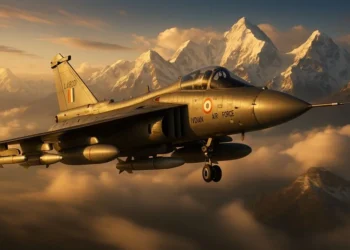


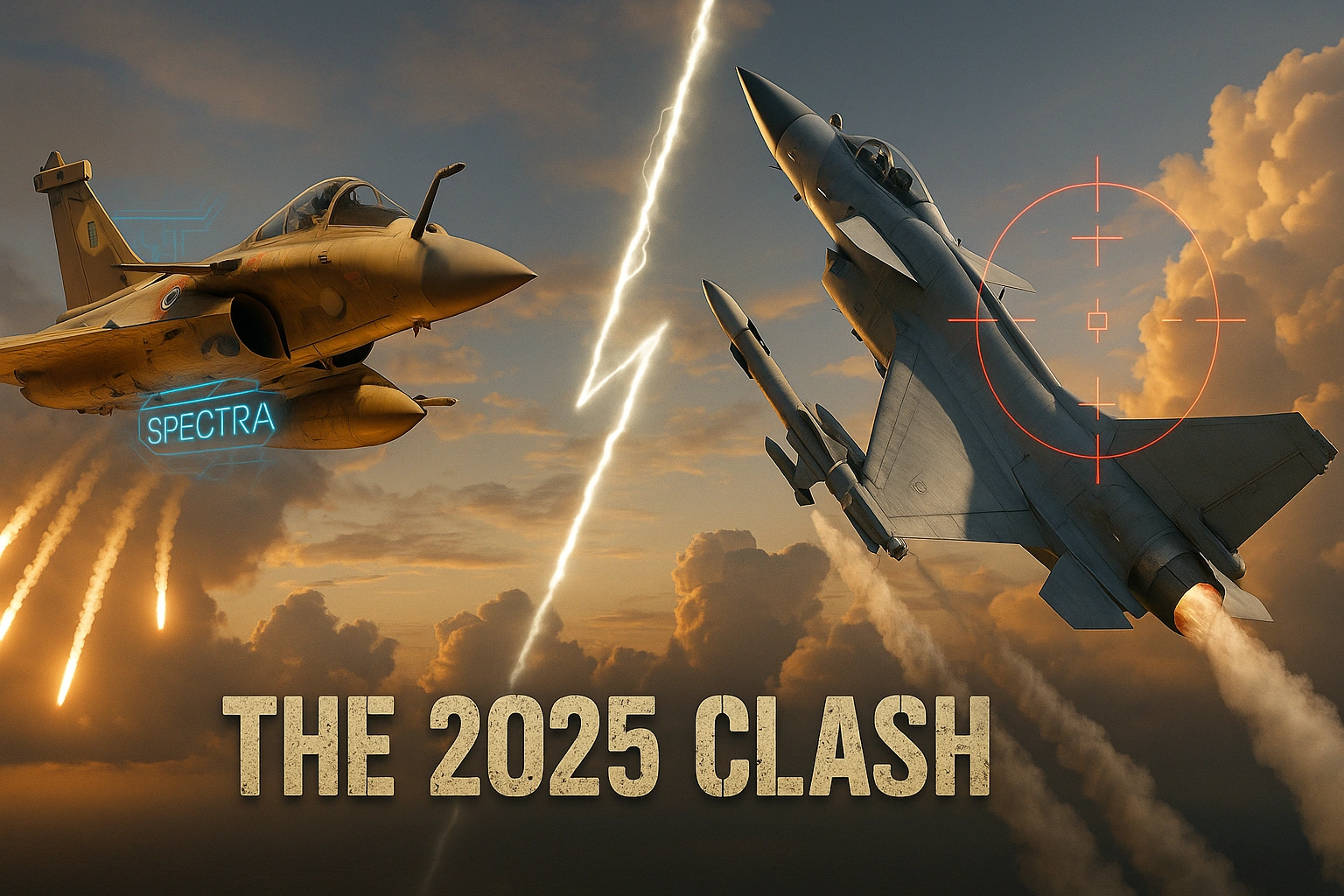
The debate used to be theoretical. “European refinement vs. Chinese pragmatism,” analysts would say. But the events of May 2025—and the unverified but persistent rumors of a J-10C engaging a Rafale over the Kashmir region—have changed the conversation forever.
The Dassault Rafale (The “Squall” of France) and the Chengdu J-10C (“Vigorous Dragon” of China) are the two most exported non-US 4.5th Generation fighters in the world today. One is a twin-engine masterpiece of expensive engineering; the other is a single-engine marvel of cost-effective lethality.
In a modern battlespace dominated by Beyond Visual Range (BVR) missiles and Electronic Warfare (EW), does the Rafale’s legendary SPECTRA suite still hold the crown, or has the J-10C’s PL-15 missile rewritten the rules of engagement?
This is the ultimate, data-driven comparison of the Rafale vs. J-10C.
Technical Specifications: The Tale of the Tape
Before we dive into the controversy, let’s look at the hard numbers. Note the crucial difference in engine philosophy and weapon range.
| Feature | Dassault Rafale (F4 Standard) | Chengdu J-10C (Vigorous Dragon) |
| Origin | France (Dassault Aviation) | China (Chengdu Aerospace) |
| Configuration | Twin-Engine Canard Delta | Single-Engine Canard Delta |
| Powerplant | 2x Snecma M88-4E (16,800 lbf each) | 1x WS-10B “Taihang” (~32,000 lbf) |
| Radar | RBE2-AA AESA (GaN Tech) | KLJ-7A AESA (Liquid Cooled) |
| Top Speed | Mach 1.8 (Supercruise capable) | Mach 2.2 (High Altitude Interceptor) |
| Combat Radius | 1,850 km (Heavy Load) | ~1,200 km (Lighter Load) |
| Primary BVR | Meteor (Ramjet, >200km Range) | PL-15 (Dual Pulse, >250km Range) |
| EW Suite | SPECTRA (Integrated Self-Protection) | KG-600/K-JDC-02 Pods (External/Internal) |
| Hardpoints | 14 (Heavy Payload – 9.5 Tons) | 11 (Medium Payload – 7 Tons) |
| Est. Unit Cost | ~$100 – $120 Million | ~$45 – $55 Million |
1. Design Philosophy: The “Omnirole” vs. The “Interceptor”
The French Swiss Army Knife
The Rafale is unique because it was designed to replace seven different types of aircraft in the French inventory. It is an “Omnirole” fighter. This means a Rafale can take off with four MICA missiles for air defense, six AASM hammers for ground attack, and a reconnaissance pod—all in the same mission. Its twin-engine design provides the redundancy needed for naval operations (taking off from the Charles de Gaulle) and deep-strike survival.1 If one engine fails, the pilot comes home.
The Chinese Dragon
The J-10C follows a different doctrine: Numbers and Agility. It is structurally similar to the F-16 but aerodynamically superior due to its large canard-delta configuration. The J-10C is designed to be purchased in bulk. For the price of one Rafale, a nation can field two or three J-10Cs. In a defensive war of attrition, this numerical advantage is impossible to ignore.
UltiDefense Insight: The J-10C’s Diverterless Supersonic Inlet (DSI) bump doesn’t just look cool; it reduces the frontal Radar Cross Section (RCS) and saves weight, making the J-10C stealthier than previous variants.2
2. The Weapons Clash: Meteor vs. PL-15
This is where the debate gets heated.
The Meteor (Rafale):
The MBDA Meteor is often called the world’s best air-to-air missile.3 Unlike traditional missiles, it uses a Ramjet engine.4 This means it can throttle its engine to save fuel and then accelerate again in the terminal phase.5 When it reaches the target 150km away, it still has maximum energy to maneuver. It has a massive “No Escape Zone.”
The PL-15 (J-10C):
The PL-15 is the weapon that woke up the West. It uses a Dual-Pulse Rocket Motor and has a reported range exceeding 250km—outranging the Meteor on paper.6 Combined with the J-10C’s AESA radar, the J-10C can theoretically take the “First Shot” before the Rafale is even in range.
The 2025 Controversy:
Reports from May 2025 suggest that in a contested electronic environment, the raw range of the PL-15 forced Rafale pilots to go defensive earlier than expected. While unconfirmed, this highlights a terrifying reality: Range dictates tactics.
3. Electronic Warfare: SPECTRA vs. Chinese EW
For decades, the Rafale’s SPECTRA (Self-Protection Equipment Countering Threats to Rafale Aircraft) was considered the gold standard. It doesn’t just jam radars; it uses “Active Cancellation” (like noise-canceling headphones for radar waves) to make the Rafale nearly invisible to older radars.7
However, the J-10C brings the new KLJ-7A AESA Radar to the fight.8 China has made massive leaps in GaN (Gallium Nitride) radar technology.
The Question: Can SPECTRA jam the frequency-hopping agility of the modern Chinese AESA?
The Reality: In recent export drills (Pakistan vs. Qatar/Turkey scenarios), the J-10C’s electronic warfare pods proved surprisingly effective at breaking radar locks. The “invincibility” of Western EW is no longer guaranteed.
4. Operational History & Reliability
Dassault Rafale:
Status: Battle Hardened.
Conflict Zones: Afghanistan, Libya, Mali, Iraq, Syria.9
Verdict: The Rafale works. It drops bombs on time, it flies off carriers, and it requires very little maintenance compared to older jets. It is a proven commodity.
Chengdu J-10C:
Status: Regional Challenger.
Conflict Zones: Taiwan Strait Patrols, Pakistan Border Skirmishes.
Verdict: While the J-10C hasn’t seen the decades of war the Rafale has, its performance in high-altitude exercises (Tibet plateau) proves it is a reliable, rugged machine. The WS-10B engine has solved the reliability issues of earlier Chinese jets.
5. Economic Reality: Why Nations Choose the Dragon
Why did Pakistan and reportedly Indonesia (in mixed fleets) look toward the J-10C?
It comes down to the $50 Million difference.
If you are a nation like Greece or India, facing a singular, high-tech threat, you buy the Rafale for its qualitative edge and nuclear capability.
But if you need to patrol a massive border and need 100 jets to do it, the Rafale is simply too expensive. The J-10C offers 90% of the capability for 40% of the price.
Conclusion: Who Wins in 2025?
The answer depends on the mission profile.
WINNER: Dassault Rafale 🏆
If you are flying deep into enemy territory without ground support.
If you need to carry heavy cruise missiles (SCALP) or nuclear weapons.
If you need a jet that can fight its way out of a 1-vs-4 situation using SPECTRA.
WINNER: Chengdu J-10C 🐉
If you are fighting a defensive air war near your borders.
If you want to win the BVR fight with the longest stick (PL-15).
If you need to build a massive air force on a budget.
The Verdict: The Rafale is the better airplane, but the J-10C might be the better war machine for the mass-production era.
❓ FAQ: Rafale vs J-10C
Q: Can a J-10C really shoot down a Rafale?
A: Yes. With the PL-15 missile, if the J-10C detects the Rafale first (using AESA radar or AWACS data), it can fire before the Rafale can respond. In modern air combat, “First Look, First Shot” often wins, regardless of the airframe.10
Q: Which engine is better, WS-10B or M88?
A: The French M88 is more reliable and has a lower heat signature. However, the WS-10B is more powerful (32,000 lbf vs 17,000 lbf), giving the single-engine J-10C an impressive thrust-to-weight ratio.
Q: Is the J-10C a copy of the Israeli Lavi?
A: While they share visual similarities (canards/delta wing), the J-10C is a significantly larger and more modern evolution. It is 2020s technology, whereas the Lavi was 1980s technology.
💬 Join the Discussion
The skies are changing. Do you trust the battle-proven French engineering, or is the sheer range and volume of the Chinese Dragon the future of air combat?
Leave a comment below: Which pilot would you bet on? 👇