


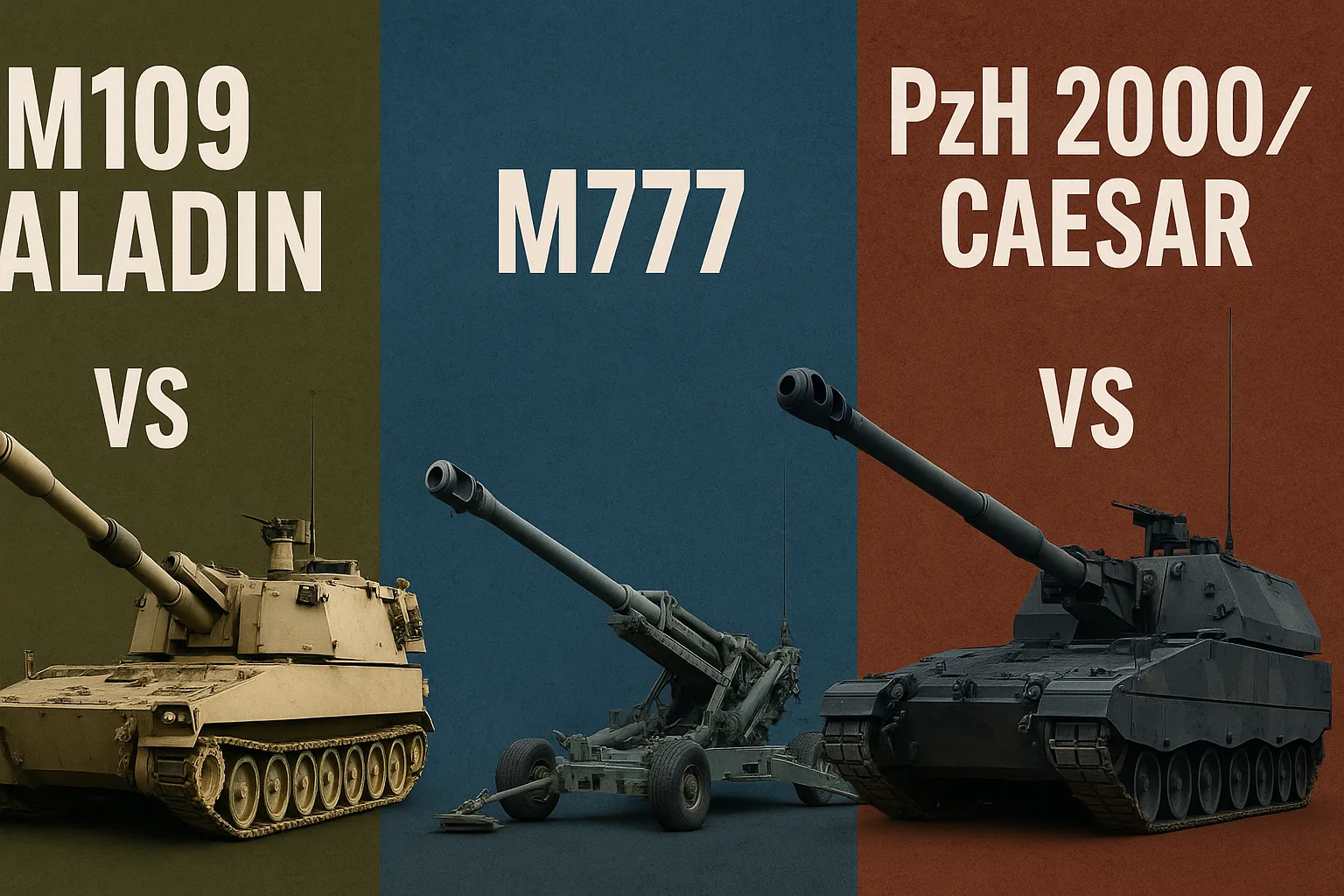
Introduction: Artillery’s Return to the Center of Modern Warfare
The war in Ukraine has revived an old truth that many strategists had begun to forget: artillery remains the backbone of land warfare. More than 70% of battlefield casualties have been attributed to indirect fires, reaffirming the cannon’s role as the core of modern combat power. Yet the conflict has also revealed a widening performance gap between traditional U.S. artillery systems—especially the towed M777 and the tracked M109 Paladin—and Europe’s new generation of mobile, automated howitzers such as PzH 2000 and CAESAR.
This article argues that while the M777 and M109 still offer unmatched availability and cost-effectiveness, they now struggle to meet the operational demands of high-intensity warfare defined by counter-battery radars, rapid displacement (“shoot-and-scoot”), automation, and long-range precision fire.
I. The Systems at a Glance: Traditional vs. Modern Mobile Artillery
To understand why modern systems are outperforming legacy platforms, we need to break down each system’s design philosophy.
A. The Classic American Duo: M109 & M777
M109 Paladin (Tracked, Self-Propelled)
Strengths: mature logistics chain, proven reliability, armor protection, low procurement cost
Weaknesses: slow engagement cycle, limited automation, shorter barrel (39-caliber), limited burst fire capability
M777 Ultralight Howitzer (Towed)
Strengths: extremely light (titanium construction), airliftable, inexpensive, widely adopted
Weaknesses: slow emplacement/teardown time, vulnerable during transport, no automation, dependent on prime movers
The U.S. artillery ecosystem is optimized for scale and logistics, not for rapid displacement under hostile sensors.
B. The European Champions: PzH 2000 & CAESAR
PzH 2000 (Tracked, Fully Automated)
Automatic loading system
Superb sustained fire rate (burst of 3 rounds in 9 seconds)
52-caliber barrel for extended range
Fully digital fire-control system
CAESAR (Wheeled, Automated)
Rapid shoot-and-scoot (in and out in 80 km/h
Lower operating cost compared to tracked systems
Highly accurate with reduced crew size
These systems are built for an environment where counter-battery detection is measured in seconds, not minutes.
II. Key Performance Metrics: Where the Real Battle Is Fought
A. Rate of Fire & Automation: The Survival Factor
Modern battlefields punish slow artillery. Counter-battery radars such as Zoopark, COBRA, or U.S. AN/TPQ-53 locate firing positions almost instantly.
Why Automation Matters
M777 & M109 rely on manual loading → slower bursts
PzH 2000 & CAESAR use automated loaders → faster rounds-on-target
Shoot-and-scoot capability is now the decisive factor. The M777’s lengthy setup and takedown make it extremely vulnerable. The M109 is better, but still slower than the digital, automated European guns.
B. Mobility and Survivability: Tracked vs. Wheeled Doctrine
CAESAR and PzH 2000
Designed to relocate before enemy counter-battery fire can reach them
Wheeled systems (like CAESAR) add strategic mobility, enabling rapid repositioning across large distances
Tracked systems (PzH 2000) excel in rough terrain
M777 & M109
M777 depends entirely on its towing vehicle
M109 is mobile, but not optimized for rapid displacement cycles
Conclusion:
Modern systems survive because they move faster—both tactically and strategically.
C. Barrel Length & Range: Physics Doesn’t Lie
A simple truth: longer barrels equal higher muzzle velocity and greater range.
52-caliber (PzH 2000, CAESAR) → 40–55 km with base-bleed or rocket-assisted rounds
39-caliber (M777, M109) → typically 24–30 km
Precision munitions such as Excalibur help the M777, but they cannot fully compensate for the inherent ballistic disadvantage.
Precision Ammunition Comparison
Excalibur (U.S.): 40 km precision
Vulcano (Italy/Germany): up to 70+ km depending on variant
Europe is outpacing the U.S. in tube artillery range—a surprising reversal of Cold War trends.
III. The Strategic Landscape: Why These Differences Matter
A. Counter-Battery Warfare Defines the Modern Battlefield
Artillery must:
Fire
Displace
Hide
Repeat
Any delay increases casualty risk by orders of magnitude.
Implication:
Modern European systems were simply built for the sensor-saturated battlespace of today. M777 and early Paladin variants were not.
B. Logistics, Sustainment, and Cost: America’s Hidden Advantage
Despite their limitations, M777 and M109 dominate global inventories because they offer:
Cheap procurement
Massive existing stockpiles
Mature maintenance infrastructure
Immediate availability
During Ukraine’s war, the U.S. delivered 100+ M777s quickly—something no European manufacturer could replicate at scale.
In a long war of attrition, numbers matter as much as quality.
C. Interoperability & NATO Dynamics
Many NATO nations are standardizing on:
PzH 2000 (Germany, Netherlands, Croatia)
CAESAR (France, Denmark, Czech Republic)
K9 Thunder (South Korea, Norway, Finland, Estonia, Poland)
The U.S.’s reliance on older systems may create future interoperability gaps unless modernization accelerates.
IV. The Future: Where is the U.S. Artillery System Heading?
A. ERCA: The Long-Awaited Leap Forward
The Extended Range Cannon Artillery (ERCA) program aims to:
Replace or augment the M109
Extend range beyond 70 km
Integrate autoloaders
Increase sustained fire rate
Enhance digital networking
However:
Budget pressure
Technical setbacks
Complexity of autoloader integration
…have slowed progress. ERCA is promising, but not guaranteed.
B. Why the U.S. Still Uses M777 and M109
Three reasons:
1. Cost Efficiency
A CAESAR costs ~$7 million.
A PzH 2000 can exceed $15 million.
The M777 costs ~$3 million.
2. Massive Legacy Inventory
U.S. stockpiles allow for rapid deployment.
3. Strategic Priorities
The U.S. invests heavily in:
Long-range rockets (HIMARS / MLRS)
Loitering munitions
Airpower
Tube artillery modernization has simply lagged behind.
V. Conclusion: A Capability Gap the U.S. Can’t Ignore
The modern battlefield values mobility, automation, rapid firing cycles, and long-range precision. In this environment:
M109 and M777 are increasingly outdated, even if still useful
PzH 2000 and CAESAR represent the current benchmark for mobile, survivable artillery
ERCA may close the gap, but uncertainty remains
Ultimately, modernization is not just a technological requirement—it is a strategic necessity. If the United States wishes to maintain artillery dominance and interoperability with its most advanced NATO partners, it must accelerate the transition to next-generation systems.
The artillery duel of the future will not be won by the biggest stockpile—but by the fastest, most automated, most precise guns on the battlefield.

