


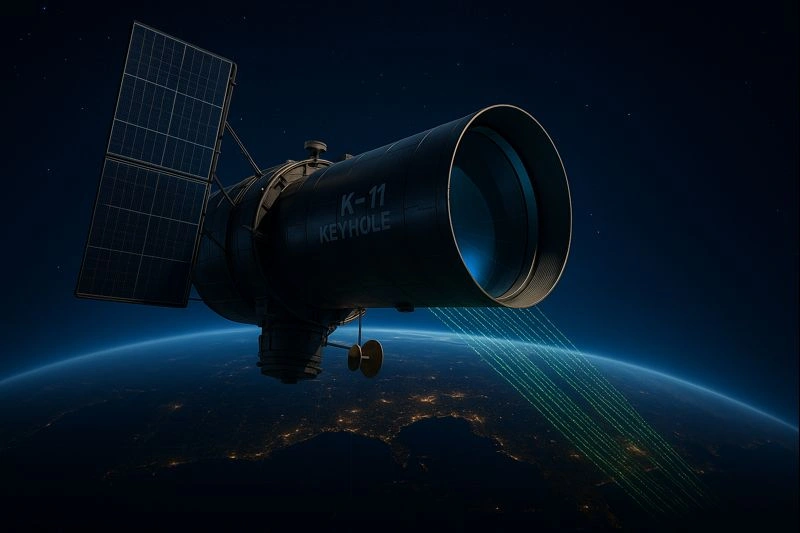
For nearly five decades, the KH-11 Keyhole reconnaissance satellite program has been the “Crown Jewel” of the United States intelligence community. Often described by experts as the “Hubble Space Telescope pointed at Earth,” the KH-11 series represents the absolute pinnacle of electro-optical (EO) imaging from space.
While commercial satellites like Maxar or Planet capture the headlines, the classified KH-11 operates in the shadows, giving U.S. decision-makers near-real-time insight into adversary movements, missile silos, and nuclear facilities with a clarity that no other nation can match.
Despite the heavy classification surrounding it, declassified documents and expert analyses allow us to paint a detailed picture of this engineering marvel. In this UltiDefense Technical Analysis, we explore the capabilities, history, and strategic significance of the Eye in the Sky.
1. What Is the KH-11 Keyhole?
The KH-11 (codenamed CRYSTAL) is a series of reconnaissance satellites developed by the National Reconnaissance Office (NRO). First launched in 1976, it revolutionized intelligence by becoming the world’s first satellite to transmit digital imagery back to Earth in real-time. Before the KH-11, spy satellites (like the KH-9 Hexagon) had to physically drop film canisters into the atmosphere to be caught by airplanes mid-air.
The “Hubble” Connection: The comparison to the Hubble Telescope is not a metaphor; it is an engineering reality. Both systems were built by Lockheed Martin with similar optical assemblies.
The Difference: Hubble looks out at the stars to capture faint light. KH-11 looks down at the Earth to capture high-contrast details.
Key Attributes (Estimated):
Primary Mirror: 2.4 meters (Identical to Hubble).
Role: High-resolution Electro-Optical (EO) reconnaissance.
Orbit: Sun-synchronous and highly elliptical polar orbits (250–1,000 km).
Data Link: Encrypted real-time downlink via SDS relay satellites.
2. Evolution: From Block I to Block V
The KH-11 is not a static relic; it has evolved through five distinct generations over 50 years.
Block I (1976–1984): The game changer. It replaced film buckets with digital CCD sensors, allowing the President to see an image minutes after it was taken, rather than days later.
Block II & III (1980s–1990s): Featured improved optics, larger fuel tanks for maneuvering, and faster data transmission speeds.
Block IV (2001–2013): Focused on survivability and enhanced “dwell time” over targets.
Block V (Current Generation): Often referred to as the “Evolved Enhanced CRYSTAL System” (EECS). These modern units likely integrate:
Advanced multispectral imaging (seeing through camouflage).
AI-assisted onboard processing.
Stealthier communication profiles to avoid detection.
3. How Good Is the Resolution? (The 10cm Debate)
This is the most debated question in the OSINT community.
Commercial Satellites: Maxar or Google Earth typically offer 30 cm resolution.
KH-11 Capability: Analysts estimate the KH-11 achieves a Ground Sample Distance (GSD) of 10 cm or better.
What does 10 cm mean strategically? At 30 cm resolution, you can see a car. At 10 cm resolution, you can identify the make and model of the car. It allows analysts to:
Identify specific aircraft variants on a runway.
Detect if a missile silo door is slightly ajar.
Count the number of troops standing in formation.
Validate nuclear treaty compliance by measuring component dimensions.
4. Orbit Strategy: Why It Is Always Watching
The KH-11 fleet operates in specific orbits designed for intelligence value.
Sun-Synchronous Orbit (SSO): The satellite passes over a target at the same local solar time each day. This means the shadows are consistent, allowing computers to automatically detect changes (e.g., a new building appearing).
Fuel & Maneuverability: Unlike commercial satellites that stay in a fixed path, KH-11s carry massive fuel reserves. They can dip their orbit (low perigee) to get a closer look at a target area during a crisis, then boost back up to a safe altitude.
Key Targets: The “Keyhole” spends its life staring at:
Chinese DF-41 ICBM brigades.
Russian submarine pens in Murmansk.
Iranian enrichment facilities.
North Korean test sites.
5. Sensor Suite: More Than Just a Telescope
While the massive primary mirror is the star of the show, the sensor backend is equally critical.
Multispectral Imaging: The KH-11 likely sees beyond the visible spectrum. It can analyze soil disturbance (to find buried IEDs or bunkers) and differentiate between real vegetation and green camouflage netting.
Thermal/Infrared (IR): While primarily an optical satellite, modern Blocks are believed to have IR overlays, allowing them to spot active engines or warm buildings at night.
AI Processing: New Block V satellites reportedly process data in orbit, discarding cloudy images and only sending valuable intel to ground stations, saving bandwidth.
6. Why KH-11 Still Matters in the Age of Drones
In 2025, with stealth drones like the RQ-180 and thousands of commercial satellites, why does the US still spend billions on KH-11s?
Political Impunity: A drone (like the U-2 or Global Hawk) entering Chinese airspace is an act of war. A satellite passing overhead is legal under international law.
Strategic Resolution: No commercial system matches the sheer optical physics of a 2.4-meter mirror. When you need to read the text on the side of a missile, you need the Keyhole.
Survivability: Flying at Mach 25 in orbit, the KH-11 is immune to standard air defenses. While ASAT weapons exist, they are politically difficult to use compared to shooting down a drone.
Conclusion: The Silent Guardian
For nearly 50 years, the KH-11 Keyhole program has shaped geopolitics from above. It has watched the fall of the Berlin Wall, the wars in the Middle East, and the rise of the Chinese Navy—all from 200 miles up.
It is not simply a piece of technology; it is the strategic nervous system of the United States. As Great Power Competition intensifies, the “Hubble pointing down” remains the ultimate high ground.
❓ FAQ: KH-11 Keyhole
Q: What is the KH-11 Keyhole? A: It is the United States’ most advanced electro-optical spy satellite system, operated by the NRO, providing real-time, ultra-high-resolution imagery for intelligence agencies.
Q: How good is the resolution of KH-11? A: While classified, estimates suggest a resolution of 10–15 cm, allowing analysts to identify object types (like specific vehicle models) that commercial satellites cannot distinguish.
Q: Is it really a Hubble Telescope? A: Structurally, yes. The KH-11 shares the same 2.4-meter primary mirror design and manufacturer (Lockheed Martin) as the Hubble Space Telescope, but it is optimized for looking at Earth rather than stars.
Q: Who operates the KH-11? A: The National Reconnaissance Office (NRO) owns and operates the satellites, distributing the imagery to the CIA, NSA, DIA, and the White House.

