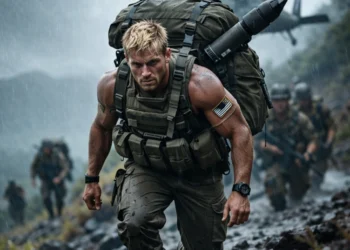


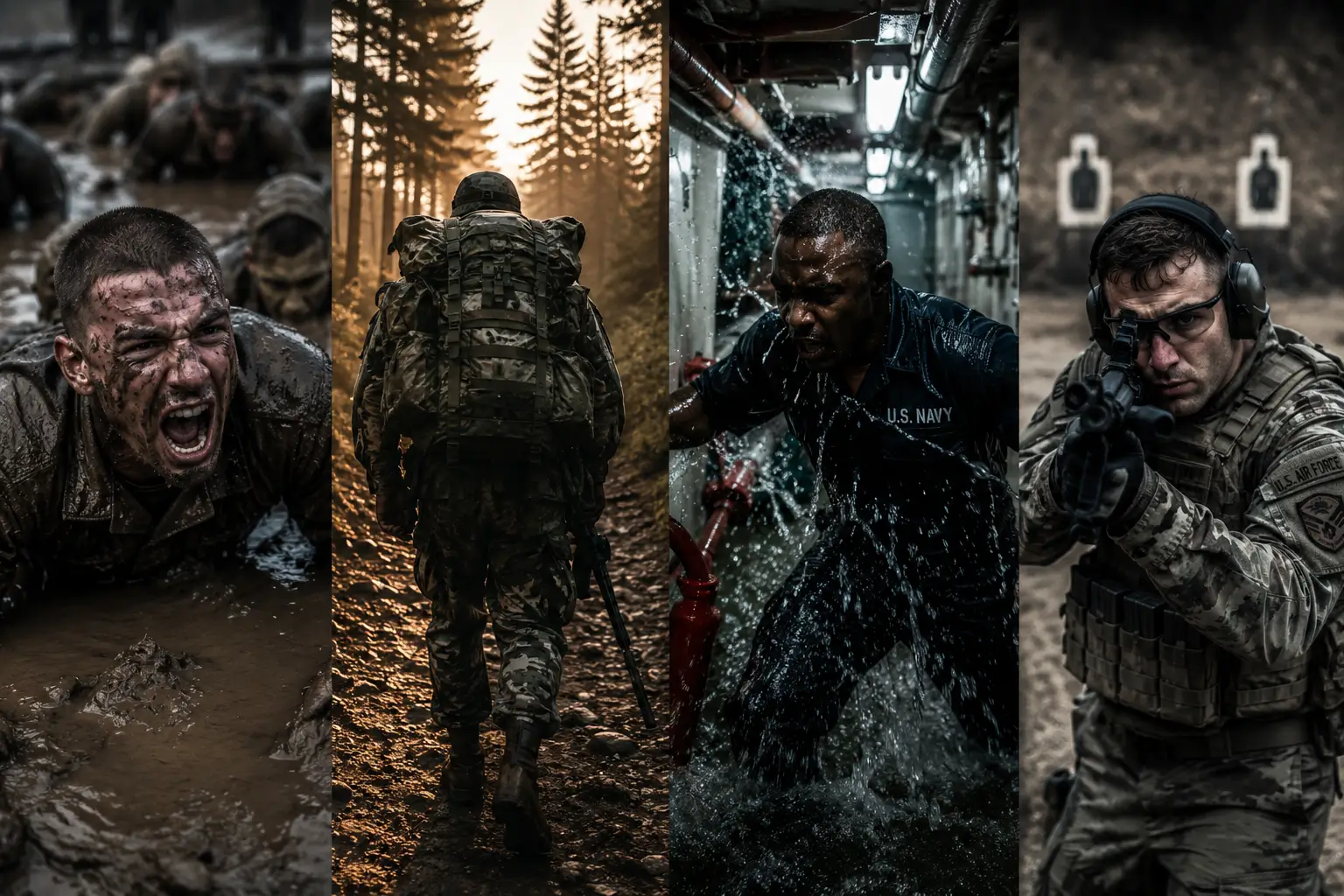
Everyone wants to know which branch has the toughest training. But ‘hardest’ isn’t just about the number of pushups. From the psychological pressure of Parris Island to the tactical field stress of Fort Moore, each branch breaks and builds recruits differently. In this expert breakdown, we rank every US military boot camp from most relentless to most academic, explaining the specific ‘stress profiles’ that define each journey.
| Rank | Branch | Primary Stress Factor | Duration |
| 1 | U.S. Marine Corps | Psychological & Physical Intensity | 13 Weeks |
| 2 | U.S. Army | Field Endurance & Tactical Stress | 10 Weeks |
| 3 | U.S. Coast Guard | High Accountability & Water Confidence | 8 Weeks |
| 4 | U.S. Navy | Confinement & Technical Repetition | 10 Weeks |
| 5 | U.S. Air Force | Academic & Professional Discipline | 8.5 Weeks |
| 6 | U.S. Space Force | Cognitive Performance & Systems Integration | 8.5 Weeks |
Marine Corps Recruit Training — The Most Relentless Overall
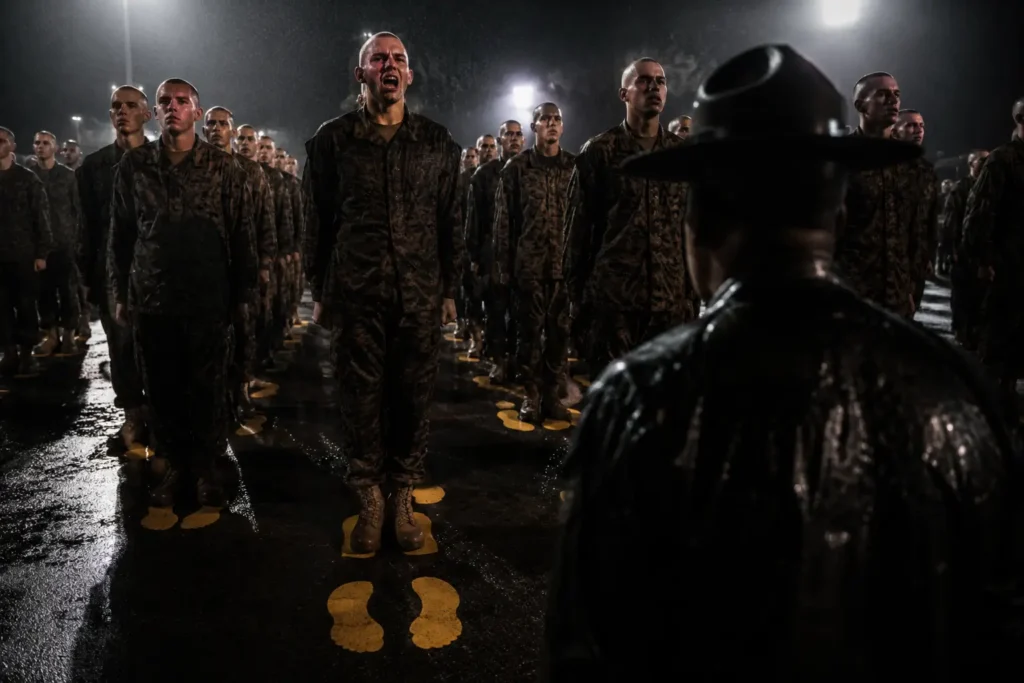
When civilians ask which boot camp is the hardest, the United States Marine Corps (USMC) is the undisputed answer. Whether it’s Parris Island or San Diego, the mission isn’t just training; it’s a total identity overhaul.
Why the Corps Ranks #1: The Psychological Siege
Marine Drill Instructors (DIs) are masters of “Total Control.” From the moment you hit the Yellow Footprints, your individuality is stripped away. Unlike other branches that focus on job skills early, the Marines focus on the Warrior Ethos.
- Duration: 13 weeks (The longest standard basic training).
- The “DI” Factor: Constant, unblinking supervision. There is no “off” switch.
- Physical Demands: High-repetition calisthenics, brutal hikes (humps), and the relentless “incentive training” (quarterdecking).
The Strategic Peak: The Crucible
- 45 miles of marching with heavy gear.
- Minimal sleep and food deprivation.
- Team-based combat hunter events and obstacle courses.
- The Reward: Only after this event do you earn the title of Marine and the Eagle, Globe, and Anchor (EGA).
Tactical Insight: What Others Miss
The Marines don’t just want you to pass a PT test; they want to see how you perform when you are emotionally and physically bankrupt. The “hardness” comes from the sustained tension. In the Army or Navy, you might find pockets of relief; in the Corps, the pressure is a 13-week constant.
Army Basic Combat Training (BCT) — The Grind of the Field
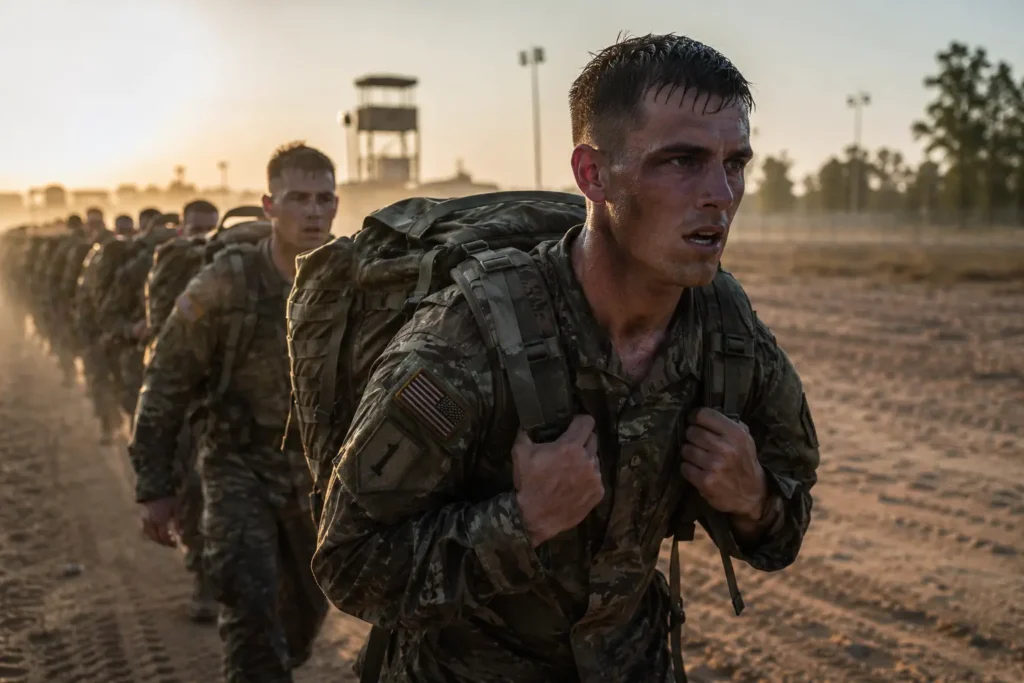
The U.S. Army’s training is often underestimated because of its sheer size. However, Army BCT is a brutal marathon of field endurance and tactical proficiency. While the Marines focus on the individual’s “soul,” the Army focuses on the individual as a combat asset within a massive machine.
The “Big Three” Locations
Where you train matters. Whether it’s Fort Moore (formerly Benning), Fort Jackson, or Fort Sill, the environment dictates the misery. Infantry recruits undergoing OSUT (One Station Unit Training) stay in the “grind” much longer than support MOS (Job) tracks.
Key Stress Factors: Rucks and Iron
- The ACFT: Recruits must master the Army Combat Fitness Test, which focuses on raw power—deadlifts, power throws, and sled drags.
- Ruck Marches: Army culture is built on the “foot march.” Carrying 35-60 lbs for miles under the sun is where the “attrition by accumulation” happens.
- The Forge: This is the Army’s answer to the Crucible. A 96-hour cumulative field exercise that tests navigation, combat medicine, and endurance under extreme fatigue.
Tactical Insight: Unpredictability and Scale
Unlike the Marines’ “controlled chaos,” the Army often feels like “The Big Green Machine.” The stress comes from the unpredictability of field conditions—sleeping in the dirt (the “field”), dealing with varied Drill Sergeant leadership styles, and the psychological weight of knowing you are part of the world’s most lethal land force.
Many “tough guys” fail Army BCT not because they can’t do pushups, but because they can’t handle 10 days in the woods with no sleep and a heavy ruck.
Coast Guard Boot Camp — Quietly One of the Hardest Pipelines
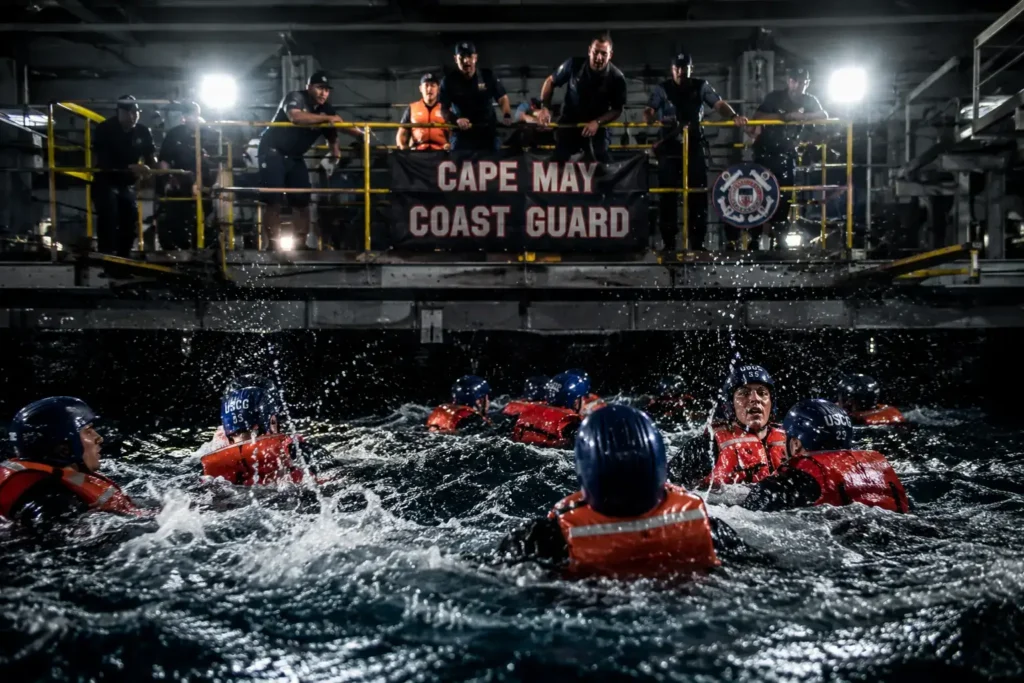
Most civilians think the Coast Guard is “Military Lite.” They are wrong. Because the Coast Guard is a small, specialized branch, they cannot afford weak links. Their boot camp at Cape May, New Jersey, is a high-pressure pressure cooker that ranks #3 for a reason: High Accountability.
Why It Surprises Recruits: The “Small Team” Stress
In the Army or Navy, you can hide in a massive platoon. In the Coast Guard, your Company Commanders (CCs) know your name, your mistakes, and your weak points by day two.
- Extreme Discipline: The Coast Guard follows a “Marine-lite” discipline model. The screaming is intense, and the “time-to-task” (getting things done in seconds) is incredibly tight.
- Academic Firehose: Recruits must memorize a massive “Reckoning” book of maritime law, knots, and procedures while under extreme physical stress.
- Water Confidence: You don’t just swim; you perform. If you aren’t comfortable in a pool while being screamed at, you won’t survive the first week.
The Psychological Edge: Immediate Maturity
Unlike other branches that “break you down to build you up,” the Coast Guard expects you to show up with a level of maturity. If you act like a child, the “reverting” (sending you back to an earlier week of training) is a constant threat.
Tactical Insight: “The Cape May Cold”
The environmental factor of training in New Jersey’s humidity or freezing winters adds a layer of physical misery that rivals the Army’s field time. For a recruit, the stress is personal. There is nowhere to hide.
Navy Boot Camp — The Mental Grind of the Deep
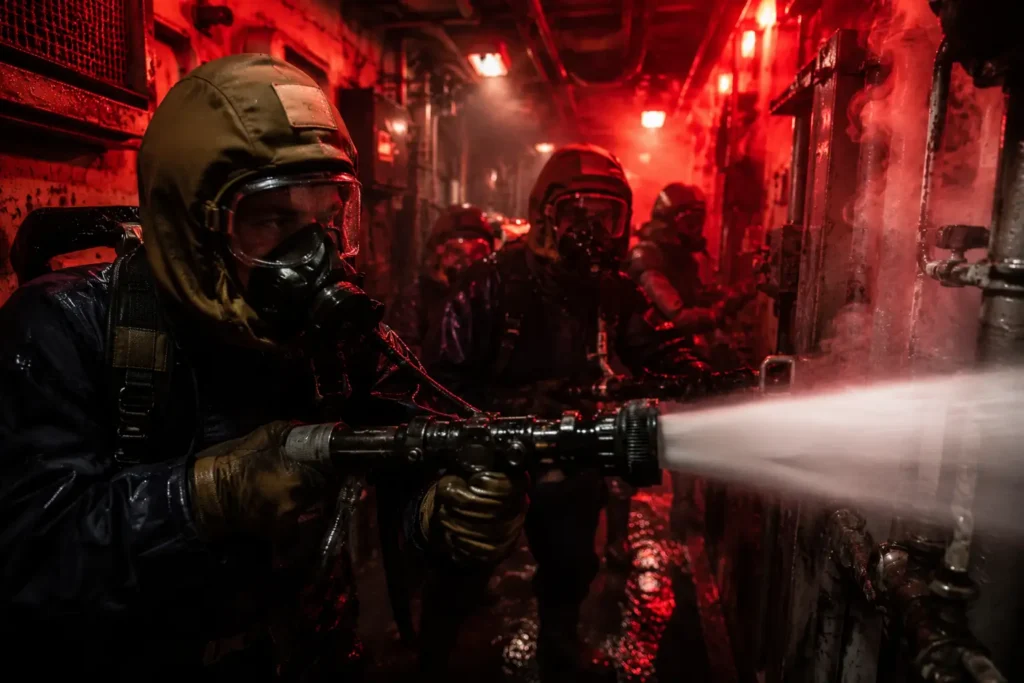
If the Marines are about “the dirt” and the Coast Guard is about “the water,” the Navy is about “the ship.” Based at RTC Great Lakes (often called “Great Mistakes” by shivering recruits), Navy boot camp is less about raw athleticism and more about mental discipline and procedural perfection.
The Real Challenge: Confinement & Compartmentalization
The Navy doesn’t just train you to fight; it trains you to live in a floating steel box. This creates a specific kind of “Hard.”
- Attention to Detail: Navy inspections are legendary for being pedantic. A single loose thread (a “mortal”) or a poorly folded shirt can lead to “IT” (Intensive Training—the Navy’s version of physical punishment).
- Damage Control & Firefighting: Every Sailor is a firefighter first. Recruits must learn to fight fires and plug leaks in dark, smoke-filled, flooded simulators while exhausted.
- Water Competency: From the third-class swim test to jumping off a 10-foot platform, you must prove you can survive in the open ocean.
The Strategic Peak: Battle Stations-21
The Navy’s version of the Crucible is Battle Stations-21. It is a 12-hour overnight “final exam” held aboard the USS Trayer, a massive 210-foot simulator.
- It replicates real-world missile attacks, floods, and mass casualty events.
- It is designed to test how you communicate and follow Standard Operating Procedures (SOPs) when you are tired, wet, and stressed.
Tactical Insight: The “Small Space” Stress
The Navy occupies rank #4 because it replaces field misery with psychological confinement. Recruits spend 10 weeks in close quarters, learning to surrender their personal space. For many, the lack of “room to breathe” is more difficult than a 10-mile ruck march.
Air Force Basic Military Training (BMT) — More Professional Than Brutal
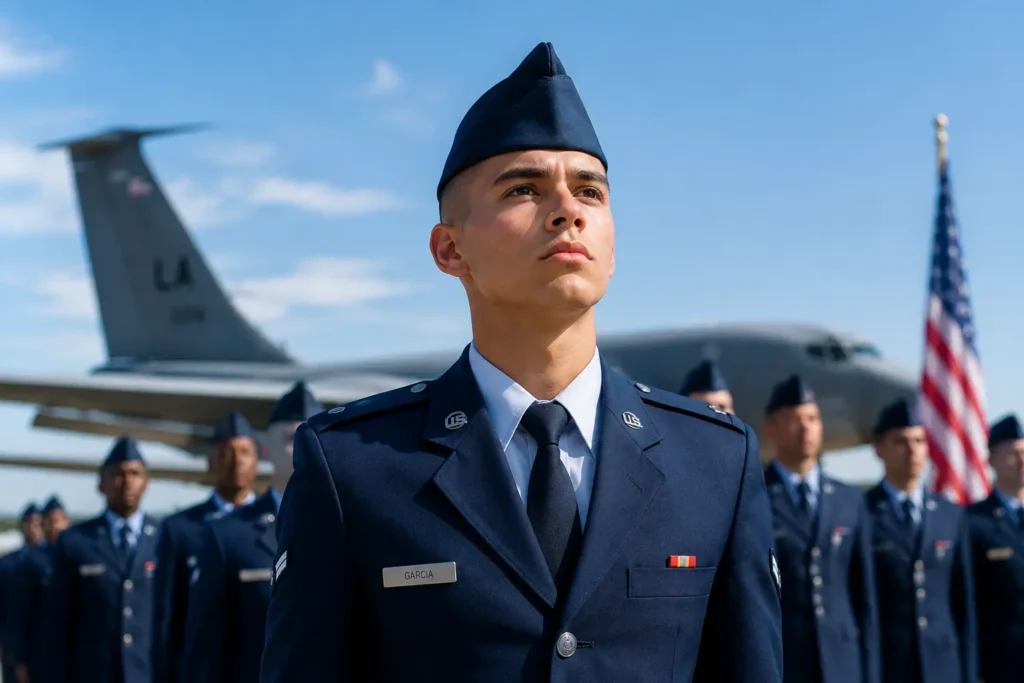
The Air Force is often mocked by the infantry branches for being “easy.” Physically, that’s largely true. However, Air Force BMT at Lackland AFB (San Antonio, Texas) is designed to produce technicians, not frontline riflemen.
The Shift: From Muscles to Mindset
- Academic Pressure: The Air Force has a massive curriculum. Recruits are tested constantly on military history, core values, and Air Force Instruction (AFI).
- Procedural Discipline: Everything is “by the book.” While a Marine DI might scream to create chaos, an Air Force Military Training Instructor (MTI) applies pressure through extreme attention to detail and professional standards.
- BEAST Week : Now evolved into PACER FORGE, this is their field training exercise. It focuses on Base Defense and Chemical, Biological, Radiological, and Nuclear (CBRN) defense. It’s less about “the mud” and more about “the mission.”
Tactical Insight: The “Gateway to the Air Force”
The Air Force ranks #5 because it transitions recruits into a corporate-style hierarchy. The stress isn’t “Will I survive this hike?” but rather “Can I maintain 100% accuracy under a high administrative workload?”
Space Force Basic Training — Cognitive Grit
The United States Space Force (USSF) currently trains at Lackland AFB, sharing much of the Air Force’s infrastructure but with a specialized “Guardian” curriculum.
The Future of Warfare: Systems Thinking
The Space Force doesn’t need you to carry a log; they need you to maintain a satellite link during a cyber attack.
- Selection for Intelligence: The USSF has the highest average ASVAB (entry test) scores. The “hardness” here is purely intellectual and technical.
- Information Dominance: Training emphasizes “Delta” culture, technical problem-solving, and managing high-stakes systems where a single mistake can cost billions.
Why the Ranking is Deceptive
While technically “the easiest” in terms of physical attrition, the Space Force has the most rigorous Security Clearance and Background Check process. Getting into the Space Force is often harder than the boot camp itself.
Final Strategy Summary: Why “Hardest” is Relative
This is the “Closing Argument” of the article, designed to keep the reader on the page (Dwell Time) and encourage social sharing.
| Branch | Identity | Core Stress |
| Marines | The Warrior | Identity Destruction |
| Army | The Soldier | Tactical Endurance |
| Coast Guard | The Guardian | Small-Team Accountability |
| Navy | The Sailor | Confinement & Precision |
| Air Force | The Airman | Technical Professionalism |
| Space Force | The Guardian | Cognitive Complexity |
Which US military branch has the highest boot camp dropout rate?
Historically, the U.S. Marine Corps and high-intensity Army combat pipelines see the highest attrition. However, “dropout” rates are often misunderstood. Most recruits fail due to medical injuries or “Failure to Adapt” (FTA) rather than lack of effort.
The Strategic Distinction: Do not confuse boot camp with “Selection.” Elite units like Navy SEALs (BUD/S) or Army Special Forces have attrition rates exceeding 70-80%, whereas standard boot camp is designed for a high pass rate to meet manpower needs.
Is Marine boot camp actually harder than Army basic training?
Yes, in terms of sustained psychological siege. Marine training is 13 weeks of total identity reconstruction. While Army Basic Combat Training (BCT) is physically grueling—especially with the ACFT and heavy ruck marches—the Army allows for more “recovery” periods. The Marines focus on constant friction; you are never “off,” which creates a higher mental toll.
Which branch has the easiest boot camp physically?
The Air Force and Space Force are traditionally ranked as the least physically punishing. However, “easy” is a trap. These branches replace “mud and rucks” with High Cognitive Load. Recruits face intense academic pressure and must master complex systems under sleep deprivation. If you are a “jock” but hate studying, the Air Force might actually be harder for you than the Army.
Is Coast Guard boot camp underrated in difficulty?
Absolutely. The Coast Guard’s Cape May facility is a “hidden boss.” Because the branch is small, there is no “hiding in the stack.” You are under a microscope 24/7. The Water Confidence requirements and the “Reckoning” (their academic bible) make this one of the most high-pressure environments in the Department of Homeland Security.
Do Drill Instructors still hit recruits?
Negative. In 2026, the “Old School” violence is a court-martial offense. Training is now professionally managed stress. Modern Drill Instructors (USMC) and Drill Sergeants (Army) use psychological pressure, “Incentive Training” (extra PT), and loss of privileges to maintain discipline. The goal is to build a soldier who can think under fire, not one who is simply afraid of their superior.
Which branch has the best quality of life after graduation?
The U.S. Air Force and Space Force consistently rank highest for quality of life, offering superior barracks (dormitories), better food, and more stable schedules. However, your experience depends on your MOS/AFSC (Job). An Air Force Security Forces member at a remote missile silo might have a harder “daily grind” than a Navy Yeoman in a climate-controlled office.