

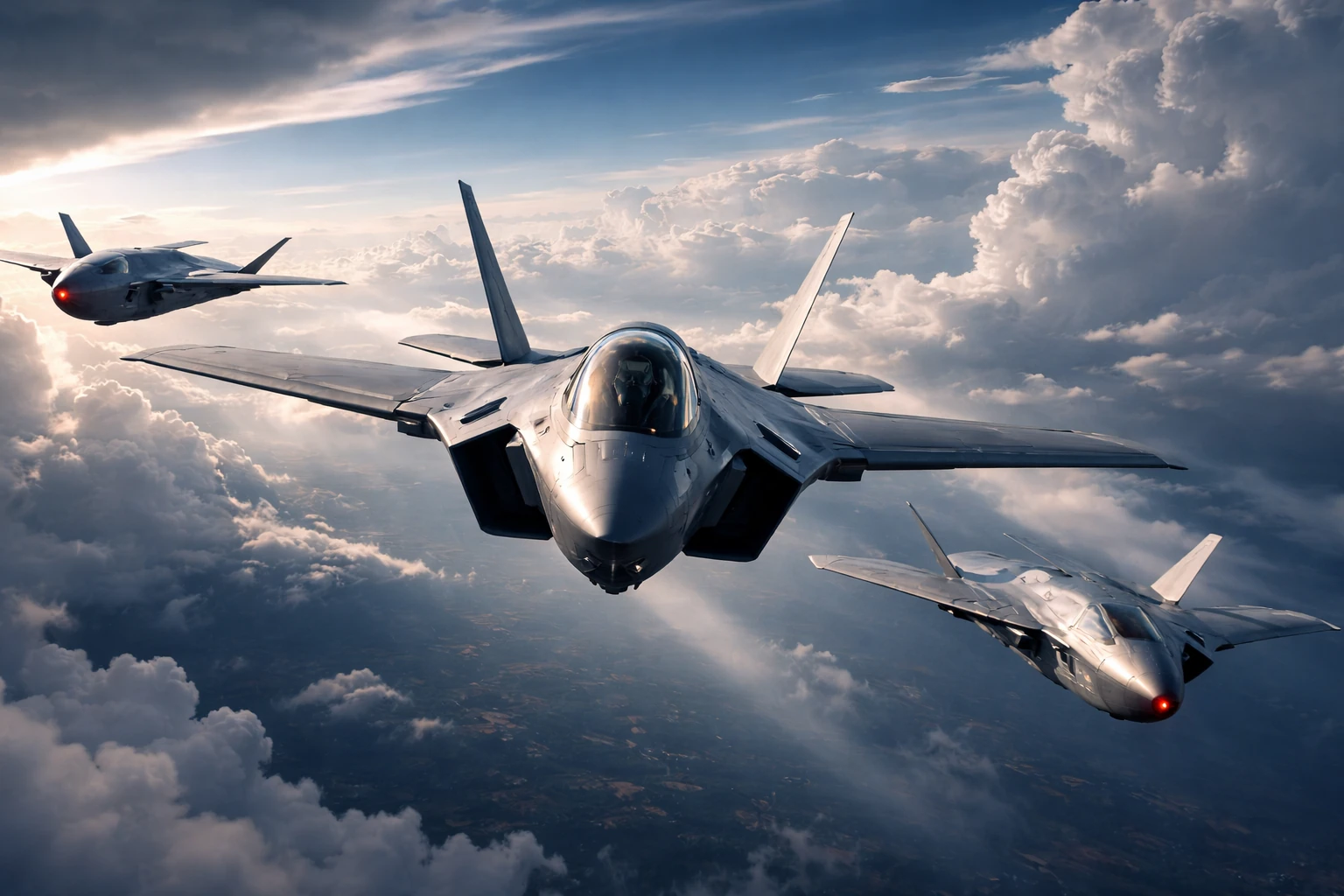
For decades, air combat revolved around a single assumption: one pilot, one aircraft, one brain. That assumption is now obsolete.
The U.S. Air Force is quietly rewriting the rules of aerial warfare through the Collaborative Combat Aircraft (CCA) program—pairing manned fighters like the F-35 Lightning II with AI-assisted, low-cost unmanned wingmen. At the center of this transformation stands one aircraft: the XQ-58A Valkyrie.
This is not science fiction. It is a flying testbed for the future structure of airpower.
What Is the “Loyal Wingman” Concept?
The Loyal Wingman concept refers to Unmanned Combat Aerial Vehicles (UCAVs) designed to operate alongside piloted fighters, extending their reach, sensing, and survivability—while absorbing risk.
In operational terms, this enables:
- Manned–Unmanned Teaming (MUM-T): Robots and humans fighting as a unit.
- Distributed Sensing and Strike: Expanding the radar horizon without exposing the manned jet.
- Attritable Mass: Risking cheap drones instead of expensive pilots.
Instead of risking an $80–100 million fighter and a highly trained pilot, air forces can now project power using intelligent, expendable partners.
XQ-58A Valkyrie Technical Specifications
Developed by Kratos Defense, the XQ-58A Valkyrie is the most advanced Loyal Wingman platform currently flying in the United States.
Below is a breakdown of the key specifications:
| Feature | XQ-58A Valkyrie Details |
| Length | ~8.8 m (29 ft) |
| Wingspan | ~6.7 m (22 ft) |
| Max Speed | High-Subsonic (Mach 0.85 est.) |
| Combat Radius | ~3,000 km (Ferry range is higher) |
| Payload | Internal Weapons Bay (JDAMs, SDBs) |
| Stealth | Low Observable Shaping (Stealthy) |
| Unit Cost | ~$2–3 Million (Target) |
| Launch Method | Rocket-Assisted Takeoff (No runway needed) |
| Recovery | Parachute System |
The cost figure is the true disruptor. At roughly 3–4% of an F-35’s price, the Valkyrie changes the cost–exchange ratio of air combat forever.
Operational Testing & Demonstrated Capabilities
Since its first flight in March 2019, the XQ-58A has completed over 10 publicly acknowledged test flights, moving beyond concept validation into operational experimentation.
1. Autonomous Formation Flight
It successfully maintained formation relative to manned-aircraft simulators, validating the complex logic required for safe Manned–Unmanned Teaming (MUM-T).
2. Weapon Bay Integration
Internal weapons bay doors opened and closed at high subsonic speeds without destabilizing the aircraft—a critical engineering hurdle for stealth drones.
3. Contested Environment Navigation
Demonstrated operations in GPS-denied conditions, relying on alternative navigation techniques to survive electronic warfare jamming.
4. Attritable Recovery
Multiple successful parachute recoveries were completed. While at least one test resulted in airframe loss, this is consistent with the “attritable” design philosophy: It’s cheap enough to lose.
Critical Gap: As of late 2024, there is no publicly confirmed live weapons release in a contested simulation, and the full extent of its AI autonomy remains classified.
AI Autonomy Levels: What “AI-Controlled” Really Means
The term “AI-controlled” is often misunderstood. The XQ-58A does not operate with unrestricted “Terminator-style” autonomy.
- Level 2 (Partial Automation): Autonomous navigation, formation keeping, pre-planned route execution.
- Level 3 (Conditional Automation): Can respond to threats within predefined rulesets and request engagement approval.
- Level 4 (High Automation – CCA Goal): Dynamic targeting, mission replanning, and threat prioritization with human authorization.
- Level 5 (Full Autonomy): Not planned. Weapons release remains human-authorized per DoD Directive 3000.09.
The Bottom Line: The USAF is deliberately keeping a human in the loop—for ethical, legal, and escalation-control reasons.
Global Loyal Wingman Programs: The Competition
How does the US stack up against rivals?
| Platform | Country | Status | Key Feature |
| XQ-58A Valkyrie | USA | Flight Testing | Low-cost, runway independent |
| MQ-28 Ghost Bat | Australia | Flight Testing | Sensor-centric, modular nose |
| Bayraktar Kızılelma | Turkey | First Flight (2023) | Carrier-capable, supersonic potential |
| GJ-11 Sharp Sword | China | Limited Info | Flying wing stealth emphasis |
| S-70 Okhotnik | Russia | Testing with Su-57 | Heavy strike focus, large airframe |
Analysis: The U.S. leads in software maturity and integration doctrine. China and Russia prioritize stealth and payload, while Turkey demonstrates how rapid iteration can disrupt the market.
Combat Scenario: Taiwan Strait 2027
To understand the value of the Valkyrie, let’s visualize a potential conflict scenario.
The Setup:
Four F-35As approach an airspace protected by HQ-9 SAMs and J-20 fighters.
The Loyal Wingman Execution:
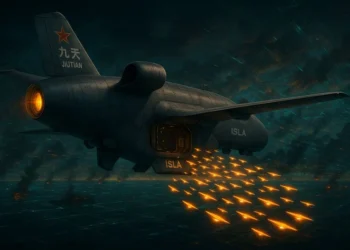
- Decoy Phase: Two XQ-58As push 50 km forward as decoys.
- Electronic Warfare: One Valkyrie deploys MALD-J decoys to simulate a massive strike force.
- The Trap: Chinese radars illuminate the decoys, revealing their hidden SAM positions.
- The Strike: A fourth Valkyrie launches an AARGM-ER missile from standoff range to suppress the radar.
- The Kill: F-35s exploit the gap, engaging enemy J-20s from outside the SAM envelope.
Outcome: Mission success. One Valkyrie lost ($3M). Zero pilot risk. This is why attritable systems rewrite the math of war.
Is the XQ-58A fully autonomous? Not entirely. It operates with high levels of automation (navigation, formation flying), but lethal force (weapons release) currently requires human authorization under US military doctrine.
Conclusion: The Question No One Can Avoid
The XQ-58A Valkyrie forces an uncomfortable question: If machines can fly, fight, and die without hesitation—what role remains for the human pilot?
The answer is not yet clear. But one thing is certain: Air forces that master this transition first will dominate the skies for decades. Those that cling to the romance of the lone fighter pilot will find themselves outmaneuvered, outgunned, and obsolete.
How much does the XQ-58A Valkyrie cost?
The target unit cost for the XQ-58A Valkyrie is approximately $2 million to $3 million. This makes it an “attritable” asset—cheap enough to be lost in combat without strategic failure.
Can the XQ-58A carry weapons?
Yes. The Valkyrie features an internal weapons bay capable of carrying JDAMs (Joint Direct Attack Munitions) and GBU-39 Small Diameter Bombs (SDB), allowing it to perform strike missions while maintaining stealth.
Does the Valkyrie need a runway to takeoff?
No. One of its key advantages is that it launches via a rocket-assisted takeoff system from a stand and is recovered via parachute. This allows it to operate from damaged airfields or remote locations.
Is the Valkyrie fully autonomous?
No. It operates under supervised autonomy—AI handles flight and navigation, but weapons release requires human authorization.
How many Valkyries can one F-35 control?
Current doctrine envisions 2-4 unmanned wingmen per manned fighter, though this may increase as software matures.
What happens if the Valkyrie loses contact with its controller?
It is programmed to return to base (RTB) or enter a holding pattern—it cannot autonomously engage targets.