
• Login
UltiDefense: Military Tech Comparisons & Modern Warfare Analysis
  • Defense Systems
    • Air Platforms
      • Fighter Jets
      • Drones
      • Attack Helicopters
      • Strategic Bombers
    • Land Systems
      • Main Battle Tanks
      • Artillery & Firepower
      • Infantry Fighting Vehicles
      • Military Logistics and Support Vehicles
      • Soldier Systems & Robotics: UGV, Exoskeleton, and Modern Infantry Integration
    • Integrated Defense Systems
      • Ballistic Missile Defense
      • Air Defense Systems
    • Missiles & Munitions
      • Air-to-Air & Anti-Ship Missiles
      • Cruise Missiles
      • Strategic & Hypersonic Weapons
    • Naval
      • Aircraft Carriers
      • Submarines
      • Surface Combatants
      • Unmanned Maritime Systems
    • Future Tech & Innovations
      • Sensors and Avionics
  • Comparisons
  • Space Warfare
    • Counter-Space & ASAT
    • Spaceplanes & Launch Vehicles
    • Military Satellites & ISR
  • Defense News
  • Military Life
  • Policy, Budget and Geopolitics
  • Cyber Security & Electronic Warfare
No Result
View All Result
Defense News
No Result
View All Result

Home - Policy, Budget and Geopolitics - The San Francisco Ghost: How a 1951 Treaty, a Secret US Doctrine, and the India-Russia Axis are Reshaping the Pacific

The San Francisco Ghost: How a 1951 Treaty, a Secret US Doctrine, and the India-Russia Axis are Reshaping the Pacific

George Schouten by George Schouten
December 8, 2025
in Policy, Budget and Geopolitics
0
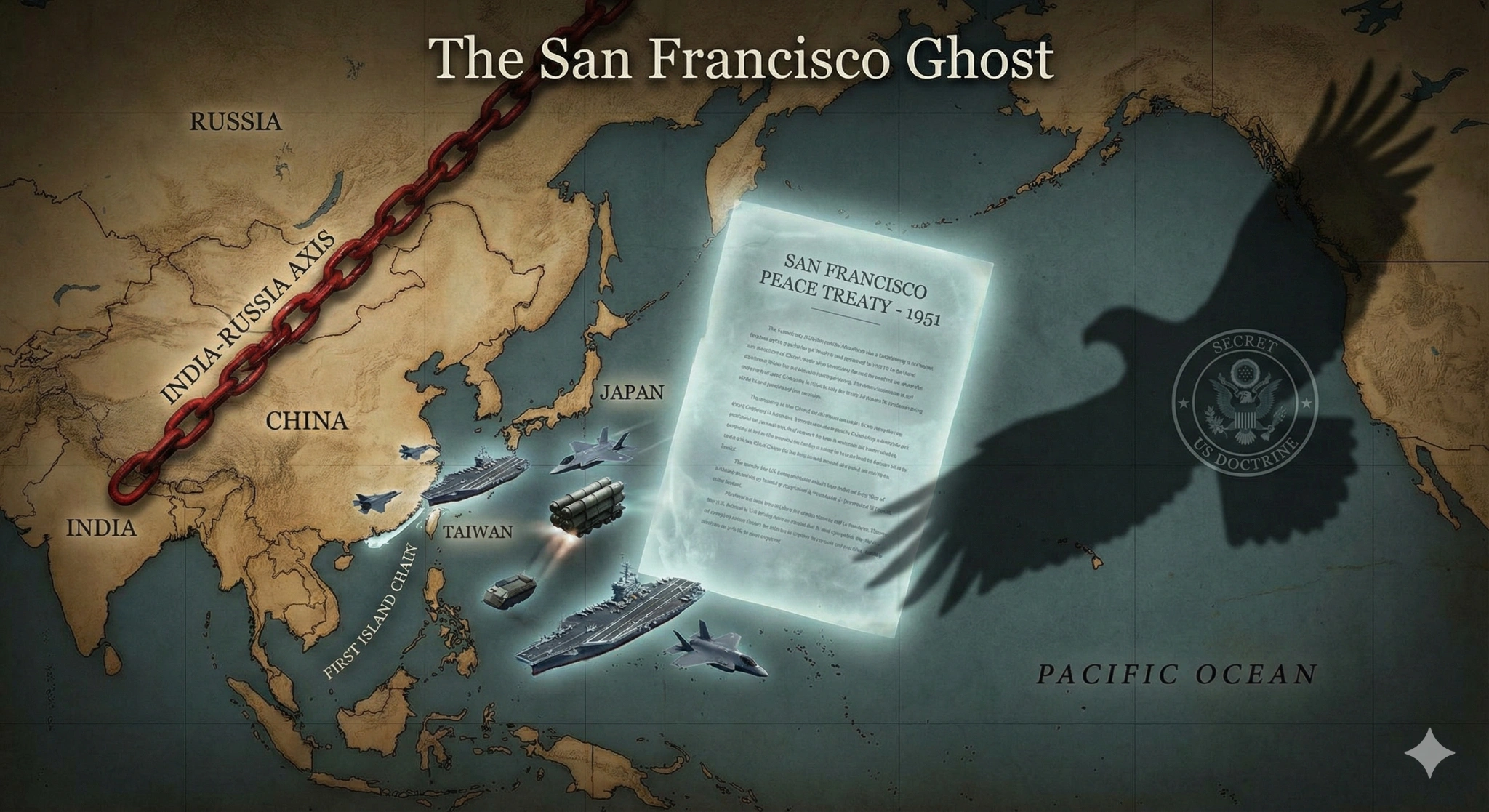
A strategic illustration combining the text of the 1951 San Francisco Peace Treaty with a modern map of the Indo-Pacific. The visual highlights the legal void regarding Taiwan's status, the US 'Offshore Balancing' strategy lines, and the emerging India-Russia defense axis challenging the post-WWII order.

Figure 1: The Ghost of 1951. How the unresolved legalities of the San Francisco Peace Treaty continue to haunt the Taiwan Strait today, intersected by the new India-Russia geopolitical axis.

153
SHARES
1.9k
VIEWS
Share on Twitter

One sentence from Tokyo was enough to pierce the strategic ambiguity of East Asia. When Japanese leadership recently referenced the San Francisco Peace Treaty to define its stance on Taiwan—stating Japan “has no position to determine Taiwan’s legal status”—it wasn’t just a history lesson. It was a diplomatic declaration of war.

To the Chinese Communist Party (CCP), this is not merely a legal dispute; it is an attack on the Post-WWII Order. But to understand why this 74-year-old document is suddenly radioactive, we must look beyond the text. We must look at the US Grand Strategy Asia, the fragility of the First Island Chain Strategy, and the wildcard that keeps Washington awake at night: the unexpected resilience of India-Russia defense ties.

READ ALSO

The Algorithm of War:The Anatomy of Conflict in 2050

JAPAN’S RED LINE: Tokyo Signals War Over Taiwan as US Pivots from NATO to the “Iron Triangle”

Why is China Angry About San Francisco Treaty?

The core of the current crisis lies in what was omitted in 1951. The treaty forced Japan to renounce sovereignty over Taiwan and the Penghu Islands, but deliberately—and strategically—failed to specify the beneficiary.

1951 Treaty vs Cairo Declaration

The legal friction stems from a direct contradiction.

  • The Cairo Declaration (1943) and Potsdam Proclamation (1945) explicitly stated that Taiwan should be returned to “China.”

  • The San Francisco Peace Treaty (1951) left this blank.

Because the People’s Republic of China (PRC) was excluded from the 1951 conference, Beijing views the treaty as an illegitimate attempt to rewrite history. Whenever a politician like Sanae Takaichi highlights this treaty, Beijing hears a challenge to its sovereignty, fearing that Japan is laying the legal groundwork for an independent Taiwan.

The Legal Status of Taiwan & US Grand Strategy Asia

Why does the West cling to this ambiguity? The answer lies in the unstated US Grand Strategy Asia. Washington knows that a direct kinetic war with China is costly. Instead, the strategy appears to be one of “entrapment and attrition.”

Did Japan Renounce Sovereignty Over Taiwan?

Yes, but by not naming a successor state, the treaty created a “legal void.” This void allows the US to argue that the Legal Status of Taiwan remains “undetermined.” This is the foundation of Strategic Ambiguity.

  • The “Porcupine” Doctrine: By keeping the status ambiguous, the US justifies the continuous arming of the island, turning it into an indigestible “porcupine” for the PLA.

  • Attrition over Invasion: The goal is not necessarily to fight a war, but to force the PLA into a costly arms race that drains China’s economic resources, leveraging the Taiwan Strait Crisis as a permanent pressure point.

Okinawa Strategic Importance for US Navy

While diplomats argue over treaties, the real chessboard is the First Island Chain Strategy. This strategy aims to bottle up the Chinese Navy within the Yellow and South China Seas. The linchpin of this chain is not Taiwan—it is Okinawa.

Ryukyu Islands Reversion and the Secret Deal

History reveals a transactional tragedy. Chiang Kai-shek, desperate for US protection against Mao’s forces, tacitly traded away Chinese claims to the Ryukyu Islands (Okinawa) in exchange for American security guarantees.

Today, the Okinawa strategic importance for US Navy cannot be overstated. It hosts the largest concentration of US military power in the region. Without Okinawa, the US capacity to project power over Taiwan collapses. This explains why the “reversion” of Okinawa to Japan in 1972 never led to demilitarization; it simply legalized the island’s role as an unsinkable aircraft carrier.

India-Russia Defense Ties: The Eurasian Wildcard

While Washington focuses on the Pacific rim, a massive geopolitical failure is brewing in its rear-view mirror. The US Indo-Pacific strategy relies heavily on The Quad (US, Japan, Australia, India) to encircle China. However, India’s refusal to join anti-China alliance fully has shocked Western planners.

Breaking the Containment

Despite immense pressure, India-Russia defense ties have deepened.

  • Hardware Dependency: India continues to operate Russian S-400 systems and leases nuclear submarines.

  • Energy Realpolitik: By purchasing Russian oil, India has helped Moscow bypass Western sanctions.

This creates a nightmare scenario for the US: A “neutral” India that refuses to join a naval blockade against China. Furthermore, the International North-South Transport Corridor (INSTC) between India, Iran, and Russia provides a trade route that is immune to US naval power, effectively neutralizing the US offshore balancing doctrine explained by many strategists as the ultimate weapon against Eurasian powers.

Conclusion: Geopolitical Fault Lines in 2025

The invocation of the San Francisco Peace Treaty is not an isolated incident. It is a signal flare. We are witnessing a convergence of timelines:

  1. Legal: The weaponization of the San Francisco Peace Treaty Taiwan clauses.

  2. Military: The race to harden defenses before PLA Modernization 2027 targets are met.

  3. Geopolitical: The consolidation of an India-Russia axis that refuses to bow to the Post-WWII Order.

For defense analysts, the lesson is clear: The next war may start over a dusty treaty from 1951, but it will be fought on the Geopolitical Fault Lines of a multipolar world that no longer follows American rules.
Tags: GeopoliticsGrand StrategyIndia-Russia AllianceIndo-Pacific StrategyMilitary HistoryOkinawaPLASan Francisco Peace TreatySino-Japanese RelationsTaiwan Strait CrisisUS Navy

Related Posts

The Algorithm of War:The Anatomy of Conflict in 2050
Policy, Budget and Geopolitics

The Algorithm of War:The Anatomy of Conflict in 2050

April 4, 2026
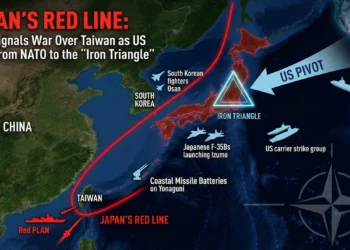
A geopolitical map illustrating Japan's declared 'Red Line' to defend Taiwan against China (PLAN). It highlights the US strategic pivot from NATO to the Indo-Pacific, forming an 'Iron Triangle' alliance with Japan and South Korea. Key elements include Japanese F-35Bs on the Izumo carrier, coastal missile batteries on Yonaguni Island, South Korean fighters at Osan airbase, and a US Carrier Strike Group, all positioned to counter Chinese naval movements near Taiwan.
Policy, Budget and Geopolitics

JAPAN’S RED LINE: Tokyo Signals War Over Taiwan as US Pivots from NATO to the “Iron Triangle”

December 14, 2025
Editorial illustration representing US defense spending: stacks of 100 dollar bills and gold coins surrounding an M1 Abrams tank, F-35 Lightning II fighter jet, and a military drone with the text DEFENSE
Policy, Budget and Geopolitics

The Trillion-Dollar Question: Is U.S. Defense Spending Reaching Diminishing Returns?

December 12, 2025
Rafale fighter jet with Meteor missiles
Policy, Budget and Geopolitics

Possible Strategic Implications of a France–Ukraine Defense Arrangement Involving Rafale and Advanced Air-Defense Systems

December 11, 2025
Next Post
A geopolitical map illustrating Japan's declared 'Red Line' to defend Taiwan against China (PLAN). It highlights the US strategic pivot from NATO to the Indo-Pacific, forming an 'Iron Triangle' alliance with Japan and South Korea. Key elements include Japanese F-35Bs on the Izumo carrier, coastal missile batteries on Yonaguni Island, South Korean fighters at Osan airbase, and a US Carrier Strike Group, all positioned to counter Chinese naval movements near Taiwan.

JAPAN’S RED LINE: Tokyo Signals War Over Taiwan as US Pivots from NATO to the "Iron Triangle"

Leave a Reply Cancel reply

Your email address will not be published. Required fields are marked *

About

Ultidefense is a digital platform focused on modern defense, military technology, and strategic innovation.
We explore how advancements in aerospace, AI, cybersecurity, and autonomous systems are transforming the global defense landscape.
Our mission is to connect technical insight with strategic awareness, helping readers understand the technologies shaping modern security and warfare.
At Ultidefense, we believe knowledge is strength — and our goal is to deliver clear, factual, and forward-looking analysis on the systems, science, and strategies defining the future of defense.

Categories

  • Comparisons
  • Cyber Security & Electronic Warfare
  • Defense News
  • Defense Systems
    • Air Platforms
      • Attack Helicopters
      • Fighter Jets
      • Global Military Drones: UAV Systems, Autonomy, and Unmanned Warfare
      • Strategic Bombers
    • Future Tech & Innovations
      • Sensors and Avionics
    • Land Systems
      • Artillery & Firepower: Self-Propelled Guns, Rocket Systems, and Barrage Analysis
      • Main Battle Tanks: Armor, Firepower, and Modern MBT Comparisons
    • Missiles & Munitions
      • Strategic & Hypersonic Weapons
    • Space Warfare
      • Military Satellites & ISR
      • Spaceplanes & Launch Vehicles
  • Integrated Defense Systems
    • Air Defense Systems
  • Military Life
  • Naval Systems: Warships, Carriers, and Maritime Defense Technology
    • Aircraft Carriers
    • Submarines
  • Policy, Budget and Geopolitics
  • Unmanned Maritime Systems

Recent Posts

  • Which Military Boot Camp is the Hardest? All 6 US Branches Ranked
  • The SFAS Fallout: What Happens After You Fail Special Forces Selection
  • The Algorithm of War:The Anatomy of Conflict in 2050
  • Russia’s Avangard HGV: Breaking the Shield of Global Missile Defense

Newsletter

Pages

  • About Us
  • Home
  • Contact Us
  • Privacy Policies
  • Terms of Service
  • Disclaimer

© 2025 Defense Systems

Welcome Back!

Login to your account below

Forgotten Password?

Retrieve your password

Please enter your username or email address to reset your password.

Log In
No Result
View All Result
  • Defense Systems
    • Air Platforms
      • Fighter Jets
      • Drones
      • Attack Helicopters
      • Strategic Bombers
    • Land Systems
      • Main Battle Tanks
      • Artillery & Firepower
      • Infantry Fighting Vehicles
      • Military Logistics and Support Vehicles
      • Soldier Systems & Robotics: UGV, Exoskeleton, and Modern Infantry Integration
    • Integrated Defense Systems
      • Ballistic Missile Defense
      • Air Defense Systems
    • Missiles & Munitions
      • Air-to-Air & Anti-Ship Missiles
      • Cruise Missiles
      • Strategic & Hypersonic Weapons
    • Naval
      • Aircraft Carriers
      • Submarines
      • Surface Combatants
      • Unmanned Maritime Systems
    • Future Tech & Innovations
      • Sensors and Avionics
  • Comparisons
  • Space Warfare
    • Counter-Space & ASAT
    • Spaceplanes & Launch Vehicles
    • Military Satellites & ISR
  • Defense News
  • Military Life
  • Policy, Budget and Geopolitics
  • Cyber Security & Electronic Warfare

© 2025 Defense Systems