
• Login
UltiDefense: Military Tech Comparisons & Modern Warfare Analysis
  • Defense Systems
    • Air Platforms
      • Fighter Jets
      • Drones
      • Attack Helicopters
      • Strategic Bombers
    • Land Systems
      • Main Battle Tanks
      • Artillery & Firepower
      • Infantry Fighting Vehicles
      • Military Logistics and Support Vehicles
      • Soldier Systems & Robotics: UGV, Exoskeleton, and Modern Infantry Integration
    • Integrated Defense Systems
      • Ballistic Missile Defense
      • Air Defense Systems
    • Missiles & Munitions
      • Air-to-Air & Anti-Ship Missiles
      • Cruise Missiles
      • Strategic & Hypersonic Weapons
    • Naval
      • Aircraft Carriers
      • Submarines
      • Surface Combatants
      • Unmanned Maritime Systems
    • Future Tech & Innovations
      • Sensors and Avionics
  • Comparisons
  • Space Warfare
    • Counter-Space & ASAT
    • Spaceplanes & Launch Vehicles
    • Military Satellites & ISR
  • Defense News
  • Military Life
  • Policy, Budget and Geopolitics
  • Cyber Security & Electronic Warfare
No Result
View All Result
Defense News
No Result
View All Result

Home - Policy, Budget and Geopolitics - The Trillion-Dollar Question: Is U.S. Defense Spending Reaching Diminishing Returns?

The Trillion-Dollar Question: Is U.S. Defense Spending Reaching Diminishing Returns?

George Schouten by George Schouten
December 12, 2025
in Policy, Budget and Geopolitics
0
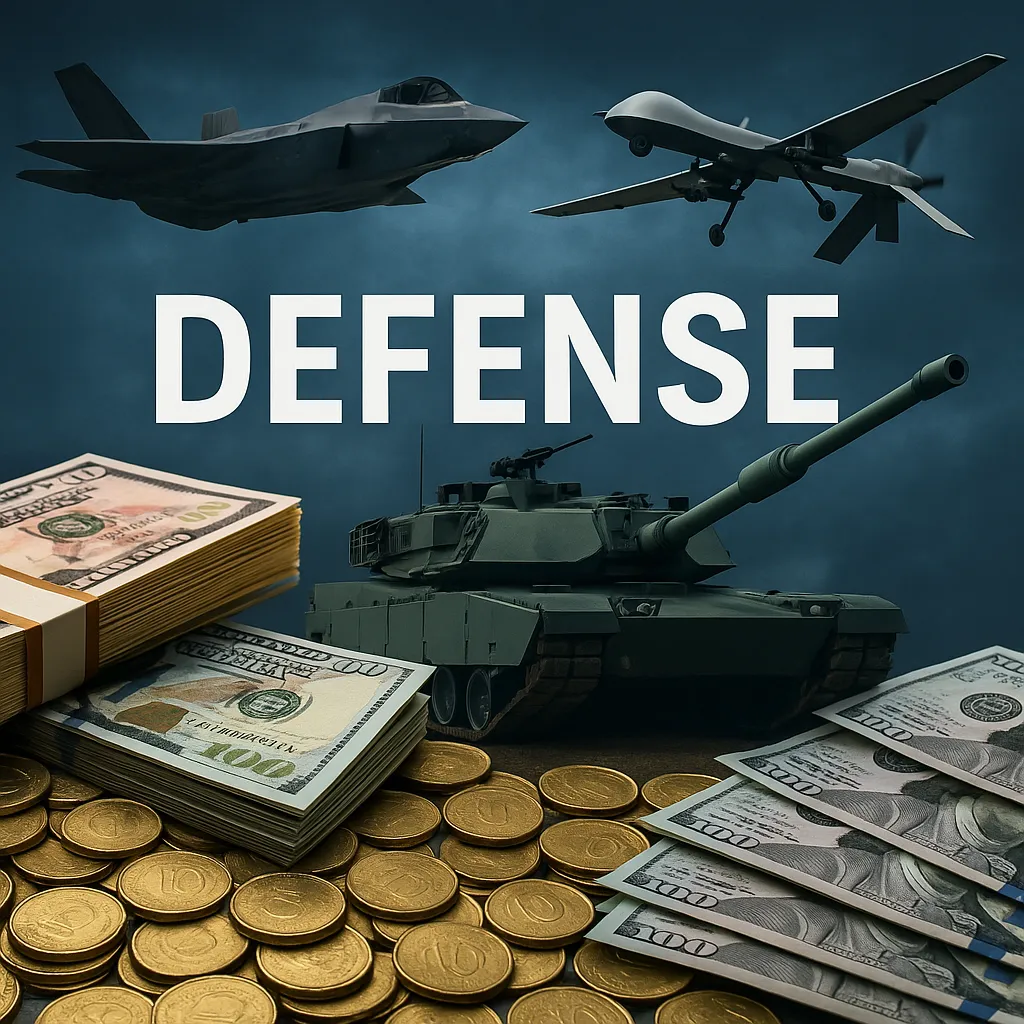
Editorial illustration representing US defense spending: stacks of 100 dollar bills and gold coins surrounding an M1 Abrams tank, F-35 Lightning II fighter jet, and a military drone with the text DEFENSE

The High Cost of Security: As the US defense budget nears the $1 trillion threshold, the rising costs of platforms like the F-35 and modern armor are creating a debate over efficiency vs. capability.

153
SHARES
1.9k
VIEWS
Share on Twitter

In short: This data-driven US defense spending analysis reveals a critical paradox: the budget is approaching $1 trillion not because the force is expanding, but because weapon complexity and bureaucracy are creating diminishing returns.

Estimated reading time: 14 minutes

READ ALSO

The Algorithm of War:The Anatomy of Conflict in 2050

JAPAN’S RED LINE: Tokyo Signals War Over Taiwan as US Pivots from NATO to the “Iron Triangle”


The Trillion-Dollar Threshold: US Defense Spending Analysis

The United States stands at an unprecedented crossroads. The fiscal year 2024 defense budget reached $886 billion, with projections indicating a breach of the trillion-dollar mark soon. To understand this shift, our US defense spending analysis breaks down the structural forces driving costs upward versus the actual combat capability gained.

Estimated reading time: 14 minutes


The Trillion-Dollar Threshold: A New Era of Escalating Costs

The United States stands at an unprecedented crossroads in defense spending. The fiscal year 2024 defense budget reached $886 billion, with projections indicating a breach of the trillion-dollar threshold by 2026–2027. This represents not merely an incremental increase but a fundamental shift in the scale of American military investment.

To understand the magnitude: when adjusted for inflation, the Reagan-era defense peak of 1985 ($456 billion nominal) equates to approximately $1.28 trillion in 2024 dollars. However, that spending represented 6.2% of GDP, while today’s near-trillion-dollar budget constitutes only 3.4% of GDP—suggesting that while absolute spending approaches Cold War peaks, the relative economic burden remains lower.

The Strategic Dilemma: Are we gaining proportionate combat capability for this massive investment, or have we entered a zone of diminishing returns where each additional dollar yields progressively less warfighting power?

This analysis examines the structural forces driving defense costs upward, quantifies the efficiency losses within the system, and proposes evidence-based reforms to restore strategic value.


Understanding the Cost Explosion: Data-Driven Analysis

Phase I: Post-9/11 Surge (2001–2011)

The September 11 attacks triggered the longest sustained defense spending increase since Vietnam. Base defense budgets grew dramatically to support counter-insurgency operations, requiring rapid deployment of MRAP vehicles and a massive expansion of ISR capabilities.

Phase II: Budget Control Act Constraints (2011–2017)

Spending caps reduced DoD budgets, revealing critical vulnerabilities: deferred modernization (F-35 delays), a readiness crisis where few brigades were combat-ready, and a $116 billion facility maintenance backlog.

Phase III: Great-Power Competition Era (2018–Present)

The shift to peer competition with China and Russia has driven the budget to $886 billion (FY2024). The primary cost drivers include:

  • Nuclear Modernization: ~$756 billion over 10 years (Columbia-class subs, B-21 Raider, GBSD).
  • Hypersonic Weapons: Multi-billion dollar R&D for programs like AGM-183A and LRHW.
  • Space Force: ~$30 billion annually for resilient satellite architecture.
  • AI & Autonomy: JADC2 and the “Replicator” initiative investments.

The Hidden Cost Disease: Industrial and Bureaucratic Inflation

Case Study 1: The F-35 Cost Paradox

The F-35 program illustrates both success and system dysfunction. While unit costs have dropped to ~$78M, the total lifecycle cost is projected at $1.7 trillion. The sustainment cost per flight hour remains high (~$33,600), and modernization delays (Technology Refresh 3) continue to add billions.

Case Study 2: Naval Shipbuilding Cost Escalation

Ship ClassInitial Cost (FY dollars)Current Cost (FY dollars)Growth Rate
DDG-51 Burke (Flight I vs III)$950M (1991)$2.4B (2024)+153%
Virginia-class SSN (Block I vs V)$2.5B (2004)$4.3B (2024)+72%
Ford-class CVN (CVN-79)Reference$12.4B-7% (Minimal gain)
Note: Costs reflect nominal dollars at time of procurement vs current estimates.

Analysis: Even accounting for inflation, per-unit costs grow 2–3% annually beyond inflation—what economists call “cost disease” in low-productivity sectors.


Quantifying Diminishing Returns: Capability-per-Dollar Decline

Metric 1: Purchasing Power Decline

For every billion dollars spent (adjusted for inflation), the US buys significantly less hardware today than in the Cold War:

  • Fighters: 32 aircraft/billion (1985) → 12 aircraft/billion (2024)
  • Surface Ships: 0.85 ships/billion (1985) → 0.42 ships/billion (2024)

Metric 2: Force Structure Contraction

Despite a budget approaching $1 trillion, the force is shrinking compared to 1990:

Metric1990 (Cold War End)2024 (Current)Change
Active Duty Personnel2.1 million1.3 million-38%
Navy Battle Force Ships529291-45%
Fighter Squadrons13488-34%

Metric 3: The Software Tax

Modern platforms are software-defined. The F-4 Phantom had 0 lines of code; the F-35 has 8.6 million. Software management now consumes 30–40% of lifecycle costs, a category that barely existed during the Cold War.


Why Diminishing Returns? Structural Explanations

  1. The Complexity Frontier: Achieving the last 10% of performance (e.g., extreme stealth or Mach 8+ speed) requires exponentially greater investment as physics limits are approached.
  2. The Bureaucratic Tax: Defense acquisition operates through layers of oversight. Programs now average 11–15 years from concept to fielding.
  3. The Vendor Oligopoly: Consolidation has left only ~5 dominant primes, reducing competitive pressure on pricing and innovation.
  4. The Dual-Threat Tax: Planning for both high-tech maritime war (China) and attritional land war (Russia) prevents optimization for a single mission.

Strategic Solutions: Reversing the Cost Curve

Addressing diminishing returns requires systemic reform, not merely spending more:

1. Procurement Transformation

Adopting Middle Tier of Acquisition (MTA) pathways to field prototypes in 2–5 years, and treating software updates as continuous delivery rather than major modifications.

2. Legacy Divestment

Retiring aging, non-combat-coded airframes (like older F-15s) to free up O&M dollars for next-generation systems.

3. Asymmetric Investment

Moving from “few exquisite platforms” to “many good-enough systems” (e.g., Collaborative Combat Aircraft – CCA) to improve cost-exchange ratios.


Conclusion: The Imperative of Efficiency

The United States will almost certainly breach the trillion-dollar defense threshold in the late 2020s. This milestone represents a strategic inflection point.

The evidence indicates a zone of diminishing returns where marginal spending yields progressively less combat capability. Without structural reform—prioritizing procurement agility, industrial competition, and asymmetric technology—the US risks funding a system that spends more to achieve less.

The ultimate question is whether the US defense establishment can reform itself before external shocks force chaotic change.


Tags: Defense EconomicsMilitary SpendingPentagon SpendingUS Defense Budget

Related Posts

The Algorithm of War:The Anatomy of Conflict in 2050
Policy, Budget and Geopolitics

The Algorithm of War:The Anatomy of Conflict in 2050

April 4, 2026
A geopolitical map illustrating Japan's declared 'Red Line' to defend Taiwan against China (PLAN). It highlights the US strategic pivot from NATO to the Indo-Pacific, forming an 'Iron Triangle' alliance with Japan and South Korea. Key elements include Japanese F-35Bs on the Izumo carrier, coastal missile batteries on Yonaguni Island, South Korean fighters at Osan airbase, and a US Carrier Strike Group, all positioned to counter Chinese naval movements near Taiwan.
Policy, Budget and Geopolitics

JAPAN’S RED LINE: Tokyo Signals War Over Taiwan as US Pivots from NATO to the “Iron Triangle”

December 14, 2025
A strategic illustration combining the text of the 1951 San Francisco Peace Treaty with a modern map of the Indo-Pacific. The visual highlights the legal void regarding Taiwan's status, the US 'Offshore Balancing' strategy lines, and the emerging India-Russia defense axis challenging the post-WWII order.
Policy, Budget and Geopolitics

The San Francisco Ghost: How a 1951 Treaty, a Secret US Doctrine, and the India-Russia Axis are Reshaping the Pacific

December 8, 2025
Rafale fighter jet with Meteor missiles
Policy, Budget and Geopolitics

Possible Strategic Implications of a France–Ukraine Defense Arrangement Involving Rafale and Advanced Air-Defense Systems

December 11, 2025
Next Post
Falcon 9 rocket launching Sentinel-6B from Vandenberg Space Force Base. SpaceX 500th mission.

Sentinel-6B Launch: The Convergence of Commercial Spaceflight and Climate Science

Leave a Reply Cancel reply

Your email address will not be published. Required fields are marked *

About

Ultidefense is a digital platform focused on modern defense, military technology, and strategic innovation.
We explore how advancements in aerospace, AI, cybersecurity, and autonomous systems are transforming the global defense landscape.
Our mission is to connect technical insight with strategic awareness, helping readers understand the technologies shaping modern security and warfare.
At Ultidefense, we believe knowledge is strength — and our goal is to deliver clear, factual, and forward-looking analysis on the systems, science, and strategies defining the future of defense.

Categories

  • Comparisons
  • Cyber Security & Electronic Warfare
  • Defense News
  • Defense Systems
    • Air Platforms
      • Attack Helicopters
      • Fighter Jets
      • Global Military Drones: UAV Systems, Autonomy, and Unmanned Warfare
      • Strategic Bombers
    • Future Tech & Innovations
      • Sensors and Avionics
    • Land Systems
      • Artillery & Firepower: Self-Propelled Guns, Rocket Systems, and Barrage Analysis
      • Main Battle Tanks: Armor, Firepower, and Modern MBT Comparisons
    • Missiles & Munitions
      • Strategic & Hypersonic Weapons
    • Space Warfare
      • Military Satellites & ISR
      • Spaceplanes & Launch Vehicles
  • Integrated Defense Systems
    • Air Defense Systems
  • Military Life
  • Naval Systems: Warships, Carriers, and Maritime Defense Technology
    • Aircraft Carriers
    • Submarines
  • Policy, Budget and Geopolitics
  • Unmanned Maritime Systems

Recent Posts

  • Which Military Boot Camp is the Hardest? All 6 US Branches Ranked
  • The SFAS Fallout: What Happens After You Fail Special Forces Selection
  • The Algorithm of War:The Anatomy of Conflict in 2050
  • Russia’s Avangard HGV: Breaking the Shield of Global Missile Defense

Newsletter

Pages

  • About Us
  • Home
  • Contact Us
  • Privacy Policies
  • Terms of Service
  • Disclaimer

© 2025 Defense Systems

Welcome Back!

Login to your account below

Forgotten Password?

Retrieve your password

Please enter your username or email address to reset your password.

Log In
No Result
View All Result
  • Defense Systems
    • Air Platforms
      • Fighter Jets
      • Drones
      • Attack Helicopters
      • Strategic Bombers
    • Land Systems
      • Main Battle Tanks
      • Artillery & Firepower
      • Infantry Fighting Vehicles
      • Military Logistics and Support Vehicles
      • Soldier Systems & Robotics: UGV, Exoskeleton, and Modern Infantry Integration
    • Integrated Defense Systems
      • Ballistic Missile Defense
      • Air Defense Systems
    • Missiles & Munitions
      • Air-to-Air & Anti-Ship Missiles
      • Cruise Missiles
      • Strategic & Hypersonic Weapons
    • Naval
      • Aircraft Carriers
      • Submarines
      • Surface Combatants
      • Unmanned Maritime Systems
    • Future Tech & Innovations
      • Sensors and Avionics
  • Comparisons
  • Space Warfare
    • Counter-Space & ASAT
    • Spaceplanes & Launch Vehicles
    • Military Satellites & ISR
  • Defense News
  • Military Life
  • Policy, Budget and Geopolitics
  • Cyber Security & Electronic Warfare

© 2025 Defense Systems