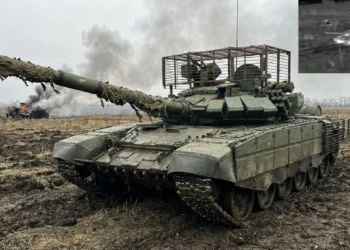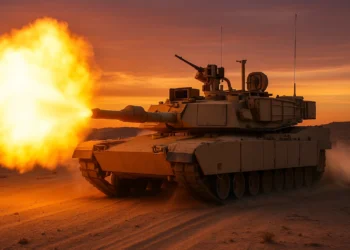


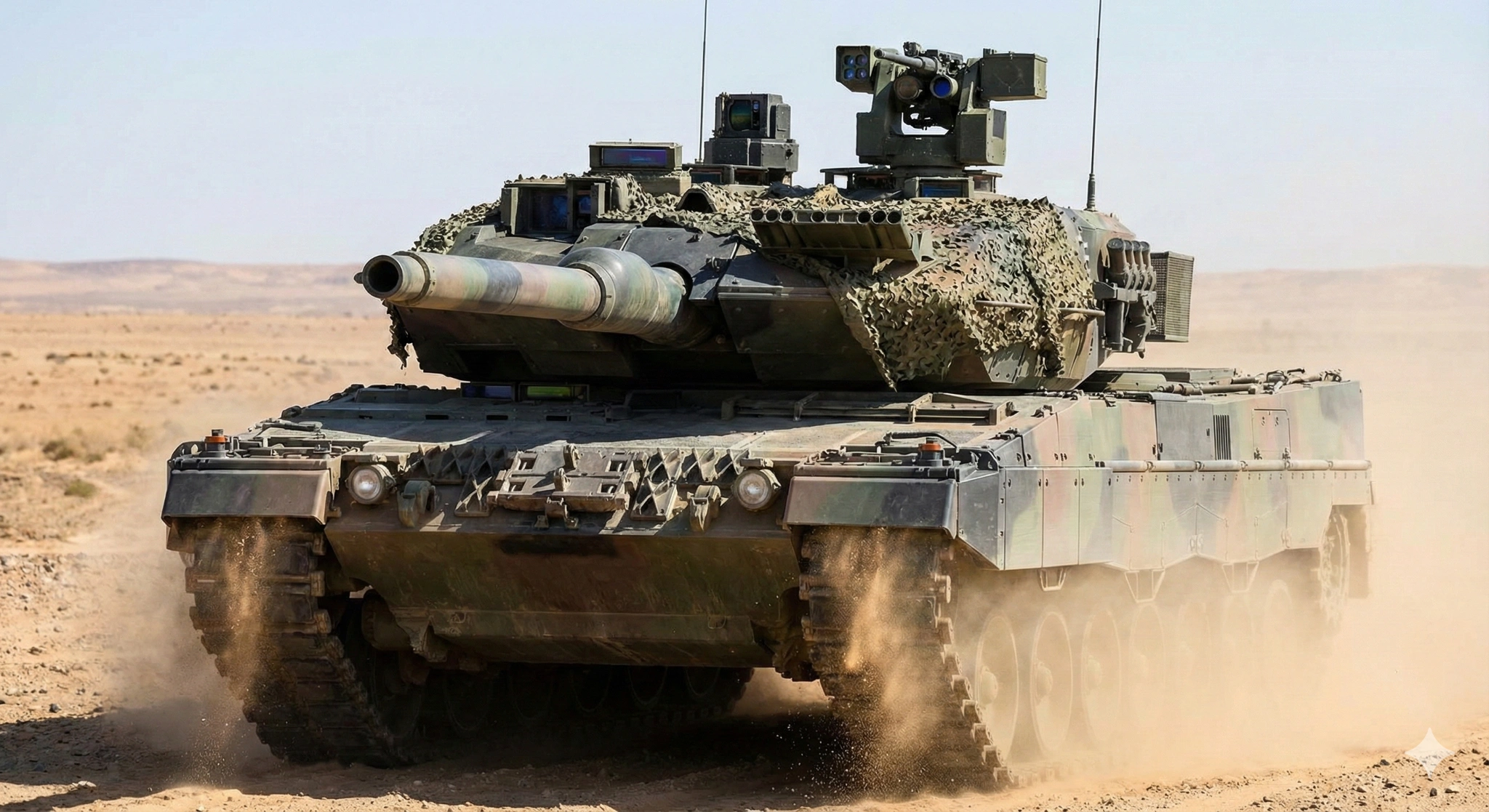
The Leopard 2A7+, developed by Germany’s legendary Krauss-Maffei Wegmann (KMW), is not merely an upgrade; it is a statement. In a world where drone warfare and loitering munitions threaten the relevance of heavy armor, the Leopard 2A7+ asserts that the Main Battle Tank (MBT) is still the king of the ground domain.
Designed for high-intensity symmetric warfare and complex urban counter-insurgency alike, this 67-ton beast brings together the “Iron Triad” of modern armored warfare: Survivability, Lethality, and Networked Mobility.
But does it truly outperform the American M1A2 SEPv3 or the South Korean K2 Black Panther? Let’s dive into the engineering.
🔥 Firepower: The Rheinmetall L55A1 Advantage
While most NATO tanks use a 120mm smoothbore, the Leopard 2A7+ utilizes the evolved Rheinmetall L55A1. This is a critical distinction.
- Higher Chamber Pressure: The A1 variant handles significantly higher pressure than the older L44 found on many Abrams models, allowing for higher muzzle velocity.
- KE Penetrators: It is optimized for the latest kinetic energy rounds (APFSDS), capable of punching through advanced Russian “Relikt” ERA (Explosive Reactive Armor).
- Programmable Lethality: The tank fires the DM11 HE-MP (High Explosive – Multi-Purpose). The gunner can program the fuse to detonate above a target (airburst) to eliminate infantry behind cover, or inside a building after penetrating the wall.
Tactical Note: The fire control system allows the Leopard 2A7+ to engage moving targets while moving itself over rough terrain with a hit probability of over 95% at 2,000 meters.
🛡️ Survivability: Beyond Simple Armor
The “Plus” in 2A7+ signifies a modular protection kit designed for MOUT (Military Operations in Urban Terrain). It moves beyond traditional steel and ceramic composites.
1. 360-Degree Modular Armor
Unlike Cold War tanks that focused only on the front, the 2A7+ features passive add-on armor modules on the sides and rear to protect against RPG-7s and EFPs (Explosively Formed Penetrators), the primary threats in asymmetric warfare.
2. The “Silent Watch” Capability
One of the most underrated features is the Auxiliary Power Unit (APU). This allows the tank to shut down its loud 1,500hp main engine while keeping all sensors, air conditioning, and turrets active. This drastically reduces the thermal and acoustic signature, making the tank nearly invisible to enemy thermal optics while in a defensive ambush position.
⚡ Mobility: 67 Tons of Agility
German engineering shines in the powertrain. Despite weighing over 60 tons, the Leopard 2A7+ is surprisingly agile.
- Engine: MTU MB 873 Ka-501 V12 liquid-cooled diesel engine (1,500 hp).
- Transmission: Renk HSWL 354. This system allows the tank to turn on a dime (neutral steer) and provides instant torque delivery.
- Top Speed: 72 km/h (road) and roughly 45 km/h (cross-country).
🧠 Digital Architecture & The “Glass Turret”
Modern combat is data-driven. The 2A7+ integrates into the Battlefield Management System (BMS). The commander doesn’t just see through a periscope; they see a digital map overlaid with friendly and enemy positions, drone feeds, and target data shared from nearby infantry.
Furthermore, the FLW 200 Remote Weapon Station allows the crew to engage close-range threats with a .50 cal or 40mm grenade launcher from under the safety of the armor—a crucial feature for city fighting.
🏆 Comparative Analysis: Leopard 2A7+ vs. The World
| Feature | 🇩🇪 Leopard 2A7+ | 🇺🇸 M1A2 SEPv3 | 🇰🇷 K2 Black Panther |
|---|---|---|---|
| Main Gun | 120mm L55A1 | 120mm L44 | 120mm L55 |
| Loading | Manual (4th Crew) | Manual (4th Crew) | Autoloader (3 Crew) |
| Engine | Diesel (Reliable) | Turbine (Thirsty) | Diesel |
| Urban Kit | Standard (+) | TUSK Kit | Limited |
Conclusion: The King of NATO?
The Leopard 2A7+ balances the “Iron Triangle” better than perhaps any other tank currently in service. While the K2 Black Panther offers newer tech and the Abrams offers depleted uranium armor, the Leopard 2A7+ provides the most well-rounded, reliable, and lethal package for European and Middle Eastern theaters.
For nations looking to dominate the ground war in the 2030s, the German big cat remains the apex predator.