

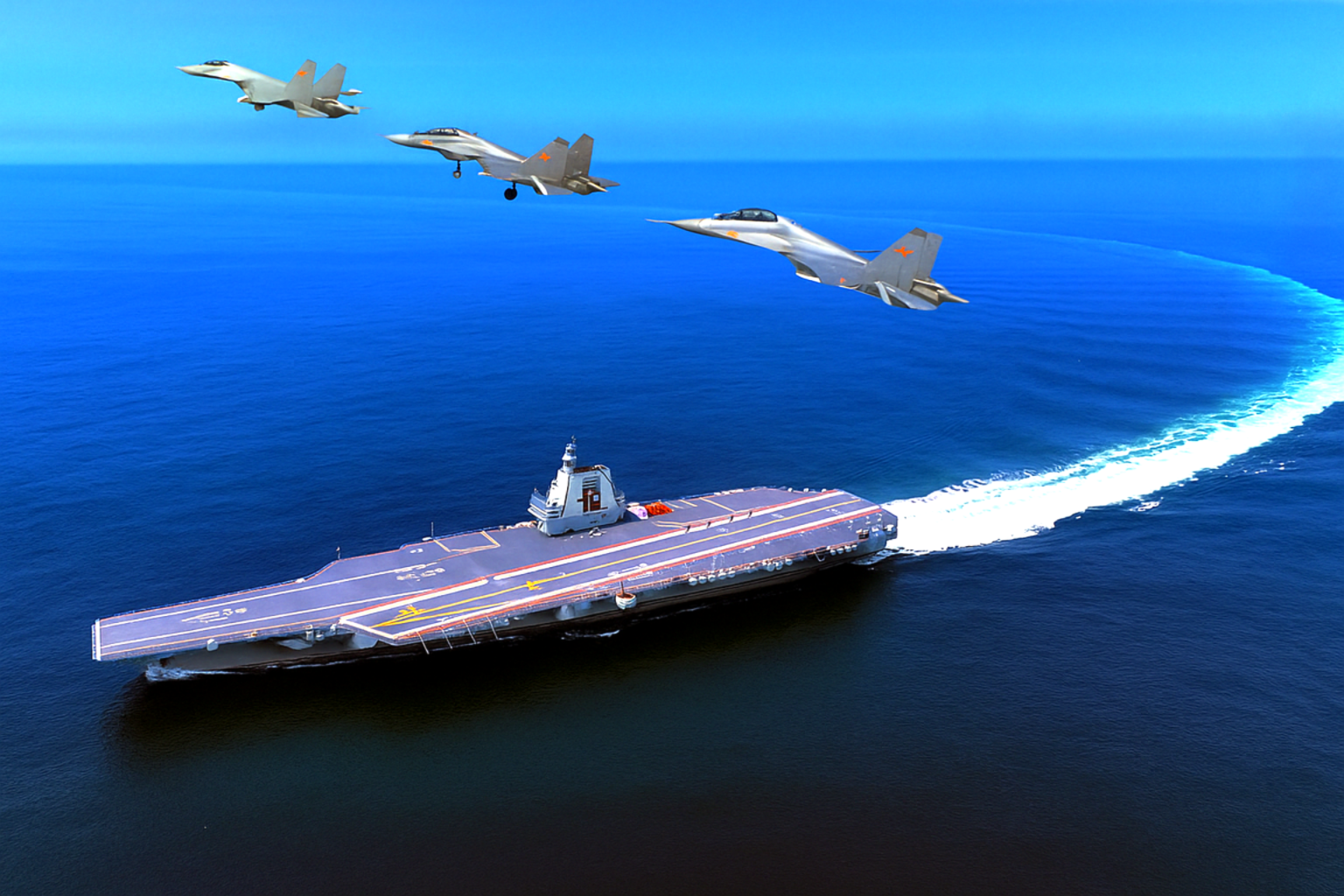
China has achieved one of the most significant milestones in its naval history. In a ceremony attended by President Xi Jinping, the country’s third and most advanced aircraft carrier, Fujian (Type 003), officially entered service. With this move, Beijing not only joins the elite club of nations with modern CATOBAR (Catapult Assisted Take-Off But Arrested Recovery) capabilities but also extends its strategic competition with Washington into the open seas. This development reflects the growing importance of the China Fujian Aircraft Carrier in regional security dynamics.
The significance of the China Fujian Aircraft Carrier extends beyond its size and technology.
1. The Electromagnetic Revolution: EMALS Technology
Weighing approximately 80,000+ tons and stretching over 316 meters, Fujian is China’s largest warship to date. However, what makes it truly revolutionary isn’t its size but the technology it employs.
The China Fujian Aircraft Carrier not only enhances the naval capabilities of the country but also poses new challenges for its adversaries.
The China Fujian Aircraft Carrier serves as a powerful symbol of China’s naval ambitions.
Fujian is the first non-US vessel equipped with an Electromagnetic Aircraft Launch System (EMALS).
With the development of the China Fujian Aircraft Carrier, China’s naval power is reaching new heights.
The Legacy: China’s previous carriers, Liaoning and Shandong, relied on Soviet-style “ski-jump” ramps. These ramps limited the fuel and weapon load of jets.
The advancements in the China Fujian Aircraft Carrier highlight a shift in naval warfare capabilities.
The Future: Fujian leaves that legacy behind. EMALS uses massive bursts of electromagnetic energy to accelerate aircraft. This allows the launch of heavier, longer-range aircraft with full ammunition loads, transforming Fujian from a symbolic flagship into a genuine Long-Range Power Projection platform.
The China Fujian Aircraft Carrier is set to redefine China’s strategic maritime presence.
2. The Air Wing: J-35 and KJ-600
A carrier is only as good as the planes it carries. Fujian brings two new game-changers to the fight:
J-35 Stealth Fighter: China’s answer to the F-35C. Unlike the older J-15, the J-35 is a 5th-generation stealth fighter designed specifically for catapult launches. It gives the PLAN a capability to contest air superiority against US assets.
The capabilities of the China Fujian Aircraft Carrier will significantly enhance the PLAN’s operational flexibility.
KJ-600 AEW&C: Known as the “Eye in the Sky.” Previous Chinese carriers lacked a fixed-wing early warning plane (relying on helicopters). The KJ-600, launched via EMALS, allows the Fujian strike group to detect threats hundreds of miles away, coordinating battles just like an American E-2D Hawkeye.
The KJ-600’s integration with the China Fujian Aircraft Carrier enhances its situational awareness.
3. A Message in a Name: Winking at the Taiwan Strait
The Fujian name carries heavy strategic weight. The ship is named after Fujian Province, which sits directly across from the Taiwan Strait. This is an unmistakable signal of Beijing’s territorial claims. The vessel’s assignment to the Southern Theater Command, at a time when tensions in the South China Sea are escalating, reinforces this message: “We are building this specifically for our backyard.”
This strategic naming reinforces the role of the China Fujian Aircraft Carrier in military exercises.
4. Strategic Perspective: Quality vs. Quantity
Despite this milestone, China remains behind the United States in total hulls.
The development of the China Fujian Aircraft Carrier illustrates the shift in naval power dynamics.
US Navy: 11 Nuclear-Powered Supercarriers (Nimitz & Ford Class).
PLAN: 3 Conventionally-Powered Carriers (Liaoning, Shandong, Fujian).
However, the numerical advantage doesn’t tell the complete story. Beijing doesn’t need to match US carrier numbers globally. In a Taiwan contingency scenario, China would operate within the protective umbrella of its land-based A2/AD (Anti-Access/Area Denial) systems.
The Asymmetric Edge: The Fujian doesn’t need to sail to California. It just needs to dominate the “First Island Chain.” Supported by land-based DF-21D “Carrier Killer” missiles, the Fujian becomes a mobile fortress that is incredibly difficult to dislodge.
As a formidable asset, the China Fujian Aircraft Carrier is crucial for coastal defense.
5. The Vulnerability Paradox: Hypersonic Threats
Here lies the central paradox: As platforms become more capable, they become more valuable targets. The war in Ukraine and recent naval conflicts have demonstrated how even cheap drones and anti-ship missiles can damage major fleets. China’s own investment in Hypersonic Weapons (like the DF-17 and YJ-21) has ironically highlighted the vulnerability of large surface vessels—including its own.
The Reality: Fujian is most powerful during “Gray Zone” warfare (coercive diplomacy). In a full-scale war with the US, it would be a priority target for US Virginia-class submarines and B-21 Raiders.
Conclusion: Not Yet a Game-Changer, But a Game-Shifter
In conclusion, the China Fujian Aircraft Carrier stands as a testament to China’s maritime strategy.
Fujian won’t tip the balance in a hypothetical war tomorrow, but the China Fujian Aircraft Carrier signals that the era of uncontested US naval dominance in the Pacific is over.
The question isn’t whether Fujian makes China equal to America at sea—it doesn’t. The question is whether it advances China’s regional dominance—and the answer is unequivocally yes.
The presence of the China Fujian Aircraft Carrier significantly alters the regional security landscape.
❓ FAQ: Fujian Aircraft Carrier
Q: Is the Fujian nuclear-powered? A: No. The Fujian uses conventional steam turbines. This limits its endurance compared to US nuclear carriers, meaning it requires more frequent refueling from supply ships (Tankers). The next carrier (Type 004) is rumored to be nuclear.
Q: How many aircraft can it carry? A: Estimates suggest a mixed air wing of 60-70 aircraft, including J-35s, J-15T Flying Sharks, and KJ-600s. This is more than the Liaoning (~40) but less than the USS Gerald R. Ford (~75+).
Q: What is the “Ski-Jump” vs “Catapult” difference? A: A ski-jump (used on older Chinese/Russian carriers) forces jets to use their own power to take off, limiting how much fuel/bombs they can carry. A catapult (EMALS) throws the plane into the air, allowing maximum takeoff weight.