

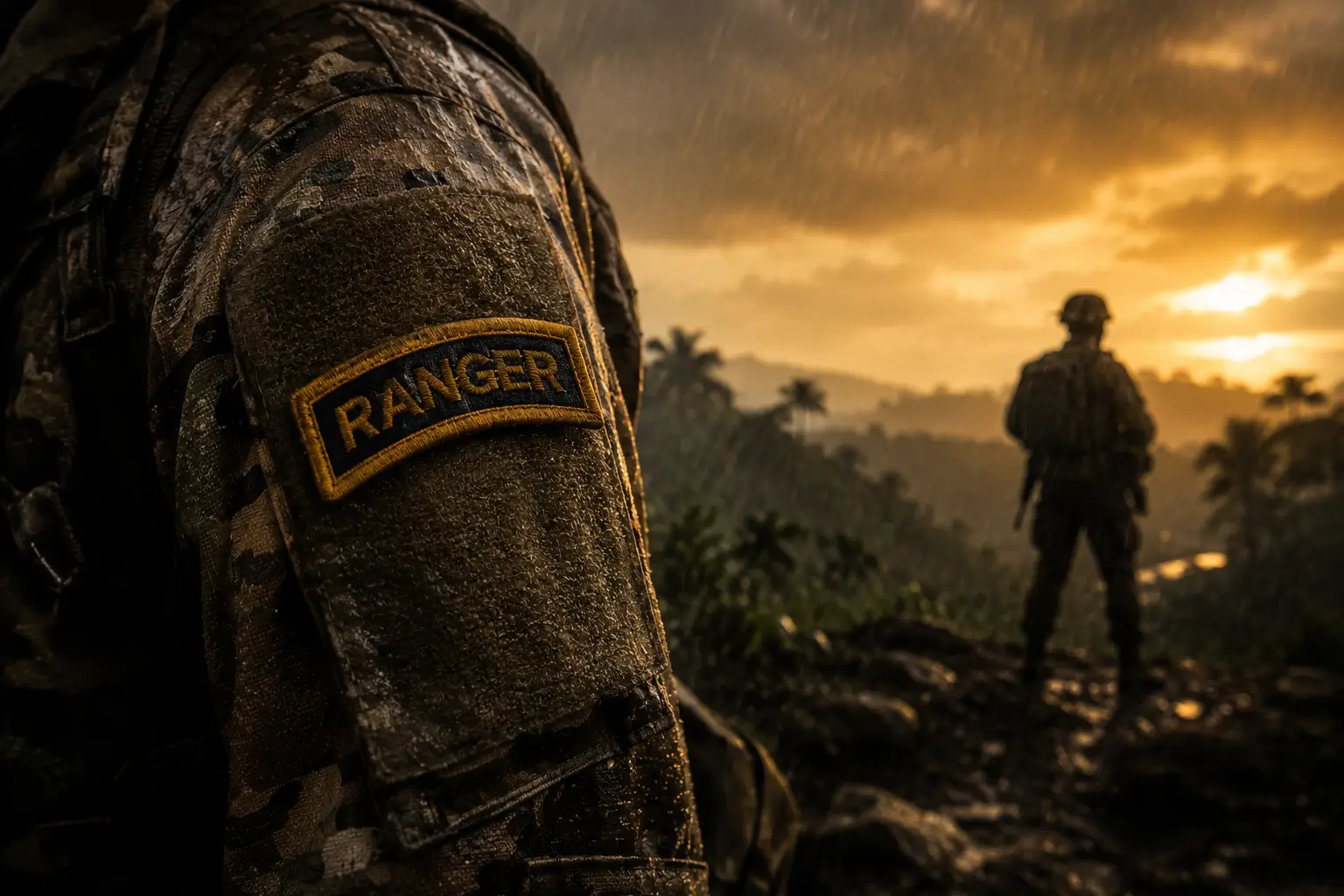
Every year, thousands of soldiers arrive at Fort Moore with a single objective: to pin that black-and-gold Ranger Tab on their left shoulder. They are physically elite, highly motivated, and structurally vetted. Yet, the vast majority will face absolute friction.
When analyzing the Ranger School failure rate, civilian commentators often mistake it for a pure physical elimination contest. It isn’t. The Ranger School washout rate is high because the course is designed to systematically dismantle a soldier’s biological reserves, forcing them to execute complex tactical decisions under continuous stress.
Quick Answer: What Is the Ranger School Failure Rate?
Ranger School Failure Rate Explained: Historical data and military estimates indicate that the first-attempt Ranger School failure rate sits between 50% and 60%. This means only about 40–50% of candidates achieve a Ranger School completion rate on their first continuous deployment. However, because the structural grading system allows disqualified students to repeat specific phases via the ranger school recycle rate, the final Ranger School graduation rate pushes closer to 50–55% over multiple attempts. Exact figures vary significantly by class, winter versus summer cycles, and evolving operational requirements.
How Ranger School Measures Success: The Go/No-Go Grading System
To understand the ranger school pass rate, you must understand how a candidate is evaluated. Ranger School does not use a traditional points-based academic scale. It utilizes a strict, unforgiving ranger school go no-go grading framework across four pillars:
- Physical Assessment: Falling below the explicit, zero-tolerance baseline on Day One results in immediate elimination.
- Tactical Leadership: Every candidate must serve as a patrol leader (Squad Leader or Platoon Sergeant) during field exercises. A single critical tactical error—failing to establish security, losing accountability of personnel, or missing a time window—results in a “No-Go” for that graded patrol.
- Peer Evaluations: At the end of each phase, candidates anonymously rank their squad members. If you are a liability, selfish, or mentally checked out, your squad will weed you out via peer assessment.
- Land Navigation: Moving solo through dense terrain under strict time limits with minimal illumination. Missing one point means a failing grade.
Understanding Attrition vs. Recycle Rates
One of the greatest analytical errors made when reviewing ranger school graduation statistics is treating every “failure” as a permanent exit. There is a critical operational difference between the ranger school dropout rate (permanent attrition) and the ranger school recycle rate (re-evaluation).
- The Washout: A candidate who quits (Voluntary Withdrawal), commits a serious safety/honor violation, or fails the baseline physical standards is permanently dropped. This drives the absolute ranger school attrition rate.
- The Recycled Student: A candidate who demonstrates the proper character and basic competence, but fails a specific tactical component—like a graded patrol or a peer review—may be offered a “recycle.” This means they do not leave the school; instead, they wait for the next incoming class to repeat that entire phase.
Why Is Ranger School’s Failure Rate So High?
If you ask a civilian why is ranger school so hard, they will point to rucksack marches and obstacle courses. If you ask a Ranger Instructor (instructor), they will tell you it’s the cumulative weight of deliberate, weaponized deprivation.
The true filter of Ranger School isn’t raw physical fitness—it’s the cumulative effect of sleep deprivation, a massive caloric deficit, ruthless peer evaluations, and repeated tactical decision-making under continuous operational stress.
Physical Exhaustion & Caloric Deficit
Candidates undergo continuous operations, surviving on one or two MREs (Meals Ready to Eat) per day while burning anywhere from 4,000 to 6,000 calories marching through swamps, mountains, and dense brush. The resulting ranger school calorie deficit triggers extreme ranger school weight loss—often between 15 to 30 pounds within a 61-day window. This rapid muscle wasting directly erodes physical endurance and structural resilience.
Sleep Deprivation & Mental Fatigue
With less than 2 to 4 hours of interrupted sleep per night over weeks of field exercises, mental fatigue sets in. Hallucinations are common. Under extreme sleep deprivation, a candidate’s cognitive function degrades to the level of clinical intoxication. Yet, they are still expected to conduct flawless mission planning and execute complex small unit tactics.
Tactical Leadership Under Stress
A patrol leader must direct a squad of completely exhausted peers who are also starving and sleep-deprived. Maintaining combat leadership when your own mind is failing is the ultimate test. If a leader loses their composure, makes a poor tactical decision, or fails to motivate their unit during patrol operations, the instructor issues a definitive No-Go.
Peer Evaluations: The Ultimate Peer Filter
You cannot fake your way through this course. At the end of every phase, your squad determines whether you carried your weight. If a candidate hoards food, sleeps on guard duty, or shifts rucksack weight to others, their squad will rank them at the bottom. Failing a peer assessment is one of the primary drivers of the ranger school dropout rate, particularly for those who hide behind rank or perceived physical strength.
Failure Rates by Phase: Where the Filter Tightens
Ranger School is divided into three distinct geographic and tactical phases. Each presents a unique set of hazards and specific drivers for the ranger school washout rate.
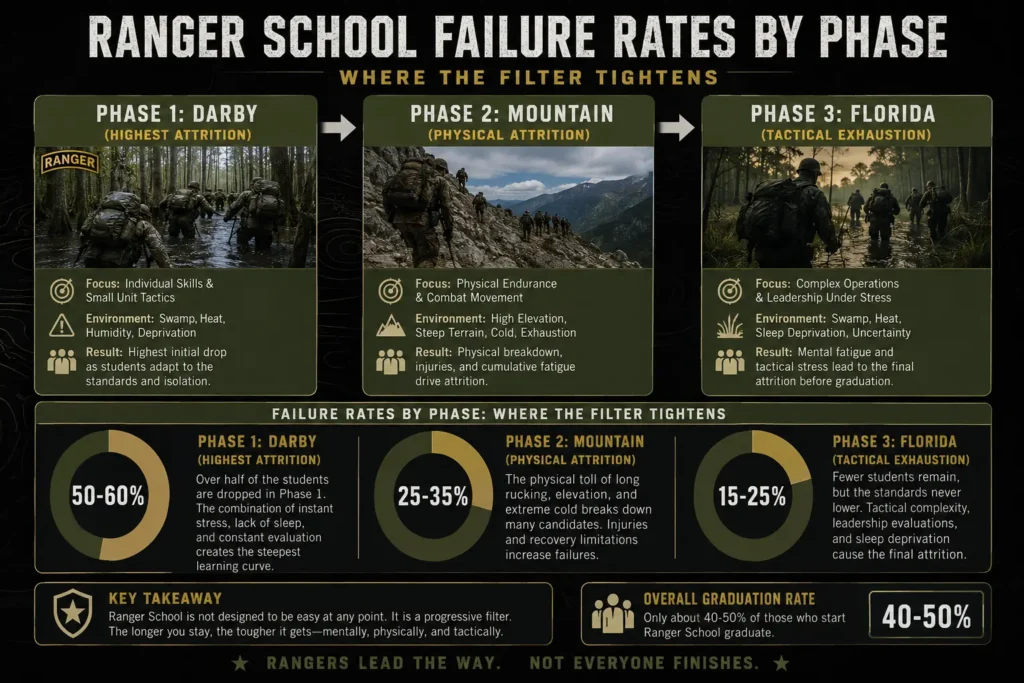
1. Darby Phase (Fort Moore, GA) – The Brutal Filter
The Darby Phase (which includes the initial Ranger Assessment Phase or RAP week) owns the highest darby phase failure rate in the entire pipeline. Statistically, roughly 60% of all total course drops happen right here.
- Candidates must pass the Ranger Physical Fitness Test (RPFT), a grueling combat water survival assessment, and the infamous night/day land navigation course.
- It is also where candidates are first introduced to Darby’s intense small unit tactics and rigorous leadership evaluation standards. If you can’t adapt to the grading system immediately, you are gone.
2. Mountain Phase (Dahlonega, GA) – The Physical Crusher
The mountain phase failure rate is driven almost entirely by terrain-induced exhaustion and environmental factors.
- Candidates operate in steep, high-altitude environments carrying rucksacks weighing up to 80–100 pounds.
- The primary causes of failure here are severe ranger school injuries (such as stress fractures, severe ankle sprains, and hypothermia) alongside failures in mountaineering techniques and platoon-level patrol operations.
3. Florida Phase (Camp Rudder, Eglin AFB, FL) – The Final Test of Endurance
If a candidate reaches the swamps of Florida, they have proven their physical grit. However, the florida phase failure rate remains a threat due to extreme mental and physical degradation.
- Operating in waist-deep water, navigating coastal swamps, and conducting complex amphibious tactical leadership exercises.
- The main culprit here is pure cognitive breakdown. After nearly 50 days of starving, a candidate might fail a graded patrol simply because their brain can no longer process a basic operations order (OPORD).
How Recycles Affect Graduation Statistics
The concept of a “recycle” is what confuses external observers looking at the ranger school graduation percentage.
Because a student can be recycled multiple times, a single Ranger School class list changes constantly. A candidate might pass Darby, fail patrols in Mountain, wait two weeks, join a new class, pass Mountain, fail peers in Florida, wait again, and finally graduate months after they started.
While only a minority of ranger school graduates complete the course in the clean, minimum 61-day timeline (“Straight-Throughs”), a massive portion of the final graduation pool consists of recycled students who refused to quit. This makes the recycle option the single greatest test of mental resilience in the military; it forces you to willingly restart a cycle of starvation and sleep deprivation that you just escaped.
What Happens After You Fail Ranger School?
Failing Ranger School is not an automatic career-killer, but its impact depends entirely on your military occupational specialty (MOS) and rank structure.
- Can Officers Fail Ranger School? Yes, frequently. For Infantry and Armor officers, earning the Ranger Tab is a culturally mandatory rite of passage. While can officers fail ranger school is technically a yes, a permanent failure can severely limit future platoon leadership assignments and derail early promotion timelines.
- Enlisted Ranger School Failure: For an enlisted ranger school failure, the consequences vary. In conventional units, they return to their duty stations without prejudice to continue their standard career path. However, for members of the 75th Ranger Regiment, failing to earn their tab within a specified window will result in them being reassigned out of the Regiment.
Operational Insight: If you are navigating an elite military pipeline and want to know how the military handles reassignment, re-classing, and psychological recovery after a performance drop, check out our comprehensive breakdown: What Happens After You Fail SFAS?
Ranger School vs. SFAS Failure Rate
A frequent debate within military circles centers on ranger school vs special forces selection (is ranger school harder than SFAS?). While both are elite, their attrition mechanisms are fundamentally distinct.
| Metric | Ranger School | Special Forces Assessment & Selection (SFAS) |
| Primary Goal | Combat leadership under extreme tactical stress. | Assessment of independent, unconventional warfare capability. |
| Historical Attrition | 50% – 60% (Includes recycles) | 50% – 70% (Hard drop, minimal recycles) |
| Diet & Sleep | Intentionally weaponized deprivation. | Regulated to test peak athletic output. |
| Grading Visibility | Direct feedback via Go/No-Go. | “Black Box” selection (No direct feedback). |
Ranger School evaluates your ability to lead a squad when you are at your absolute worst. SFAS evaluates who you are naturally when no one is watching. Ranger School is an endurance course of survival and leadership; SFAS is an intellectual and psychological assessment.
Ranger School vs. RASP: The Unit vs. The Course
Another common point of confusion within military analysis is mixing up Ranger School with RASP (Ranger Assessment and Selection Program).
- RASP is a selection process: It is an 8-week gatekeeper program designed solely for soldiers who want to join the 75th Ranger Regiment (the Army’s premier special operations raid unit). Passing RASP earns you the Tan Beret and a spot in a Ranger Battalion.
- Ranger School is a leadership course: It is a 61-day tactical crucible open to the entire military. Passing it earns you the Ranger Tab.
You can be in the Ranger Regiment (passed RASP) but not yet have your Ranger Tab. Conversely, you can wear a Ranger Tab (passed Ranger School) but serve in a conventional division like the 82nd Airborne, never stepping foot in the 75th Ranger Regiment. Within the Regiment, however, passing RASP gets you in the door, but you are structurally expected to pass Ranger School later to maintain your leadership trajectory.
Frequently Asked Questions
Why is Ranger School’s failure rate so high?
The failure rate is driven by the intentional combination of structural stressors: severe calorie restriction, intense sleep deprivation, unforgiving peer reviews, and strict tactical Go/No-Go standards applied uniformly by Ranger Instructors.
What percentage of students graduate Ranger School?
On average, between 40% and 50% of all starting candidates will eventually graduate and earn the Ranger Tab. The remaining 50% to 60% drop out due to physical, tactical, or medical reasons.
Can you fail Ranger School and come back?
Yes. If you are dropped for a technical or physical failure but demonstrated high character and effort, you may receive a “Return to Unit” (RTU) with an invitation to return in a future cycle. If you quit voluntarily, returning is extremely difficult and requires command waivers.
Which Ranger School phase has the highest attrition?
The Darby Phase (Phase 1), specifically the initial Ranger Assessment Phase (RAP week), accounts for approximately 60% of all course drops.
Is Ranger School harder than Special Forces Assessment?
They are difficult in entirely different ways. Ranger School is physically and biologically harder due to prolonged food and sleep deprivation. SFAS is psychologically harder due to the isolation, independent problem-solving requirements, and the complete lack of performance feedback from cadres.
How many times can you recycle Ranger School?
Typically, a student is allowed to recycle a phase once or twice if performance and attitude merit it. Under extraordinary circumstances, such as a major medical injury followed by a recovery period, a student can be granted a rare “Day One” camera or command recycle, spending upwards of six months to a year in the pipeline.
How much weight do students lose?
Due to a massive caloric deficit and non-stop operational movement, the average candidate loses between 15 and 30 pounds over the 61-day course.
What happens after failing Ranger School?
Conventional soldiers return to their original units to continue their careers. For infantry officers, it may limit initial leadership assignments, while elite personnel (like those in the 75th Ranger Regiment) will face reassignment if they fail to secure the tab within their required window.