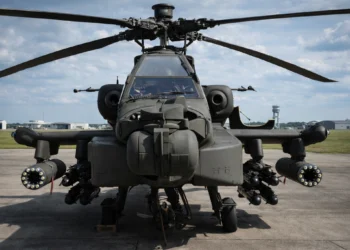


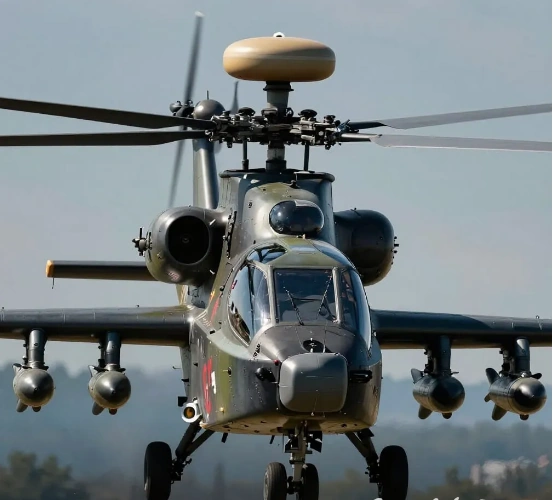
The Ka-52 is not built like any other helicopter. It defies conventional aerodynamic rules, challenges Western design philosophy, and carries a feature no other helicopter pilot has: a way out.
Known by NATO as Hokum-B and by Russia as the Ka-52 Alligator, this platform represents a radical departure from the AH-64 Apache Guardian. With its distinctive coaxial rotors and side-by-side seating, it is a beast of engineering.
But does unique engineering translate to battlefield dominance? In this UltiDefense deep dive, we analyze the specs, the controversial combat history in Ukraine, and answer the ultimate question: Is it better than the Apache?
Ka-52 Alligator At A Glance (Quick Specs)
Before diving into the analysis, here are the hard numbers that define the “Alligator.”
| Role | Scout / Attack Helicopter |
| Manufacturer | Kamov Design Bureau (Russian Helicopters) |
| Crew | 2 (Pilot + Weapon Systems Officer) – Side-by-Side |
| Engines | 2 × Klimov VK-2500 turboshafts |
| Max Speed | 300 km/h (186 mph) |
| Service Ceiling | 5,500 m (18,000 ft) |
| Unit Cost | Est. $15–$20 Million |
1. The Coaxial Advantage: Why No Tail Rotor?
The first thing you notice about the Ka-52 is the lack of a tail rotor. Instead, it uses a contra-rotating coaxial rotor system. This isn’t just an aesthetic choice; it’s a strategic one.
The Pros of Coaxial Design:
- Power Efficiency: Traditional helicopters waste 15-30% of engine power just to keep the tail straight. The Ka-52 uses 100% of its power for lift and thrust.
- Wind Resistance: It can hover steadily in crosswinds that would ground an Apache.
- Compact Footprint: Without a long tail boom, it can operate from smaller clearings or ship decks (like the maritime Ka-52K Katran variant).
The Cons:
- “Rotor Clash”: Under extreme G-force maneuvers, the top and bottom blades risk colliding—a catastrophic failure mode known as “blade intersection.”
- Maintenance Nightmare: The rotor mast is incredibly complex compared to standard helicopters.
2. The Survival Factor: How the Ejection Seats Work
This is the Ka-52’s claim to fame. It is the only operational helicopter in the world equipped with a pilot ejection system (Zvezda K-37-800).
The Ejection Sequence (In under 2 seconds):
- Pilot pulls the handle.
- Explosive charges detonate at the base of the rotor blades, blowing them away from the aircraft.
- The canopy glass is jettisoned.
- Rocket motors under the seats fire, launching the crew to safety.
UltiDefense Insight: While Western doctrine focuses on “crashworthiness” (absorbing impact), Russian doctrine with the Ka-52 focuses on “escape.” This admits a grim reality: they expect the helicopter to be hit.
3. Firepower: Teeth of the Alligator
The Ka-52 is a flying arsenal designed to hunt tanks, bunkers, and slow-moving aircraft.
Primary Weapons
- 30mm Shipunov 2A42 Cannon: Unlike the Apache’s chain gun, this is a rigid, truck-mounted cannon. It is less flexible but arguably more accurate at long ranges.
- 9K121 Vikhr (AT-16 Scallion): Laser-guided anti-tank missiles with a range of up to 10-12km.
- LMUR (Izdeliye 305): The game-changer. A new long-range missile seen on the Ka-52M, allowing strikes from outside the range of most MANPADS.
4. Combat Analysis: Lessons from Ukraine
The war in Ukraine has been the ultimate stress test for the Ka-52. The results are mixed.
The Failures:
Early in the conflict, many Ka-52s were lost to MANPADS (like Stinger and Starstreak). The “Vitebsk” electronic warfare suite (L-370) proved effective against some threats but was overwhelmed by dense air defense networks. Furthermore, high vibration levels have reportedly caused avionics issues.
The Successes:
During the 2023 counter-offensive, the Ka-52 adapted. By using the Vikhr and LMUR missiles, they outranged Ukrainian short-range air defenses, destroying significant numbers of Western-supplied armor. The ejection seats also saved several pilots’ lives, validating the design concept.
Ka-52 vs. AH-64 Apache: The Verdict
This is the most searched comparison in military aviation. Let’s break it down.
| Feature | 🇷🇺 Ka-52 Alligator | 🇺🇸 AH-64E Apache Guardian |
|---|---|---|
| Agility | Winner (Coaxial rotors) | High |
| Sensors & Radar | Good (Arbalet-52) | Winner (Longbow Radar) |
| Networking | Limited | Winner (Link 16 / MUM-T) |
| Survivability | Winner (Ejection Seats) | High (Crashworthiness) |
| Doctrine | “Lone Wolf” Hunter | Networked Team Player |
Conclusion: A Flawed Masterpiece?
The Ka-52 Alligator is a marvel of mechanical engineering. It does things no other helicopter can do. Its ability to fly without a tail and eject its pilots makes it unique in aviation history.
However, modern warfare is shifting from “mechanical performance” to “digital awareness.” While the Ka-52 is a deadly duelist, it lags behind the Apache in sensor fusion and drone integration. For pure kinetic power, the Alligator remains one of the deadliest predators in the sky.
FAQ
Q: Can the Ka-52 fly with a damaged tail?
Yes. Since it has no tail rotor, the tail is mostly for aerodynamics. It can return to base even with severe tail damage.
Q: How many Ka-52s has Russia lost?
Open-source intelligence (Oryx) confirms significant losses, though exact operational numbers remain classified.