

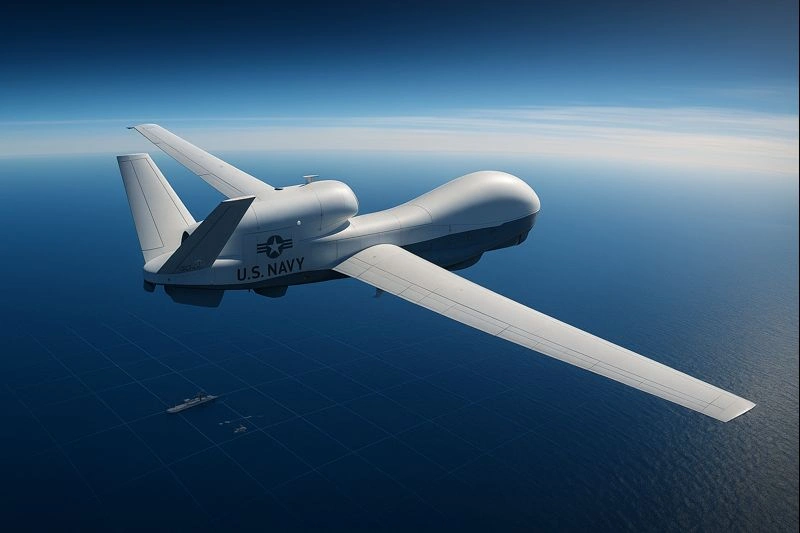
he MQ-4C Triton, developed by Northrop Grumman, is the U.S. Navy’s premier high-altitude, long-endurance (HALE) maritime surveillance drone.
Designed to watch entire oceans rather than just battlefield sectors, the Triton is the only UAV capable of providing persistent, 360-degree maritime domain awareness across thousands of kilometers. In an era defined by contested waters, anti-ship missiles, and submarine proliferation—from the South China Sea to the Mediterranean—the MQ-4C has become a strategic necessity.
The MQ-4C Triton is essential for modern naval warfare, providing unparalleled surveillance capabilities.
In this UltiDefense Deep Dive, we analyze the Triton’s sensor architecture, its unique “MFAS” radar, and why it is the most important asset you’ve never seen.
1. What Is the MQ-4C Triton?
Understanding the MQ-4C Triton helps to appreciate its immense value in maritime operations.
The MQ-4C Triton is the maritime variant of the famous RQ-4 Global Hawk, but calling it a “naval repaint” is a mistake. Nearly 60 percent of the aircraft’s structure and systems have been redesigned for harsh maritime conditions.
While the Global Hawk is designed to fly high and straight, the Triton is built to descend through clouds to inspect ships closer to the water. It features:
Heavy icing tolerance on wings and intakes.
Lightning protection systems for ocean storms.
Bird-strike reinforced airframe.
24+ hours endurance at altitudes over 50,000 ft.
The Strategy: Where the P-8A Poseidon patrol aircraft is the “Hunter,” the Triton is the “Spotter.” The P-8 only becomes lethal when the Triton tells it where to look.
The MQ-4C Triton serves as a bridge between detection and engagement in naval tactics.
2. Key Technical Specifications
The numbers behind the surveillance beast:
| Feature | MQ-4C Triton |
| Length | 14.5 m |
| Wingspan | 39.9 m (Larger than a Boeing 737) |
| Altitude | 55,000 ft (Above commercial traffic) |
| Endurance | 24–30 hours |
| Sensor Suite | MFAS AESA Radar, ESM, EO/IR, AIS Receiver |
| Coverage | 2.7 million km² in a single mission |
| Primary Role | Maritime ISR, Surface Detection, SigInt |
| Secondary Role | Search-and-Rescue, Submarine Tracking Support |
3. The Heart of the Beast: MFAS AESA Radar
The MQ-4C’s game-changing capability is its radar: the AN/ZPY-3 MFAS (Multifunction Active Sensor).
Unlike traditional radars that scan a narrow slice of the sky, the MFAS is a 360-degree AESA system optimized for the clutter of the ocean waves.
Capabilities:
Vast Coverage: Scans over 2,000 miles in any direction.
Small Target Detection: Can spot a small fishing boat or a periscope amidst high waves.
Inverse SAR (ISAR): It creates a “picture” of a ship using radar waves, allowing operators to identify the ship class (e.g., destroyer vs. merchant ship) from high altitude.
This radar effectively makes the Triton the “AWACS of the Ocean,” but cheaper and with longer endurance than any manned aircraft.
4. Triton vs. Global Hawk: Not the Same Drone
A common misconception is that the Triton is just a “Navy Global Hawk.”
RQ-4 Global Hawk: Designed for strategic overland surveillance. High altitude, thin air, stable flight.
MQ-4C Triton: Designed for the chaos of the ocean. It has a stiffer wing to handle low-altitude turbulence, algorithms to filter out sea clutter (waves reflecting radar), and a specialized 360-degree sensor dome.
Verdict: While the Global Hawk conducts strategic reconnaissance from the stratosphere, the Triton rules the waves.
5. Why the Triton Matters in 2025
The Anti-Ship Missile Era
Utilizing the MQ-4C Triton, the Navy can maintain a strategic advantage over potential adversaries.
Modern anti-ship missiles like China’s YJ-21 or Russia’s Zircon have ranges exceeding 1,000 km. To defend against them, you need to see the launch platform before it fires. The Triton pushes the Navy’s “eyes” thousands of miles forward, detecting threats long before they enter missile range.
The “Kill Chain”
The Triton completes the Navy’s most critical Kill Chain:
Triton detects a suspicious electronic signal (ESM) or radar contact.
It uses its cameras to visually identify the target.
It beams the data to a P-8 Poseidon or a Destroyer.
The P-8 launches a Harpoon or LRASM missile.
Search and Rescue (SAR)
It is arguably the world’s best SAR asset. Its ability to scan vast swathes of ocean for a life raft or debris field is unmatched, saving days of searching by manned ships.
Conclusion: The Digital Sentinel
The MQ-4C Triton is not just a drone; it is the data backbone of the US Navy. As the world becomes more dangerous and the oceans more contested, the value of an “Unblinking Eye” that can watch the Pacific for 30 hours straight cannot be overstated.
The future of naval operations will heavily rely on the MQ-4C Triton and its capabilities.
UltiDefense Verdict: The Triton is the primary intelligence gatherer for the Pacific strategy of the 2030s. Without it, the fleet is flying blind.
❓ FAQ: MQ-4C Triton
Q: Is the MQ-4C Triton armed?
A: No. The Triton is strictly an ISR (Intelligence, Surveillance, Reconnaissance) platform. It carries sensors, not weapons. Its “weapon” is the data it sends to armed aircraft like the P-8 Poseidon.
Q: How does it work with the P-8 Poseidon?
A: They work as a “Manned-Unmanned Team” (MUM-T). The Triton does the long, boring patrols (endurance). When it finds something, the P-8 flies in to investigate or attack (speed and firepower).
Q: Can Triton operate in bad weather?
A: Yes. Unlike many drones, the Triton is reinforced for lightning strikes, heavy icing, and the turbulence found in maritime environments.