

Introduction: A Transformation Beneath the Waves
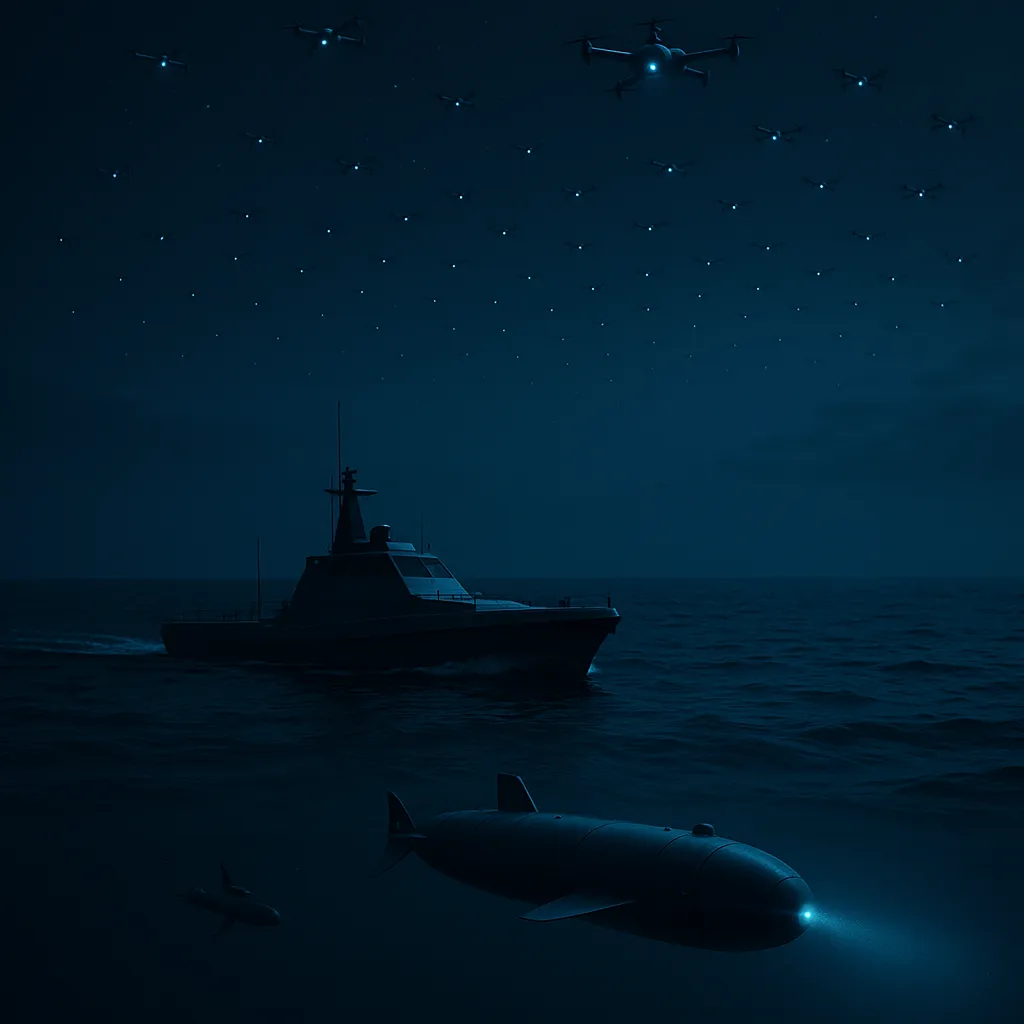
Across the world’s oceans, a quiet but profound transformation is underway.
Unmanned Maritime Systems (UMS) — a broad family that includes Unmanned
Surface Vehicles (USVs) and Unmanned Underwater Vehicles (UUVs) — are rapidly
evolving from experimental tools into indispensable components of modern
naval strategy and commercial ocean operations.
Once seen primarily as platforms for “dull, dirty, and dangerous” tasks,
UMS are now moving toward frontline roles, reshaping concepts of maritime
domain awareness, deterrence, and blue-economy sustainability. This shift
reflects something deeper: unmanned maritime technologies are no longer
peripheral adjuncts to crewed fleets. They are emerging as
central pillars of future naval power, redefining how
states understand risk, projection, and control across contested seas.
II. The Technical Landscape of UMS: Categories, Capabilities, and Enablers
A. Unmanned Surface Vehicles (USVs): The New Guardians of the Sea
USVs operate on the surface and provide persistent presence at a fraction of
the cost of crewed vessels. Their primary advantages — endurance, modularity,
and reduced risk — make them attractive to navies, coast guards, and
civilian industries.
Core Missions of USVs include:
- Intelligence, Surveillance, and Reconnaissance (ISR)
- Maritime security and patrol
- Mine Countermeasures (MCM)
- Communications relay nodes
- Emerging Anti-Surface Warfare (ASuW) applications
Representative examples: long-endurance ocean-data USVs such as Saildrone
and the U.S. Navy’s Large Unmanned Surface Vessel (LUSV) program, which aims
to host long-range weapons and advanced sensors on unmanned platforms.
The trajectory is clear: USVs are becoming platforms that expand the
battlespace both horizontally and temporally, creating persistent
surveillance webs far beyond what manned fleets alone can sustain.
B. Unmanned Underwater Vehicles (UUVs): The Deep-Water Disruptors
While USVs dominate the surface, UUVs quietly redefine the undersea domain.
From littoral waters to abyssal depths, these vehicles extend naval presence
into environments previously too risky, too costly, or simply inaccessible.
Key missions for UUVs include:
- Covert ISR below the surface
- Seabed mapping and subsea cable monitoring
- Persistent Anti-Submarine Warfare (ASW)
- Special operations support
- Potential roles in strategic deterrence in the future
Notable examples range from extra-large UUVs such as the Orca XLUUV,
designed for long-range autonomous missions, to small tactical UUVs used
for shallow-water reconnaissance and explosive ordnance disposal.
The ability of UUVs to quietly operate for extended periods below the
surface represents a fundamental change in how states think about undersea
intelligence, stealth, and force projection.
C. Key Enablers: The True Drivers of UMS Evolution
UMS innovation is not solely about the vehicles themselves — it is also about
the core enablers that make these platforms autonomous,
survivable, and strategically valuable.
1. Power and Endurance
The ocean is vast, and endurance remains one of the greatest barriers to
truly persistent unmanned operations. Current research focuses on:
- High-density lithium-ion and solid-state batteries
- Hydrogen fuel cells for extended missions
- Wave-powered surface vehicles for near-infinite patrols
- Small nuclear reactors for global-range UUVs
2. Sensors and Connectivity
Advanced UMS rely on integrated sensor suites combining:
- Synthetic Aperture Sonar (SAS) for high-resolution seabed imaging
- Long-endurance electro-optical/infrared (EO/IR) systems
- Active and passive acoustic arrays
- Distributed sensor-fusion networks across multiple platforms
Underwater communication remains a challenge — acoustic links are slow,
bandwidth-limited, and vulnerable — but AI-driven autonomy reduces the need
for continuous human guidance.
3. Autonomy and Artificial Intelligence
The heart of the UMS revolution is autonomy. Platforms are shifting from
remotely piloted assets to collaborative, decision-capable machines
capable of:
- Swarm operations involving dozens of vehicles
- Manned–Unmanned Teaming (MUM-T) with crewed ships and aircraft
- Real-time threat classification and route optimization
- Autonomous navigation and obstacle avoidance in complex waters
This evolution mirrors the shift in airpower brought by unmanned aerial
systems two decades ago, but with potentially deeper strategic implications
due to the opacity and criticality of the maritime domain.
III. Strategic and Operational Implications
A. Naval Warfare: A Fundamentally Changing Battlespace
1. Distributed Lethality
UMS enable navies to disperse their offensive and defensive capabilities
across hundreds of nodes, forcing adversaries to detect, track, and
neutralize a far larger and more complex threat network. This concept of
distributed lethality reduces the vulnerability of high-value assets while
increasing overall combat persistence.
2. Risk Mitigation
Some of the most dangerous missions at sea — mine countermeasures and ISR in
contested waters — can now be automated. By sending unmanned assets into
mined straits, chokepoints, or near-hostile coastlines, navies can greatly
reduce the exposure of their crews and high-value platforms.
3. Manned–Unmanned Teaming (MUM-T)
Future fleets may see a single crewed destroyer or frigate controlling:
- USV pickets conducting perimeter security and screening
- UUV swarms scanning for submarines and underwater mines
- Autonomous relay nodes extending sensor range beyond the horizon
In this model, the crewed vessel becomes a command hub and arsenal ship,
while unmanned platforms provide reach, redundancy, and resilience.
B. Geopolitical Hotspots: Where UMS Are Already Shaping Strategy
1. South China Sea
In the South China Sea, UMS are increasingly viewed as tools for persistent
presence and gray-zone competition. USVs and UUVs can monitor disputed
features, track naval movements, and collect evidence of coercive behavior
without the political risks associated with deploying larger crewed ships.
2. Black Sea and Baltic Region
Recent conflicts have highlighted how small, low-cost USVs can become
asymmetric tools capable of striking larger warships, harassing logistics
lines, and complicating an adversary’s coastal defense. These operations
suggest that relatively modest investments in unmanned systems can have
strategic-level impact in confined seas like the Black Sea or the Baltic.
C. Civilian, Scientific, and Commercial Uses
Beyond strictly military applications, UMS are accelerating what many
observers describe as Blue Economy 2.0. Their roles include:
- Inspection of offshore energy infrastructure and subsea pipelines
- Fisheries monitoring and enforcement
- Environmental and climate data collection on a global scale
- Deep-sea research and exploration
- Maritime disaster response and search-and-rescue support
In this sense, UMS sit at the intersection of security, commerce, and
sustainability, blurring the line between defense technology and civilian
innovation.
IV. Challenges and the Road Ahead
Technical Limitations
Despite rapid progress, UMS still face significant technical hurdles:
- Limited underwater communications and low-bandwidth acoustic links
- Power constraints on multi-month missions
- Sensor performance in extreme temperatures and high sea states
- Navigation accuracy in GPS-denied or magnetically disturbed waters
Legal and Ethical Questions
1. Maritime Law and Rules of Engagement
International maritime law has yet to fully classify or regulate armed UUVs,
autonomous strike decisions, or mixed fleets of manned and unmanned vessels
operating in contested Exclusive Economic Zones (EEZs). Questions remain
about responsibility, attribution, and escalation control when unmanned
platforms are involved in hostile incidents.
2. The Lethal Autonomy Debate
The prospect of lethal autonomy at sea raises sensitive questions about human
oversight, moral responsibility, and strategic stability. Navies must decide
how much decision-making authority to delegate to algorithms and where to
place the “human in the loop” for targeting and engagement.
Cybersecurity Risks
UMS networks are inherently digital and therefore inherently vulnerable.
Potential threats include:
- Hacking and unauthorized remote control
- GPS spoofing and navigation deception
- Data interception and manipulation of sensor feeds
- Adversarial attacks on AI models used for classification and autonomy
Ensuring cyber-resilience is now as important as ensuring hull integrity or
seaworthiness.
V. Future Trajectories: Where the Silent Revolution Leads
Looking ahead, the next decade is likely to bring:
- Fully autonomous droneships conducting long-range patrols and logistics
- Nuclear-powered UUVs providing near-global persistent undersea presence
- AI-driven swarms executing dynamic reconnaissance and deception operations
- Institutionalization of UMS in every major naval doctrine and wargame
The implications are not just technological but strategic: UMS are redefining
deterrence, escalation, and sea control.
Conclusion: The Future Is Already Surfacing
Unmanned Maritime Systems are no longer experimental novelties —
they are the foundation of a new maritime era. From the depths of the ocean
to the surface of contested seas, UMS are reshaping naval power, commercial
operations, and global maritime governance.
Their rise marks a turning point in how nations project strength, gather
intelligence, and safeguard critical waters. The revolution may be silent,
but its impact will echo across the world’s oceans for decades to come.

